England at 79%: What Happens When Every Market Agrees
England at 79%: What Happens When Every Market Agrees
There is a version of prediction-market analysis where the numbers argue with each other, where sharp money on Polymarket runs one way and the sportsbooks shade another and you have to weigh the disagreement. England versus Ghana is not that version.
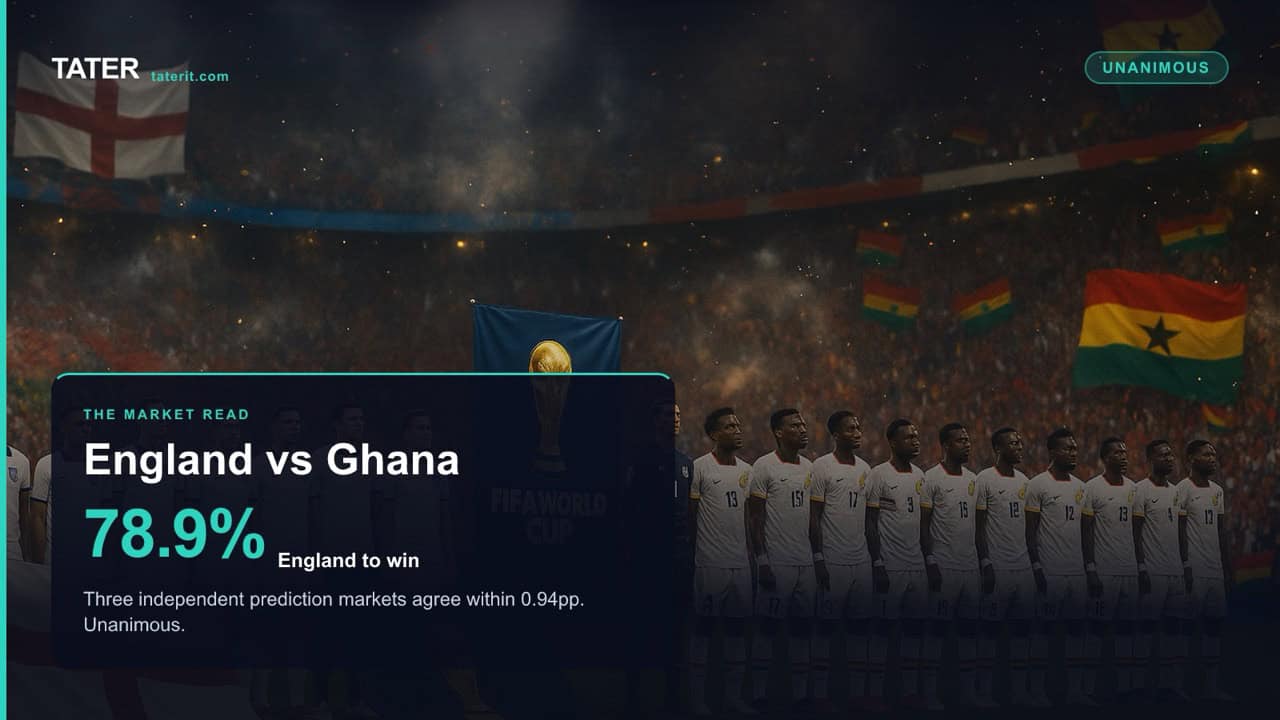
Tater, which reads Polymarket, Kalshi, and nine sportsbooks and blends them into a single consensus read, returned what it classifies as a Unanimous archetype for this fixture. That designation is not handed out loosely. It means the spread across all platforms is less than one percentage point. In this case it is exactly 0.94 percentage points, which is about as close to silence as markets get when three distinct ecosystems with different participant pools, different incentive structures, and different pricing mechanisms are asked the same question simultaneously.
The blended read: England at 78.9%, the draw at 14.5%, Ghana at 6.6%.
Break that down by source and the picture does not shift meaningfully. Polymarket, with roughly $696,000 in volume behind it, prices England at 79.1%. Kalshi, a regulated prediction exchange, has England at 79.3%. The nine-book sportsbook consensus sits at 78.4%. The gap between the most optimistic and most pessimistic England read across all those platforms is under one point. That is not a market with latent disagreement waiting to surface. That is a market that has already done its work.
What the Unanimous archetype tells you is that the information is settled. Not that England wins, because no market can guarantee an outcome, but that the available information has been processed across multiple platforms and it has converged. When Polymarket traders and Kalshi traders and nine separate sportsbooks all land within one point of each other, you are not looking at noise. You are looking at a consensus that has been stress-tested.
The draw deserves a second look, because 14.5% is not trivial. In a match priced this heavily toward one side, the draw is where a significant portion of the residual probability lives. It is priced at more than twice the Ghana outright. A Ghana win at 6.6% is genuinely deep in the tail, the kind of outcome that pays well precisely because every market in the ecosystem has independently concluded it is unlikely. The draw, by contrast, is the most available hedge against a one-sided result.
Tater does not tell you to bet anything. It reads what the markets collectively believe and surfaces where they agree and where they diverge. In this fixture there is almost no divergence. The platform spread of 0.94 points is a signal about the quality of information in the market, not a trading instruction.
What this matchup illustrates is how useful cross-platform consensus becomes precisely in cases like this one, where a heavy favorite creates the temptation to either blindly follow or reflexively fade. Tater’s blended read tells you that nine books and two prediction exchanges have all arrived at the same place independently. Ghana at 6.6% is not an oversight. It is a conclusion.
Unanimous market consensus on England at 79% signals either high conviction or collective blindspot—operators need to know which.
We watch these moments because they reveal how different betting ecosystems—prediction markets, regulated exchanges, traditional sportsbooks—converge or diverge. When they align this tightly, it tells us something real about where sharp money sits. That's exactly the cross-market intelligence our network trades on.
- Polymarket, Kalshi, and nine sportsbooks all converge on England within 0.94 percentage points—a Unanimous archetype
- The blended read: England 78.9%, draw 14.5%, Ghana 6.6%
- Less than one point spread across three distinct ecosystems with different pools, incentives, and pricing mechanisms
SCCG angle: This is exactly why our network matters. We track consensus like this across regulated and unregulated markets in real time. When everything agrees, that's when you need to know which platforms your competitors are reading—and where the real money actually sits under the surface.
Gaming, betting and prediction markets — the desk’s read, every weekday.
Subscribe →