Norway vs. Senegal: When Every Market Agrees the Outcome Is Unknowable
Norway vs. Senegal: When Every Market Agrees the Outcome Is Unknowable
There are games where the market tells you who wins. Then there are games like Norway versus Senegal, where the market’s most important signal is that nobody knows.
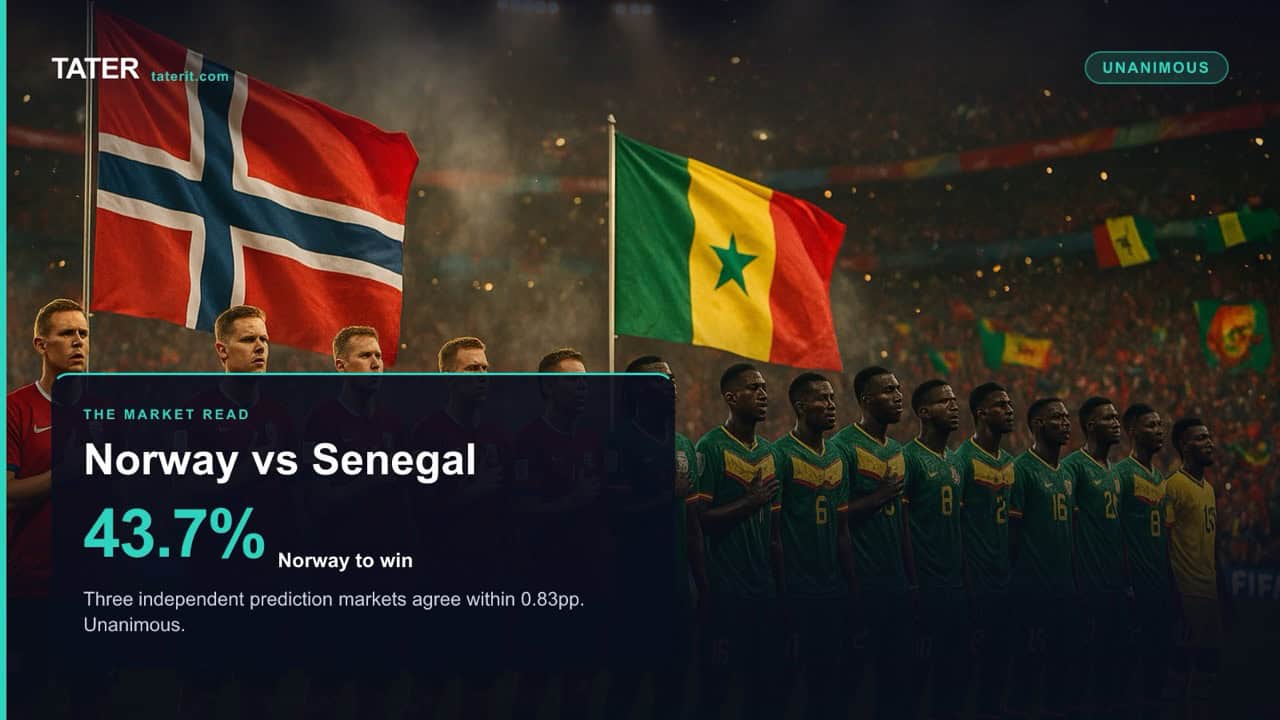
Tater, the cross-platform intelligence tool that reads Polymarket, Kalshi, and nine sportsbooks simultaneously, ran the consensus read on this match ahead of kickoff. What came back was not a clean favourite. It was something rarer: a genuine three-way split so tight that all three venues converged on almost identical numbers, earning the match a Unanimous archetype and a platform spread of just 0.83 percentage points.
That spread figure matters. It measures the gap between the widest and narrowest probability estimates across every platform Tater tracks. In a market where sharp money, retail crypto traders, and regulated sportsbooks are all pulling from different pools of information, landing within 0.83 points of each other is not noise. It is a signal that the information state is settled. Everyone has priced this the same way because there is no edge available.
The blended read breaks down as follows: Norway at 43.7%, Senegal at 29.2%, and the draw at 27.1%. Norway carries a modest edge as the nominal home side in this tournament format, but modest is the operative word. No outcome commands a majority. The gap between draw and away is under two percentage points. Anyone pricing Senegal out of this match is working against market consensus from three independent directions.
Polymarket, which is running on roughly $1.65 million in volume for this fixture, placed Norway at 43.3%, Senegal at 29.4%, and the draw at 27.4%. Kalshi came in at 43.7% Norway, 29.6% Senegal, and 26.6% draw. The nine-book sportsbook consensus landed at 44.1% Norway, 28.5% Senegal, and 27.4% draw. Strip out the vigorish and the implied probabilities collapse into near-identical territory.
This is the condition Tater is built to surface. Prediction markets and sportsbooks operate on different incentive structures, different participant bases, and different mechanisms for incorporating information. When they land within a fraction of a point of each other, that convergence is the read. It means the collective intelligence of real-money markets, across multiple regulatory environments and trading structures, has reached the same conclusion: Norway, Senegal, and a draw are all genuinely live outcomes.
The Unanimous archetype that Tater assigns here reflects that condition precisely. It is not a label for certainty. It is a label for agreement, and specifically agreement about uncertainty. The market is not saying Norway wins. It is saying Norway is roughly a coin flip against the combined probability of the other two outcomes, and that every serious pricing source sees it the same way.
For anyone trying to find an angle on this match, the market data is, in its own way, the most useful thing a data layer can return: an honest account of how much information is actually available. Here, the answer is that the probabilities are tight, the platforms agree, and the match is exactly as open as it looks.
Tight cross-platform consensus on Norway-Senegal signals a genuinely settled market with no exploitable edge.
We watch these moments because they reveal how modern markets actually work. When crypto, retail, and regulated books converge this tightly, you're seeing real price discovery in action. That 0.83-point spread isn't luck—it's the market telling you the information is genuinely uncertain.
- Norway 43.7%, Senegal 29.2%, draw 27.1% across all venues simultaneously
- 0.83-point spread between widest and narrowest estimates signals settled information state
- Unanimous archetype: three distinct betting pools reaching identical probabilities
SCCG angle: This is exactly why our network matters. We connect you to operators and traders across 150+ partnerships who are watching the same consensus tools. When markets lock like this, our contacts know where sharp money moves next—and we help you see it first.
Gaming, betting and prediction markets — the desk’s read, every weekday.
Subscribe →