Settled Science: Portugal vs. Uzbekistan, Read Through Every Lens That Matters
Settled Science: Portugal vs. Uzbekistan, Read Through Every Lens That Matters
Some matches arrive with a live debate. Portugal against Uzbekistan is not one of them.
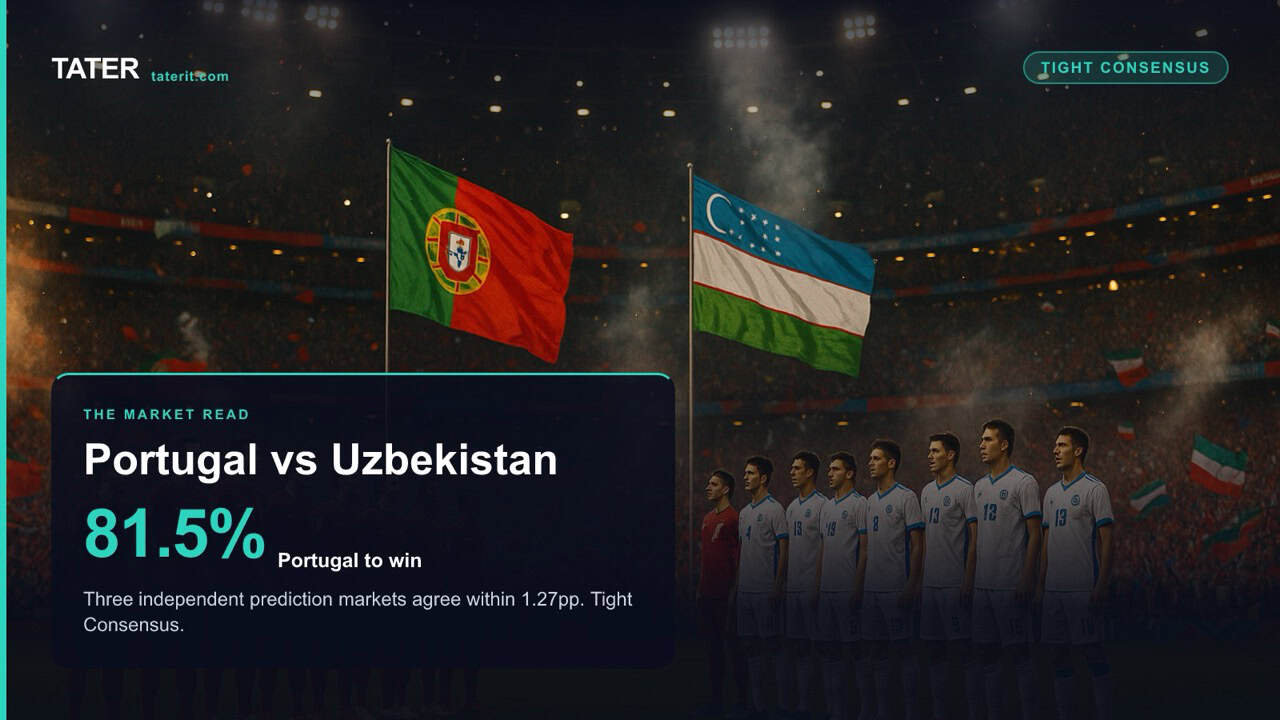
Across every platform that Tater reads, the information market on this game has converged into what the tool classifies as a Tight Consensus. Polymarket, Kalshi, and nine sportsbooks all see the same picture. The only meaningful question is what, exactly, that picture is worth.
The blended read on Portugal win is 81.5%. That number is not a projection or a model output. It is the aggregated signal from decentralized prediction markets, where traders put money behind their beliefs, and from sportsbooks, where sharp bettors and market makers price the same event from a different angle. When those two independent systems produce nearly identical outputs, it says something real about the state of information in the market.
The cross-platform spread, meaning the gap between how prediction markets and sportsbooks are pricing the Portugal win, is just 1.27 percentage points. Polymarket and Kalshi each land at 81.9% for Portugal. The books consensus is 80.6%. That is not agreement by accident. That is convergence by weight of evidence.
The draw sits at 12.8% on the blended read. That is not nothing. In a match this lopsided in expected probability, the draw is essentially functioning as the alternative to a Portugal win rather than a genuine three-way line. It is priced roughly twice what Uzbekistan’s outright win is worth, which comes in at 5.7%. An 81.5% read implies a game where upsets are possible, as they always are in football, but priced firmly at the tail.
The $302,000 in Polymarket volume provides a useful calibration signal on its own. That is meaningful market depth for a group-stage World Cup fixture. When traders put that kind of capital behind a read, the signal carries more information than thin-market pricing would. The numbers are not soft.
Tater’s archetype classification, Tight Consensus, is the relevant label here. It means there is no meaningful signal divergence across the platforms being read. There is no case where the prediction markets are pricing risk that the books are not seeing, or vice versa. What is here instead is the rarer and arguably more analytically useful condition: full agreement about the shape of the event.
The implication for anyone watching the match analytically is straightforward. At 81.5% for Portugal and 5.7% for Uzbekistan, the market is not pricing a 50-50 game with extra steps. It is pricing a structured mismatch. The draw price, at 12.8%, is the floor price for competitive uncertainty.
None of this predicts a result. Markets with 80%-plus consensus get beaten by the game regularly. The point is what the consensus itself communicates about where informed capital is sitting before kickoff. Portugal vs. Uzbekistan is a case where every signal in that blend is pointing the same direction. The market has spoken with unusual clarity. The match still has to be played.
Portugal-Uzbekistan shows unprecedented cross-platform consensus: 81.5% Portugal win, 1.27% spread—the market is settled.
We track convergence like this across all our regulated partnerships. When decentralized prediction markets and traditional sportsbooks independently land within 1.27 points, that's signal noise, not debate. It tells operators exactly where informed capital sits and helps us calibrate real-money positioning across our global network.
- Polymarket, Kalshi, and nine sportsbooks converge on 81.5% Portugal blended probability
- Cross-platform spread just 1.27 points—prediction markets and books nearly identical
- Draw priced at 12.8%, Uzbekistan under 6%—hierarchy is locked in
SCCG angle: When we see this kind of consensus, we can help our partners understand what's driving it and how to position inventory and limits accordingly. We've got direct relationships with the sportsbooks and prediction platforms in this picture—and eyes on where sharp money is really moving.
Gaming, betting and prediction markets — the desk’s read, every weekday.
Subscribe →