Alberta Opens Competitive iGaming Market with 50 Approved Operators

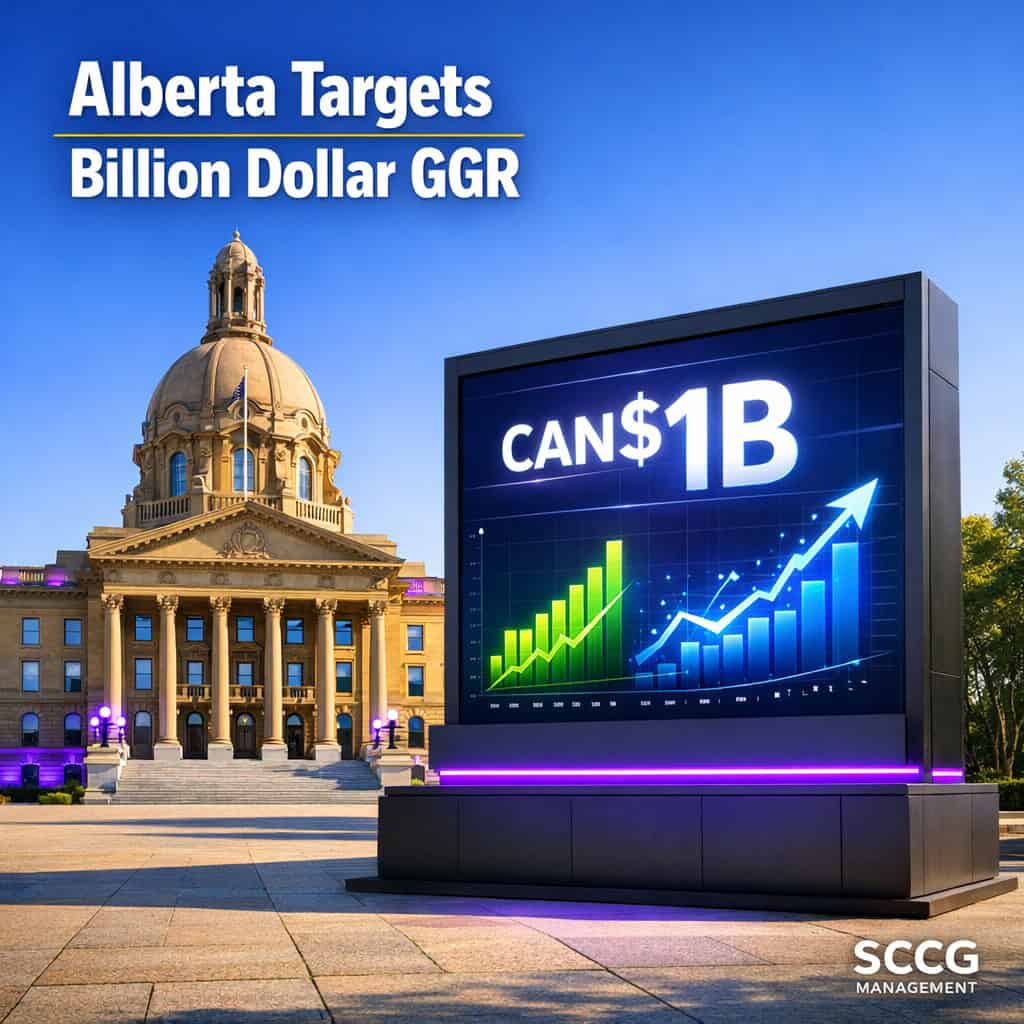
Alberta launched its regulated iGaming market on July 13, 2026, with 50 approved operators and 22 sites live on day one. The province targets US$1 billion first-year revenue while aiming to channel activity from 70% offshore into licensed operators, modeled on Ontario’s 2022 framework. This adds competitive density in a 5-million-resident market.
SCCG Take — Operators should prioritize localization and compliance infrastructure to capture channelization gains quickly. This rollout offers a scalable template for remaining Canadian provinces and U.S. states weighing liberalization.
Alberta Opens Competitive iGaming Market with 50 Approved Operators as Canada’s Regulatory Map Evolves
Key Takeaways
- Regulatory Milestone: Alberta launched its licensing-based online gambling market on July 13, 2026, becoming the second Canadian province after Ontario to adopt a competitive private-operator model.
- Scale at Launch: More than 50 operators completed registration, with 22 operator sites live on day one including DraftKings, FanDuel, BetMGM, and bet365.
- Revenue Target: The province is targeting US$1 billion in first-year gambling revenue, with H2 Gambling Capital projecting CAN$1.2 billion GGR for the current fiscal year.
- Channelization Goal: Officials aim to shift activity from an estimated 70 percent currently on offshore sites toward regulated channels, learning from Ontario’s 83.7 percent rate.
Alberta’s regulated iGaming market officially opened July 13, 2026. The province now joins Ontario as the second Canadian jurisdiction to implement a competitive licensing system for online sports betting and casino products.
Fifty operators have completed the registration process with the Alberta Gaming, Liquor & Cannabis Commission. The Alberta iGaming Corporation oversees commercial agreements. As first reported by Focus Gaming News, this launch culminates years of legislative work modeled directly on Ontario’s 2022 framework.
Competitive Model Delivers Immediate Scale
The operator roster published by the Alberta iGaming Corporation shows 22 sites went live at midnight on opening day. Major brands including bet365, BetMGM, DraftKings, FanDuel, theScore Bet, and BetRivers entered the market immediately. European Gaming reported that more than 50 online sports betting and casino sites have been licensed alongside almost 60 gaming systems providers and 14 platform providers.
Suppliers moved quickly. Pragmatic Play certified its slots and live casino portfolio, with titles such as Fury of Anubis, Big Bass Blast, and the Gates of Olympus series now available. Altenar secured approval to supply its sportsbook platform to licensed operators. According to GamblingNews, the decision to follow Ontario’s approach gave lawmakers confidence that competition would drive both consumer protection and market growth.
This represents a structural shift. An uncapped licensing model in a province of roughly 5 million residents creates immediate density. iGaming Future noted that Ontario’s 16.1 million residents supported 49 operators generating just over CAN$4 billion in non-adjusted gross gaming revenue in 2025. Alberta’s smaller base will test whether volume and innovation can sustain dozens of competitors from day one.
Channelization Targets and the Offshore Reality
Provincial authorities estimate 70 percent of current gambling activity in Alberta flows through offshore websites. Dan Keene, chief executive officer of the Alberta iGaming Corporation, expressed confidence that the regulated market can significantly increase the licensed share. The IPSOS study cited across reporting pegs Ontario’s 2025 channelization rate at 83.7 percent, leaving nearly 16 percent with unregulated operators.
The launch arrives near the end of the FIFA World Cup. Only the semi-finals and final remained, yet coverage from multiple outlets expects the tournament to deliver an immediate boost to betting volume. GamblingNews highlighted that Alberta hopes to convert existing offshore players rather than simply add new ones.
A transition window for offshore and grey-market operators to enter the regulated system should limit consumer disruption. This mechanism, combined with localized sports markets and responsible gaming tools, forms the operational backbone. Coverage from iGaming Future underscores that Alberta is not starting from zero, given the prior existence of the government-owned Play Alberta platform since 2020.
Supplier and Operator Momentum on Day One
bet365 confirmed its participation and extended a partnership with the Canadian Football League as official sports betting and online casino partner in both Ontario and Alberta ahead of the 113th Grey Cup. Trip Stoddard, head of development at bet365, stated: “Canada is a key market for bet365, and cementing our brand’s presence in Alberta marks another milestone in our long-term commitment to Canadian sports fans.”
Pragmatic Play’s director of PR, Sharon McHugh, said: “Building on our strong momentum in Ontario, this expansion reinforces Pragmatic Play’s long-term commitment to the Canadian market.” Matthew Ferrara, sales manager at Altenar, added: “The launch of Alberta’s regulated market is an important moment not only for the province but for the wider Canadian industry. Regulation creates opportunities for operators to build trusted brands while giving players access to safer, more transparent betting environments.”
DraftKings marked the launch as its 34th North American market. Greg Karamitis, Executive Vice President and General Manager of Sports at DraftKings, emphasized the passionate sports fan base and the timing with the World Cup. Tonybet also secured its license, with CEO Dmitry Arabuli noting 52 percent growth in both registrations and gross gaming revenue for the operator in Ontario during 2025.
Community initiatives accompanied the launch. FanDuel donated CAN$50,000 to the A Dollar A Day Foundation for mental health programs in Alberta. DraftKings contributed CAN$150,000 to Food Banks Alberta and deployed employee volunteers. Whether these steps signal sustained local commitment remains an open question.
What Combined Coverage Underemphasizes
The reporting from Focus Gaming News, European Gaming, GamblingNews, and iGaming Future captures launch metrics, operator lists, and channelization forecasts effectively. Yet the synthesis leaves room for deeper operator and investor scrutiny on unit economics. With an uncapped model and only 5 million residents, the competitive pressure could compress margins faster than Ontario experienced, particularly if customer acquisition costs remain elevated. Regulatory coverage also gives limited attention to how data-sharing protocols between the Alberta iGaming Corporation and operators will evolve to support responsible gaming at scale.
Where Channelization Risk Lies
Dale Nally, Minister of Service Alberta and Red Tape Reduction, stated at the launch press conference: “We expect companies to operate responsibly and to meet our high standards. This market is open, but operators are expected to earn the privilege of participating.” This framing highlights the balance regulators must strike.
The primary risk is that channelization falls short of targets. Ontario’s 83.7 percent rate still leaves meaningful offshore leakage. Alberta’s smaller population and established Play Alberta presence may accelerate uptake, yet the gap between 70 percent offshore and regulated dominance will not close without sustained enforcement, consumer education, and product parity. Operators must price in higher compliance costs while competing aggressively for a finite player pool.
The Path Forward for Canadian Provincial Rollouts
Alberta’s launch marks an inflection point for Canada’s iGaming sector. Other provinces now have a second data set against which to model their own liberalization strategies. The competitive licensing approach, high channelization ambitions, and measured transition mechanisms offer a blueprint that balances innovation with accountability.
For operators and client-partners evaluating Canadian expansion, the lesson is clear: success will hinge on rapid localization, responsible gaming integration, and nimble response to a crowded field. Regulators elsewhere in Canada and parallel U.S. state frameworks should watch how quickly Alberta converts offshore volume while maintaining high standards. This evolution reinforces that thoughtful, competitive regulation can expand legitimate markets without sacrificing player protections. The coming quarters will reveal whether the US$1 billion first-year target proves conservative or aspirational as the market matures.
Reporting: Alberta launches regulated online gambling market with 50 approved operators (focusgn.com)
Alberta's Ontario-style launch proves the Canadian competitive model works — now every operator needs local infrastructure fast.
We've seen this playbook work in Ontario, and Alberta is running it harder and faster. Fifty approvals on day one means crowded lanes and thin margins unless you localize smart — compliance, payments, and player acquisition all need Canadian boots on the ground. For our partners eyeing the rest of Canada, this is the blueprint.
- 50 operators approved, 22 sites live July 13 — DraftKings, FanDuel, bet365 among the pack
- Province targets $1 billion first-year revenue, channeling 70% of offshore activity
- Modeled on Ontario's 2022 framework; template for other provinces and U.S. states weighing liberalization
SCCG angle: SCCG has compliance, payments, and CRM partners already live in Ontario who can spin up Alberta infrastructure in weeks, not quarters. We've connected operators to the local tech and marketing stack that actually converts in competitive Canadian markets — this is about speed to revenue, not just speed to launch.
Gaming, betting and prediction markets — the desk’s read, every weekday.
Subscribe →