TL;DR — Sweepstakes casinos face a fragmented US regulatory landscape with five states banning mimicry of online casinos in 2025 and enforcement in Arizona, Louisiana, Delaware and Maryland. Major operators exited Indiana after its July 1 dual-currency ban. Consumer research shows 90% view it as gambling, raising stakes for licensed operators generating $78.6bn GGR.
SCCG Take — Client-partners should treat this patchwork as a planning input, prioritizing compliant jurisdictions and advocating clear separate pathways for sweepstakes to balance innovation with accountability and tax contribution.
Sweepstakes Casinos Legality by State: Comprehensive Guide for Gaming Executives and Operators
Key Takeaways
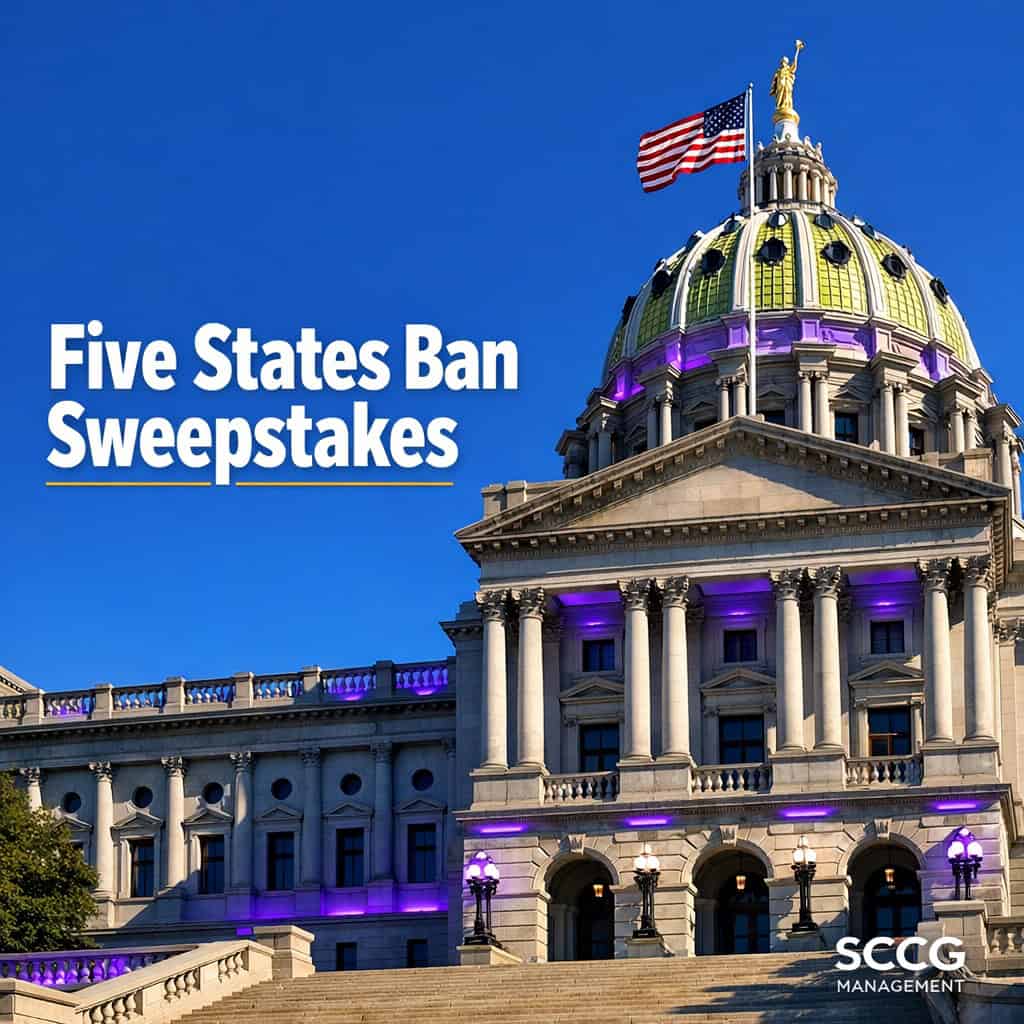
- Explicit Bans Enacted: California, Connecticut, Montana, New Jersey and New York passed new legislation in 2025 to explicitly prohibit sweepstakes gaming platforms that mimic online casinos or sportsbooks.
- Active Enforcement: Arizona, Louisiana, Delaware and Maryland have taken enforcement measures against sweepstakes operators, including cease-and-desist orders, based on pre-existing gambling laws.
- Consumer Views and Market Scale: 90% of sweepstakes casino users considered the activity to be gambling while 68% said their main reason for playing was to win real money; regulated commercial gaming generated $78.6bn in gross gaming revenue in 2025 and $17.9bn in gaming tax revenue.
- Advertising Concentration: Half of all the online ads for online casinos that consumers are exposed to are for offshore or sweepstakes casinos, with targeting focused on states without enforcement or prohibition actions.
Sweepstakes casinos are online platforms that offer casino-style games through a promotional model rather than as direct betting sites. Players can obtain free entries but the model often involves purchasable virtual currency that can lead to potential cash winnings, creating ongoing disputes over whether these constitute illegal gambling. This guide provides a state-by-state overview of the current legality as of mid-2026, drawing directly from available reporting to help gaming executives navigate the patchwork.
What Are Sweepstakes Casinos
Sweepstakes casinos operate by framing their offerings as promotional games. The core argument from operators is that these platforms provide a sweepstakes entry mechanism that does not require a purchase to participate, distinguishing them from traditional online casinos or sportsbooks. However, enforcement bodies have challenged this framing when platforms enable coin purchases tied to casino-style games with cash-out potential.
The American Gaming Association has cast the issue as one of the sharpest threats facing the US gambling market. According to reporting by iGaming Future, the debate centers on who controls gambling: state regulators, licensed casino operators, or companies running these promotional games.
Some states have moved to shut the sector down while others rely on existing gambling laws. A third group has yet to take firm action, leaving operators to chase customers in legal grey areas. This divide reflects deeper tensions between innovation in digital gaming and the established regulated framework that includes licensing, taxation and responsible gambling measures.
For client-partners evaluating market entry, the distinction matters because sweepstakes platforms sit outside the systems built around casinos, sports betting and iGaming. The economic contrast is clear: regulated commercial gaming generated $78.6bn in gross gaming revenue in 2025.
How the Dual Currency Model Works
The dual currency model involves separate virtual currencies, one obtained for free as a promotional tool and another available for purchase. Enforcement actions have focused on cases where the purchased currency enables casino-style games that can produce cash winnings, undermining the promotional claim.
In Delaware, the Division of Gaming Enforcement found that one operator had misrepresented its services as promotional sweepstakes while enabling players to purchase coins for casino-style games, leading to potential cash winnings. Similar concerns appear in actions taken in other jurisdictions.
This model has drawn scrutiny because it can resemble paid gambling while claiming exemption. The Indiana dual-currency ban, which took effect on July 1, prompted major operators to exit the state entirely. As shared by @igamingrepublic on X, major sweepstakes operators including Chumba Casino, stake.us and VGW have exited Indiana as the state’s dual-currency ban took effect on July 1.
From an operational standpoint, the model requires careful separation of free and purchased paths. Failure to maintain that separation has led to cease-and-desist orders in multiple states. Executives must weigh whether the acquisition benefits justify the compliance overhead in uncertain markets.
Federal Legal Framework Overview
There is no comprehensive federal prohibition specifically targeting sweepstakes casinos in the provided reporting. Instead, the framework leaves primary authority to states, resulting in the current patchwork. The long-running battle involves interpretation of existing federal statutes on gambling versus promotional activity.
Sweepstakes have historically relied on exemptions for prize promotions that do not require consideration. However, when platforms blend free entries with purchasable coins and cash redemption, regulators argue the consideration element appears, reclassifying the activity.
The American Gaming Association has emphasized that sweepstakes sites operate outside the licensing, tax and responsible gambling systems states built around regulated verticals. This creates an uneven competitive landscape. Licensed operators pay taxes that generated $17.9bn for state and local governments in 2025, while sweepstakes platforms do not contribute in the same way.
The convergence of promotional gaming and digital casino experiences represents a structural shift that federal and state rules are still addressing. What remains unknown from current coverage is any pending federal legislation that would preempt state variation or create a national standard.
State-by-State Operating Status
As of mid-2026, the operating status varies significantly. Five states have passed explicit prohibitions: California, Connecticut, Montana, New Jersey and New York. These laws target platforms that mimic online casinos or sportsbooks.
A second category includes states that have applied pre-existing gambling statutes without new legislation. Arizona, Louisiana, Delaware and Maryland fall into this group. Arizona’s Department of Gaming sent cease-and-desist orders to several sweepstakes casinos platforms, accusing them of illegal gambling. Louisiana regulators and the attorney general’s office treated the issue as already covered by gambling statutes.
Delaware’s investigation highlighted misrepresentation of services. Maryland sent cease-and-desist orders to operators of unauthorised sweepstakes platforms. A bill to confirm that casino-style sweepstakes were illegal passed the Maryland state Senate but failed to advance in the House.
Many other states have yet to take firm action according to the iGaming Future analysis. This leaves operators in legal grey areas where customer acquisition continues but with elevated risk. The RotoWire list of sweepstakes casinos for July 2026 provides one ranking of platforms still operating in permitted environments, though availability changes rapidly.
Tribal interests have voiced concerns in certain debates. In California, Big Lagoon Rancheria warned that a ban would eliminate business opportunities for various tribes by locking them out of emerging digital business sectors, without offering any offsetting benefits. This will impact tribes that do not have the geographic benefit of being able to operate large gaming casinos.
States Cracking Down on Sweepstakes Operators
The crackdown has accelerated in multiple jurisdictions. The clearest actions appear in the five states that enacted 2025 legislation: California, Connecticut, Montana, New Jersey and New York. These measures explicitly prohibit platforms mimicking regulated online gambling.
Enforcement under existing laws has been equally aggressive elsewhere. Arizona issued cease-and-desist orders. Louisiana involved both regulators and the attorney general. Delaware focused on misrepresentation in its Division of Gaming Enforcement findings. Maryland combined cease-and-desist orders with attempted legislation that passed one chamber.
The advertising data explains the intensity. Half of all the online ads for online casinos that consumers are exposed to are for offshore or sweepstakes casinos. These operators target consumers in states without sweeps enforcement or prohibition actions.
The American Gaming Association’s July 2025 consumer research found that 90% of sweepstakes casino users considered the activity to be gambling. 68% said their main reason for playing was to win real money. These figures challenge the industry’s central defence that the products are not gambling.
Where the risk lies for operators is the potential for sudden enforcement even in states without new statutes. The economic argument from licensed operators centers on the $78.6bn gross gaming revenue figure and the associated tax contributions that sweepstakes platforms bypass.
Recent Exits from Key Jurisdictions
Recent exits demonstrate the practical impact of tightening rules. In Indiana, the dual-currency ban that took effect on July 1 led several major players to withdraw. Chumba Casino, stake.us and VGW ceased operations there, according to reporting from @igamingrepublic.
VGW has faced additional leadership transition. VGW Founder Laurence Escalante Resigns as CEO of the Sweepstakes Casino Giant, as covered in industry news aggregation. This change at one of the sector’s largest operators may reflect broader pressures from regulatory scrutiny and market exits.
These developments illustrate how enforcement prompts strategic retreats. Operators have concentrated activity in jurisdictions with less immediate action. However, the advertising targeting of states without enforcement suggests that exits in one market often shift activity to others, perpetuating the cycle.
The combined coverage from iGaming Future, iGaming Republic and RotoWire underscores a fast-moving environment. What the reporting underemphasizes is the long-term viability for operators who invest in compliance infrastructure early. From an investor lens, repeated exits signal elevated regulatory risk that must be priced into any sweepstakes-related allocation.
Compliance Requirements for Operators
Compliance begins with strict adherence to each state’s interpretation of gambling statutes. Platforms must ensure that free promotional entries are genuinely accessible without purchase and that any cash redemption paths do not create an illegal consideration element.
Cease-and-desist orders in Arizona, Maryland and elsewhere demonstrate that misrepresentation of services as purely promotional can trigger enforcement. Operators should maintain clear separation between free and purchased currencies and transparent terms.
Responsible gambling tools, while not required in the same manner as for licensed iGaming, represent a prudent step given that 90% of users view the activity as gambling. Alignment with broader industry standards can reduce criticism from the American Gaming Association and licensed operators.
Legal review of advertising practices is essential. The data showing half of online casino ads come from offshore or sweepstakes operators, often targeting lax jurisdictions, has intensified regulatory focus. Client-partners should avoid practices that appear to exploit regulatory gaps.
Documentation and audit readiness have become baseline. When regulators investigate, as in Delaware, the ability to demonstrate genuine sweepstakes mechanics versus disguised gambling determines outcomes.
Regulatory Outlook and Potential Changes
The outlook points toward continued state-level variation rather than rapid uniformity. With five states having passed explicit bans in 2025 and additional enforcement in at least four others, the trend favors tighter controls in markets with strong licensed casino presence.
Tribal perspectives, such as those expressed by Big Lagoon Rancheria in California, introduce complexity. Smaller tribal interests have argued that bans may protect established operators while limiting digital opportunities for tribes without large land-based casinos.
The resignation of VGW Founder Laurence Escalante as CEO may foreshadow industry consolidation as compliance costs rise and uncertain markets shrink. According to the RotoWire July 2026 ranking, platforms continue to operate selectively where enforcement remains limited.
What this means for operators is the necessity of agile market selection and proactive engagement with regulators. A dedicated regulatory pathway for sweepstakes, separate from sports betting or iGaming, could resolve much of the current ambiguity while capturing tax revenue and enforcing consumer protections.
The structural shift underway rewards those who treat regulatory clarity as a planning input rather than an obstacle. Forward-looking executives will monitor legislative efforts in remaining states and prepare contingency plans for further exits.
What states have banned sweepstakes casinos mimicking online gaming?
California, Connecticut, Montana, New Jersey and New York passed legislation in 2025 to explicitly prohibit such platforms.
Is the dual currency model legal across the US?
No. The model has triggered bans, such as Indiana’s dual-currency prohibition that took effect on July 1, leading to operator exits. Legality depends on state-specific enforcement of gambling statutes.
How do regulators distinguish sweepstakes from gambling?
Regulators examine whether purchases are required to play or win cash prizes. Cases involving misrepresented promotional sweepstakes that enable purchased coins for casino games with cash potential have led to enforcement in Delaware, Arizona and other states.
What should operators monitor going forward?
Operators should track enforcement in states without new legislation, consumer perception data showing 90% view the activity as gambling, and potential tribal or legislative pushback that could alter the patchwork.
Reporting: Sweepstakes Casinos State-by-State Legality Tracker (igamingfuture.com)