How Sports Betting Taxes Work By State: North Carolina Case Study

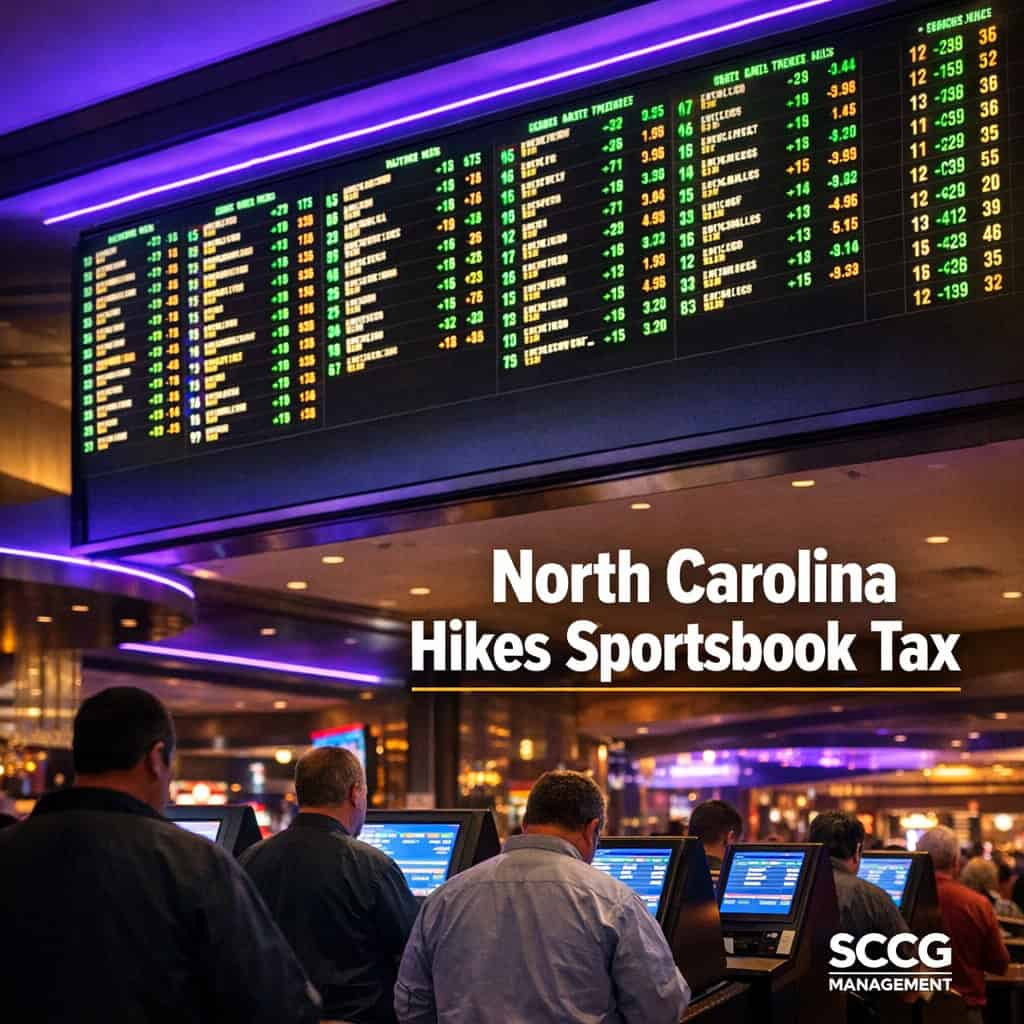
North Carolina’s $34 billion budget raises sports betting tax from 18% to 23% with a 6% rate on prediction market net trading fee revenue, creating competitive disparity. The state has collected over $287 million since March 2024 launch. This highlights varying state approaches to taxing traditional and emerging verticals.
SCCG Take — Operators should model the margin impact of tax gaps and consider diversified offerings. This inflection point favors agile client-partners who engage on balanced frameworks.
How Sports Betting Taxes Work By State: Fundamentals, Structures, and the North Carolina Case Study
Key Takeaways
- State Tax Autonomy: U.S. states independently set sports betting tax rates with no uniform national standard, as illustrated by North Carolina’s increase from 18% to 23% on sportsbooks alongside a 6% tax on prediction market net trading fee revenue.
- Revenue and Licensing Details: Licensed sportsbooks in North Carolina pay a $1 million licensing fee, and the state has collected more than $287 million in sports betting tax revenue since online wagering launched in March 2024.
- Tax Disparity Concerns: The lower 6% rate for prediction markets has fueled criticism that it creates a competitive advantage and could reduce funding for public school athletic programs.
- Regulatory Recognition: The $34 billion budget signed by Gov. Josh Stein formally recognizes prediction market operators while imposing lighter taxes and oversight than on traditional sportsbooks.
Sports betting taxes are levied by individual states on licensed operators with no single nationwide rate. Each jurisdiction determines its tax structure, typically applied to revenue figures, and adjusts rates through legislation. As of mid-2026 North Carolina taxes sportsbooks at 23% while applying a 6% tax to prediction market net trading fee revenue, creating a clear example of how these frameworks operate and diverge.
Fundamentals of US Sports Betting Taxation
State governments treat sports betting as a taxable activity to generate public revenue. The core mechanism imposes a percentage on the net revenue realized by operators after accounting for payouts. This approach focuses on actual earnings rather than total amounts wagered.
North Carolina’s framework demonstrates the principle in action. The state collects tax on sports betting activity and has now extended formal recognition to prediction markets with its own rate. According to reporting by Gaming Today, Gov. Josh Stein signed the $34 billion budget that enacts these changes.
These taxes support specific allocations. The North Carolina budget directs portions of proceeds to the Major Events, Games, and Attractions Fund, which receives up to $30m annually, and adds North Carolina State University and the University of North Carolina at Chapel Hill as recipients.
The fundamental distinction between sportsbooks and prediction markets lies in the taxable base. Sportsbooks face the standard rate on their revenue while prediction market operators pay on net trading fee revenue. This separation reflects ongoing policy debates about how to classify event contracts.
How State Tax Rates Are Structured
Tax rates are enacted via state legislation and often embedded in budget bills. Rates apply to the defined revenue base and are supplemented by one-time or recurring licensing costs. North Carolina requires licensed sportsbooks to pay a $1 million licensing fee.
The structure also includes compliance obligations. Operators must track and report revenue accurately to calculate the tax due. The North Carolina increase from 18% to 23% illustrates how states can adjust rates after initial legalization to meet budget needs.
Prediction markets receive differentiated treatment. The 6% rate on net trading fee revenue is substantially lower than the sports betting rate. This structure, as detailed in coverage by Focus Gaming News, positions prediction markets under a distinct tier within the same budget legislation.
Such designs aim to balance revenue collection with market participation. However, the resulting gap can influence operator decisions on product emphasis and market investment.
Variations Across Different Jurisdictions
States exercise broad discretion in setting tax rates and oversight models, producing noticeable differences in commercial conditions. While exact figures for every jurisdiction are not enumerated here, the principle of localized control remains consistent. Operators must evaluate each market on its specific terms.
North Carolina’s approach adds another layer to this variation. By raising the sports betting rate to 23% and introducing the 6% prediction market tax, the state has created an explicit disparity. Critics argue this favors prediction market operators with lower costs and reduced regulatory burdens.
The variation extends to regulatory classification. Some states maintain unified oversight while others, like North Carolina, recognize prediction markets separately. This can affect how operators structure compliance programs across borders.
As of mid-2026 the landscape continues to reflect these jurisdictional differences. The North Carolina example, as first reported by Gaming Today, shows how budget processes serve as vehicles for updating tax rules without standalone bills.
North Carolina Tax Increases Explained
North Carolina Governor Josh Stein signed Senate Bill 257, approving the $34 billion budget. The legislation raises the tax on online sports betting operators from 18% to 23% and introduces a 6% tax on prediction market operators. This marks the first change since online sports betting launched in March 2024.
A prior proposal to double the sports betting tax rate failed to advance in the previous year. The current increase was approved by the House of Representatives in an 88-21 vote and the Senate by 35-10. The state has collected more than $287 million in sports betting tax revenue since launch.
Sen. Julie Mayfield, D-Buncombe, warned of potential consequences. She stated: “The revenue that we’ve been getting from sports betting, it’s going to plummet. And then that has all sorts of implications. Not just for our budget, but for the schools that have again come to rely on this money for their athletic programs.”
The budget also adds recipients for revenue proceeds and allocates up to $30m annually to the Major Events, Games, and Attractions Fund. These details appear in reporting by Focus Gaming News.
Treatment of Prediction Markets
Prediction market operators such as Kalshi and Polymarket fall under the new 6% tax on net trading fee revenue. They are not subject to the same regulatory framework that governs sportsbooks. The legislation provides formal legal recognition while maintaining lighter oversight.
This treatment has drawn criticism. Opponents contend it creates a competitive advantage and conflicts with state authority over sports wagering. North Carolina Attorney General Jeff Jackson joined a multistate coalition urging greater federal oversight through the Commodity Futures Trading Commission.
Market integrity concerns have also surfaced. These include allegations that participants with access to nonpublic information could exploit event contracts. Such issues gained attention following a federal case involving U.S. Army Master Sgt. Gannon Ken Van Dyke.
Mick Mulvaney, director of Gambling Is Not Investing, criticized the approach. He stated: “There’s no reason a state should favor these rogue operators over the licensed sportsbooks who fully comply with regulations and tax structures. Prediction markets are unlicensed sports gambling apps — full stop. The proposed North Carolina budget legitimizes and gives a sweetheart deal to the same prediction market operators that are trampling on the state’s gambling regulations while opening a pathway for underage users to gamble on sports through prediction markets.”
The coverage from NEXT.io and iGamingPub_News underscores that North Carolina is among the first states to set explicit rules for the event-contract sector.
Impact on Operators and Consumers
Higher tax rates directly affect operator margins. The jump to 23% in North Carolina increases the cost of doing business and may prompt adjustments in pricing, promotions, or product focus. Prediction markets, facing only 6%, could draw activity away from licensed sportsbooks.
Consumers may encounter fewer incentives or higher effective costs in the sports betting segment. The potential migration to prediction platforms raises questions about product availability and user experience across categories.
For operators the disparity represents a planning input rather than an abstract grievance. Resource allocation, compliance budgeting, and market prioritization must account for the different tax burdens. Investors similarly weigh these factors when assessing exposure to specific jurisdictions.
The concerns voiced by state lawmakers highlight downstream effects. Reduced sports betting revenue could limit funds available for athletic programs, illustrating the connection between tax policy and broader public priorities.
Compliance and Revenue Reporting Rules
Operators must maintain precise records of revenue and submit payments according to state schedules. Licensing requirements, such as North Carolina’s $1 million fee, form an additional component of market entry costs. Accurate classification of revenue—whether standard sports betting or net trading fee revenue for prediction markets—is essential.
Regulatory expectations include adherence to applicable oversight rules. Sportsbooks operate under one framework while prediction markets function with lighter state-level requirements. This dual structure demands segmented compliance systems.
Failure to meet reporting standards can result in penalties. The North Carolina budget reinforces the importance of transparent revenue declarations to support the calculated tax amounts.
Emerging Trends in Gambling Taxes
States are increasingly addressing prediction markets through dedicated tax provisions. North Carolina’s 6% rate alongside the sports betting increase exemplifies this evolution. The move recognizes existing consumer activity while capturing revenue under state law.
This development signals a structural shift in how jurisdictions approach the convergence of sports wagering and event contracts. Lower rates on prediction markets may encourage innovation but also intensify debates over competitive equity and regulatory consistency.
The differentiated treatment invites ongoing review. Operators and regulators alike will watch whether the disparity affects overall market revenue or prompts further legislative adjustments in other states. The North Carolina case, synthesized across Gaming Today, Focus Gaming News, and iGamingPub_News coverage, provides a concrete reference point for these emerging dynamics.
From a commercial standpoint the trend underscores the value of agility. Client-partners benefit from models that can adapt to varied tax and oversight environments while maintaining compliance and consumer trust.
Frequently Asked Questions
How is the sports betting tax calculated in North Carolina?
North Carolina applies a 23% tax on online sportsbooks following the increase from the prior 18% rate, with an additional $1 million licensing fee required.
What tax rate applies to prediction markets in the state?
Prediction market operators pay a 6% tax on net trading fee revenue under the new budget legislation.
How much tax revenue has North Carolina generated from sports betting?
The state has collected more than $287 million since online wagering launched in March 2024.
Why does the tax disparity between sportsbooks and prediction markets matter?
Critics including Sen. Julie Mayfield and Mick Mulvaney argue it could reduce overall tax revenue, affect public funding, and grant unlicensed operators an advantage over fully regulated sportsbooks.
Reporting: How Sports Betting Taxes Work By State (www.gamingtoday.com)
A 17-point tax gap between sports betting and prediction markets will reshape operator strategy and ignite nationwide policy debate.
We have 545 partners across every regulated market, and North Carolina's lopsided tax structure is a warning shot: prediction markets are now a recognized vertical with radically different economics. Operators who don't model this disparity and diversify product mix will leave margin on the table—or worse, lose share to nimbler competitors.
- North Carolina raised sports betting tax from 18% to 23%; prediction markets taxed at only 6%
- State collected over $287M since March 2024 launch; $1M licensing fee per sportsbook
- Tax disparity fuels competitive concerns and threatens school athletic program funding
SCCG angle: SCCG works with regulators, operators, and platform partners in every U.S. market. When tax structures diverge like this, we help clients stress-test product mix, model margin impact, and engage stakeholders on balanced frameworks before the next legislative cycle locks in disadvantage. We've been in these rooms for three decades.
Gaming, betting and prediction markets — the desk’s read, every weekday.
Subscribe →