North Carolina Budget Deal to Authorize Prediction Markets Highlights Patchwork Legalization Path

A North Carolina budget deal would authorize prediction markets, per Axios. This advances the state-by-state legalization pattern and surfaces questions around CFTC preemption, tribal sovereignty, and sports betting compacts. Operators must prepare for added regulatory complexity across fragmented jurisdictions.
SCCG Take — This authorization accelerates patchwork rules that reward agile suppliers with strong data infrastructure. Operators who map compliance and liquidity variances earliest will hold the commercial advantage.
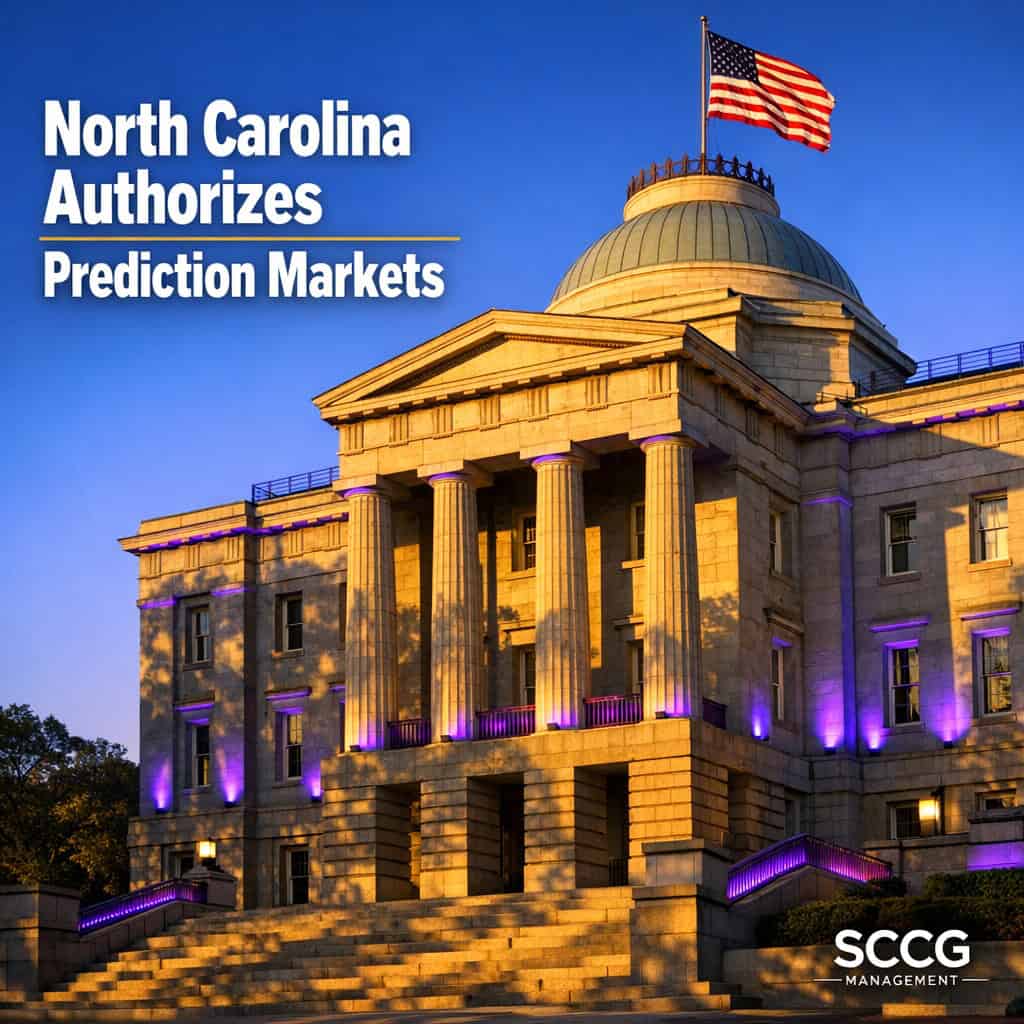
North Carolina Budget Deal to Authorize Prediction Markets Highlights the Patchwork Legalization Path
“A budget deal would authorize prediction markets in North Carolina.” That is the direct report from Axios on the latest development in state regulation.
This single line signals another state entering the space. It fits the pattern of fragmented approaches that operators track daily. From the supplier side the authorization creates immediate commercial questions around integration, compliance and market entry.
The Core Development in North Carolina
The budget deal under consideration would bring prediction markets under state authorization. According to Axios this represents a concrete step at the legislative level. No additional details on timelines or specific frameworks appear in the reporting.
For gaming operators and sports tech partners this adds North Carolina to the list of jurisdictions opening the door. The move arrives as the industry evaluates how prediction markets sit alongside traditional sports betting products. North Carolina becomes the latest data point in that evaluation.
I count this as further evidence that state legislatures are moving faster than federal coordination. From eighteen years across iGaming and sportsbook operations on the supplier and data infrastructure side that pace is familiar. Platforms must adapt quickly or risk missing early positioning.
Acceleration of State-by-State Prediction Market Rules
One state at a time the map fills in. North Carolina’s budget mechanism shows how prediction market authorization can ride alongside routine fiscal negotiations. This route lowers the procedural barrier compared with standalone bills.
The result is a regulatory patchwork. Each state sets its own guardrails on contract types, liquidity requirements and participant eligibility. Operators face a compliance matrix that grows with every new jurisdiction.
Data infrastructure teams see the downstream effect first. Feeds, risk models and user verification flows must accommodate multiple rule sets. A single national framework would simplify the build. The current path demands modular architecture instead.
Intersections with CFTC Preemption and Tribal Sovereignty
Prediction market rules at state level inevitably collide with federal oversight questions. The CFTC maintains authority over certain event contracts. How North Carolina’s authorization aligns with or tests that boundary remains unresolved in the current reporting.
Tribal sovereignty adds another layer. Gaming compacts between states and tribes already govern sports betting in many jurisdictions. Any prediction market framework must clarify whether those compacts extend or require separate negotiation.
From the commercial operations perspective these intersections determine speed to market. A clean state authorization without federal challenge accelerates platform launches. Overlap or ambiguity invites legal review that delays integration and customer acquisition.
The reporting from Axios does not resolve these tensions. It simply adds North Carolina to the list of active conversations. Industry participants will watch for amendments or companion legislation that address preemption and sovereignty directly.
Sports Betting Compacts and Competitive Positioning
Sports betting compacts provide a natural reference point. Many states folded sports wagering into existing tribal and commercial frameworks. Prediction markets could follow the same path or carve out independent treatment.
The competitive calculus shifts with each new state. Operators already licensed for sports betting may gain an advantage if prediction markets fall under the same license. New entrants focused solely on event contracts could target markets where the rules remain separate.
Liquidity and user overlap become immediate operational metrics. Shared customer bases reduce acquisition costs but increase cross-product risk management requirements. Supplier platforms that already handle both sportsbooks and prediction market data hold an edge in these environments.
This North Carolina development does not rewrite national policy. It does force operators to update their regulatory trackers and resource allocation models. The states moving first create de facto templates that later adopters may copy or modify.
Where the Risk Lies
Every new state authorization carries execution risk. The budget deal must still pass final votes and avoid amendments that tighten or kill the provision. Timing matters because fiscal year deadlines can compress debate.
On the operational side the risk sits in mismatched compliance systems. A platform built for one state’s rule set may require costly rewrites for the next. Data vendors without flexible APIs will lag behind those engineered for regulatory variance.
Counterarguments exist. Some industry voices contend that rapid state action fragments liquidity and confuses customers. A slower, federally guided process might produce more uniform standards. The current trajectory suggests the patchwork will arrive first.
The limitation is clear. Without coordinated federal guidance operators absorb the cost of navigating inconsistency. That cost appears in legal budgets, engineering sprints and delayed product rollouts.
The Fragmentation Calculus for Operators
North Carolina’s budget deal reinforces the state-by-state reality. Prediction market legalization is accelerating through fiscal vehicles rather than comprehensive reform. This path favors operators and suppliers who maintain agile compliance and modular tech stacks.
The next twelve months will reveal how many additional states adopt similar language. Early movers gain market share. Late adapters spend to catch up. The data on the table shows fragmentation is the default setting.
Watch for amendments to the North Carolina language and for parallel moves in neighboring states. Those signals will dictate where commercial teams allocate resources first. The operator who maps the patchwork fastest keeps the edge.
Reporting: Budget deal would authorize prediction markets in North Carolina – Axios (news.google.com)
Another state, another ruleset—operators who build agile compliance infrastructure first win the long game.
We've watched this pattern play out across 30 years and 150+ partners: legalization accelerates fastest through budget deals, not deliberate legislation. Each state that opens prediction markets adds a new compliance layer and liquidity variance. Operators who map these rules early and build data-driven supplier relationships across jurisdictions capture real commercial advantage.
- North Carolina budget deal authorizes prediction markets, advancing patchwork state-level legalization.
- CFTC preemption, tribal sovereignty, and sports betting compacts create overlapping regulatory questions.
- Agile operators with strong compliance infrastructure and liquidity mapping will outpace slower players.
SCCG angle: We help clients map regulatory variances and identify the right partners in each new jurisdiction the moment it opens. Our network includes operators, compliance experts, and venue stakeholders in every regulated market—so you move faster than the rulebook.
Gaming, betting and prediction markets — the desk’s read, every weekday.
Subscribe →