Massachusetts House Advances Historical Horse Racing Machines in $561 Million Bill

Massachusetts House passed HHR legislation July 8 within a $561M economic bill, potentially unlocking $225M investment at Suffolk Downs and Raynham Park. Strong opposition from commercial casinos and Mashpee Wampanoag Tribe centers on regulatory bypass and tribal compact violations. Senate review will determine if this becomes a model for redevelopment or a flashpoint for gaming policy.
SCCG Take — This vote tests whether states can pursue economic redevelopment while honoring tribal sovereignty as foundational. Operators and regulators must prioritize inclusive frameworks that prevent compact erosion.
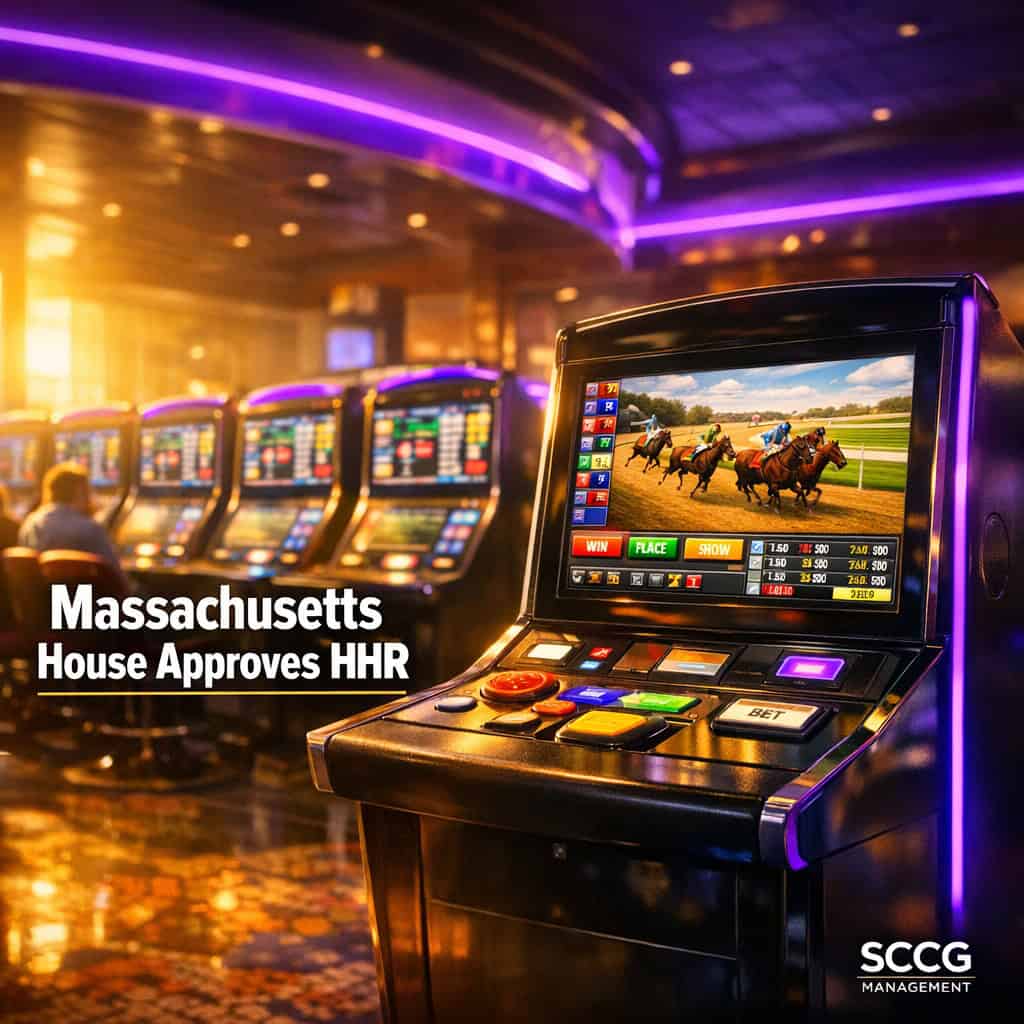
Massachusetts House Advances Historical Horse Racing Machines in $561 Million Bill Despite Casino and Tribal Opposition
Key Takeaways
- House Passage: Legislators approved the HHR measure on July 8 as part of a $561 million economic development bill that now advances to the Senate for further scrutiny.
- Investment Potential: A Spectrum Gaming Group report projects approximately $225 million in combined capital investment at Suffolk Downs and Raynham Park if the legislation becomes law.
- Key Backer: Developer Richard Fields has supported the proposal for years and has an agreement to acquire Raynham Park contingent on approval.
- Stakeholder Resistance: Commercial casino operators and the Mashpee Wampanoag Tribe argue the machines bypass existing regulatory frameworks and tribal compacts.
The Massachusetts House approved legislation that would legalize historical horse racing machines at the state’s remaining racetrack properties. The measure passed Wednesday night, July 8, as one of several last-minute amendments tucked into a sweeping $561 million economic development bill, according to reporting by Casino.org. It now moves to the Senate, where its prospects remain uncertain amid expected pushback.
This development highlights ongoing tensions in how states classify and expand gaming options. Supporters frame historical horse racing as a way to revitalize former racetracks without live racing, while opponents see it as unregulated competition. As the proposal advances, it tests the balance between economic redevelopment and established gaming compacts.
Defining Historical Horse Racing Machines
Historical horse racing machines look like traditional slots but rely on the outcomes of previously run races rather than random number generators. The races are anonymized, and players wager into pari-mutuel pools, with the reels serving mainly to display results. Proponents maintain this structure keeps the activity within the realm of horse racing rather than casino-style gambling.
As first reported by GamblingNews, the machines would operate at eligible racetrack sites even without current live racing. Part of Suffolk Downs still functions as a simulcast wagering facility, providing a foundation for the new attraction. This setup has allowed similar installations in other states to navigate regulatory gray areas by emphasizing the pari-mutuel element.
The distinction matters. By tying outcomes to real past events instead of digital randomness, operators can argue the product extends existing horse racing frameworks. Yet the visual and mechanical similarity to slots fuels the core debate now playing out in Massachusetts.
Economic Redevelopment and the $225 Million Opportunity
Developer Richard Fields has championed the legislation for years as part of his broader redevelopment of Suffolk Downs into a mixed-use neighborhood in East Boston. Fields has also reached an agreement to acquire the former Raynham Park in southeastern Massachusetts if the bill passes. A report prepared by Spectrum Gaming Group estimates $225 million would be invested to develop HHR venues at the two sites.
Supporters believe the machines could refresh these properties, generating fresh investment, jobs, and tax revenue. Suffolk Downs, once a premier thoroughbred track, now sits at an inflection point where gaming could anchor revitalization efforts. The same logic applies at Raynham Park, where no live racing currently occurs.
From a commercial standpoint, the proposal offers a targeted economic development tool. It focuses resources on specific underutilized sites rather than broad casino expansion. If approved, the $225 million figure represents tangible capital commitment in a market that has otherwise seen limited new gaming infrastructure.
Commercial Casino Operators’ Competitive Concerns
The state’s licensed casino operators have strongly opposed the measure. Encore Boston Harbor, MGM Springfield, and Plainridge Park jointly urged House leaders to reject the amendment. They argue the terminals function like slot machines but escape the rigorous regulatory requirements applied to licensed casinos, creating an uneven playing field.
This pushback reflects a classic tension in gaming expansion. Established operators invested under the Massachusetts Expanded Gaming Act now face potential direct competition from a product that looks and plays similarly but arrives through a different statutory path. Their criticism centers on regulatory parity rather than the concept of additional gaming itself.
The limitation here is clear. Without equivalent oversight on advertising, responsible gaming tools, or taxation, HHR machines could divert revenue from regulated facilities. This risk becomes more pronounced if the Senate weakens any proposed guardrails during its review.
The Mashpee Wampanoag Tribe’s Sovereignty Challenge
The Mashpee Wampanoag Tribe has also criticized the legislation, stating it would expand gambling outside the existing legal framework of the state’s gaming laws and the Tribal-State Compact. The tribe issued its statement to Casino.org, declaring: “This is not just a gaming issue. It is a matter of Tribal sovereignty, government-to-government respect, and the Commonwealth keeping its word.”
This position aligns with longstanding tribal concerns about unilateral changes to the commonwealth’s gaming compact. As a sovereign nation with its own casino operations, the Mashpee Wampanoag views the proposal as bypassing negotiated frameworks that govern how gaming expands in Massachusetts. The combined coverage from GamblingNews and Casino.org captures the immediate opposition but underemphasizes how such moves could erode trust in future tribal-state negotiations across other jurisdictions.
In my experience advising on tribal gaming matters, these compact questions rarely resolve through legislation alone. They require deliberate dialogue that treats sovereignty as foundational rather than an afterthought. The current proposal risks setting a precedent that prioritizes economic development over consistent application of existing agreements.
The Open Question of Compact Integrity
What remains unclear is whether the Senate will incorporate amendments addressing the casinos’ regulatory parity concerns or the tribe’s sovereignty objections. The bill’s 11th-hour attachment to the larger economic package may have limited full debate in the House. Operators, investors, and tribal leaders will now watch closely for any modifications that could either mitigate or exacerbate these tensions.
This moment represents a structural test for Massachusetts. The state must weigh immediate redevelopment gains against the longer-term need for coherent gaming policy that respects all stakeholders. Precedent from other states shows HHR can coexist with commercial gaming when clear boundaries are drawn early.
Client-partners should monitor the Senate process for signals on how Massachusetts intends to manage emerging gaming verticals. The outcome will likely influence not only local investment decisions but also how other states approach similar proposals at the intersection of racing heritage, economic revival, and tribal relations.
Reporting: Closer to Reality: Historic Horse Racing Wins Key Vote in Massachusetts House (www.gamblingnews.com)
HHR just became the fastest path to backdoor slot expansion, and every stakeholder with a compact is watching.
We are tracking HHR expansion in every jurisdiction because it rewrites the playbook on slot deployment outside traditional casino frameworks. When a state moves hardware that looks, plays, and pays like a slot without touching its gaming compact, it sets a precedent that reverberates across tribal and commercial markets nationally. This Massachusetts vote is a stress test.
- House passed HHR inside $561M economic bill; $225M projected investment at Suffolk Downs and Raynham Park
- Commercial casinos and Mashpee Wampanoag Tribe oppose, citing regulatory bypass and compact violations
- Senate review is next — outcome will influence HHR strategy in states balancing tribal sovereignty and expansion
SCCG angle: SCCG has worked both sides — tribal nations protecting sovereignty and operators exploring HHR as a growth vector. We connect clients to regulatory advisors, tribal consultants, and hardware providers who understand the compact landscape, so you enter these markets informed and respectful of existing frameworks, not blind.
Gaming, betting and prediction markets — the desk’s read, every weekday.
Subscribe →