Pennsylvania Gaming Control Board Urges CFTC to Rein In Prediction Markets as State-Federal Clash Intensifies
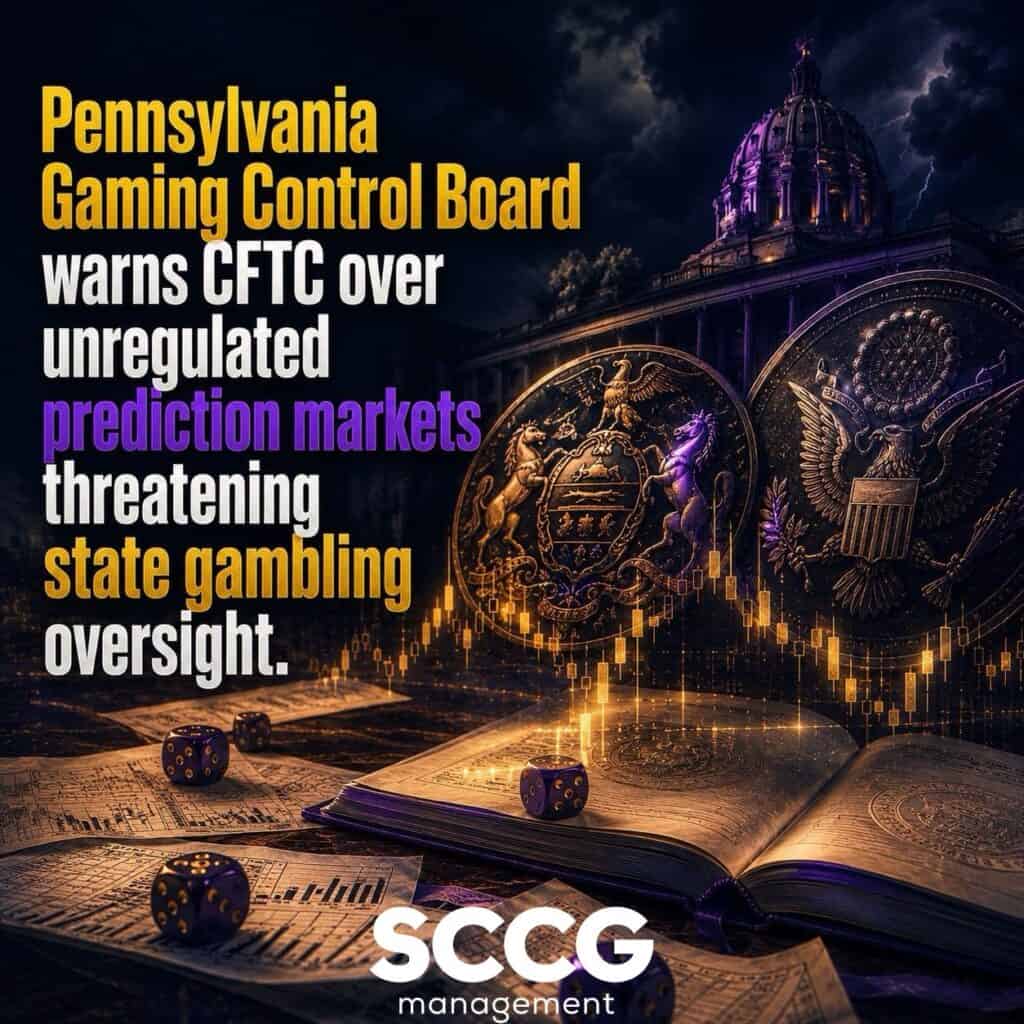
The Pennsylvania Gaming Control Board (PGCB) has issued a warning to federal regulators, cautioning that the rapid expansion of prediction markets could undermine years of careful gambling oversight. In a sharply worded memo, the PGCB criticized the Commodity Futures Trading Commission (CFTC) for allowing platforms offering event-based contracts to operate as unregulated sportsbooks.
This intervention marks another escalation in the growing tension between state gaming authorities and federal oversight of prediction markets. At its core, the dispute centers on whether these platforms function as financial derivatives or as a new form of gambling. The stakes extend beyond regulatory jurisdiction to consumer protections, market integrity, and the competitive landscape for licensed operators.
State Regulators Warn That Prediction Platforms Lack Critical Protections
The PGCB letter signals that state gaming authorities are preparing for a prolonged fight over the future of prediction platforms. Their central argument questions whether prediction markets are truly financial tools or simply gambling by another name.
The CFTC has long treated platforms like Kalshi as part of the derivatives ecosystem under federal oversight. Pennsylvania regulators, however, see little difference between those contracts and traditional wagers.
The memo cites an official statement dating to the aftermath of the 2008 financial crisis. Lawmakers then warned against using derivatives markets to bet on public events.
Several critical guardrails are now being ignored. The CFTC is simply not built to adequately monitor retail transactions valued at $100 or less and entered into by a teenager.
Licensed sportsbooks must follow strict regulations. These include a minimum age of 21 and extensive monitoring for suspicious activity. Prediction markets often allow participation at 18 and lack equivalent oversight.
The PGCB argues that prediction markets operate like sportsbooks without the legal protections afforded by state laws. This creates an uneven playing field that disadvantages regulated operators.
Integrity and Oversight Gaps Raise Serious Concerns
Integrity concerns form another key element of the PGCB critique. The memo highlights recent allegations of trading tied to geopolitical events and sports outcomes.
Questions about insider knowledge and market manipulation have surfaced. Pennsylvania’s regulated system manages such risks through collaboration with other state authorities. No such structures oversee federally overseen prediction platforms.
Even if the CFTC can authorize these markets, it is not necessarily in the best interest of the citizens to do so.
Kevin O’Toole, PGCB executive director, previously described the issue as the emergence of a “dual-track” system. One track is tightly regulated by states. The other operates under federal authority with fewer restrictions on access and participation.
These differences matter as prediction markets now attract millions of users. The scale has drawn increased scrutiny from regulators and policymakers alike.
Risk of a Prolonged Legal Battle and Supreme Court Resolution
Despite the controversy, the CFTC has maintained its current position. Several states have formally challenged prediction platforms such as Kalshi and Polymarket in court.
Different rulings appear almost inevitable. This conflict could ultimately reach the US Supreme Court for a final verdict.
A structural shift of this magnitude carries real risks. States have invested decades building layered consumer protections, age verification, and integrity monitoring. Federal classification as derivatives could erode those safeguards without clear replacement mechanisms.
Operators in the regulated sports betting space face competitive pressure from platforms that operate with lighter compliance burdens. At the same time, the innovation driving prediction markets cannot be dismissed. The technology and liquidity models offer genuine advancements in how events are priced and traded.
The counterargument from the CFTC and platforms rests on the financial instrument framing. If courts ultimately classify event contracts as outside traditional gambling definitions, states may lose significant authority. Yet that outcome would still require addressing the consumer protection gaps the PGCB has flagged.
The Bottom Line
The PGCB’s memo sharpens the state-federal clash over whether prediction markets constitute gambling or legitimate derivatives. With millions of users already engaged and multiple legal challenges underway, this dispute represents an inflection point for the sector. A Supreme Court resolution may ultimately be required to clarify jurisdiction and establish consistent rules. In the interim, operators and policymakers must navigate uncertainty while preserving the integrity and protections that have defined regulated gaming for decades. The outcome will shape not only prediction markets but the broader convergence of event-based trading and traditional wagering.