The ABCs of Prediction Markets: Where Your Dollar Actually Goes
Every figure below carries a source and a date at the foot. Nothing here is legal advice.
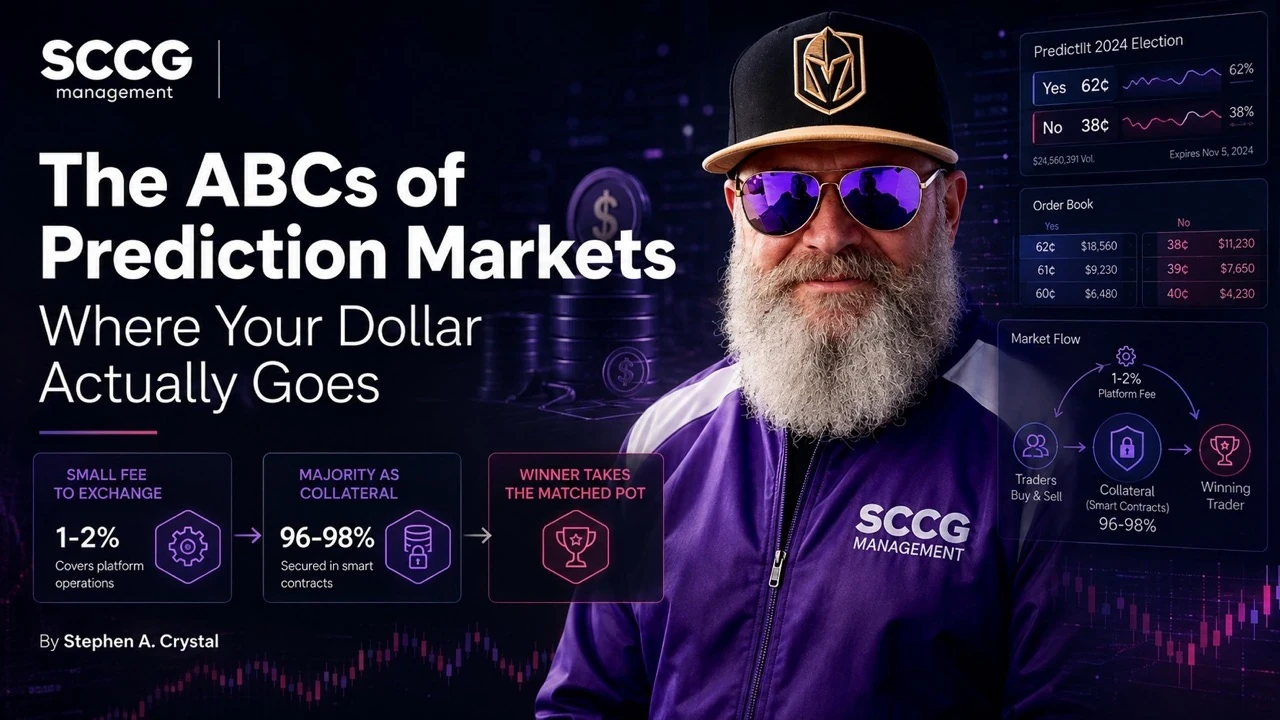
Put a dollar on a prediction market contract, and almost none of it goes to the house.
At the worst point on the curve, roughly three and a half cents of every dollar you stake goes to the exchange as a trading fee. On most contracts it is well under one cent. The rest of your dollar does not go anywhere at all. It sits in a segregated account as collateral, alongside a matching stake from whoever took the other side, until the event happens. Then the whole pot is paid to whoever was right.
The exchange never takes a position. It does not win when you lose. It cannot lose when you win. It is a venue charging admission, not a book carrying risk.
That single fact explains almost everything else about this industry: who the players are, why each one exists, and how each one gets paid. It is also the thing almost nobody explains, because the coverage stops at the two or three consumer brands you have heard of and never gets to the people standing behind them. So let me walk the whole field.
First, the arithmetic, in full
Take Kalshi’s own published fee table, because it is the clearest one in the market.
You buy 100 contracts at 50 cents each. That costs you $50. The trading fee on that order is $1.75. So $51.75 leaves your account.
The person on the other side of your trade has bought the opposite position, also for $50, and paid their own fee. Between the two of you, $100 is now sitting as collateral. Each contract pays exactly $1.00 if it resolves in your favour and exactly $0.00 if it does not. When the event settles, the winner takes the $100 and the loser takes nothing.
So the honest summary is this: two people put up a hundred cents between them, the venue takes a few cents off the top for running the market, and the winner takes the hundred.
Notice where the fee is largest. On Kalshi’s formula the fee is highest at 50 cents, where the outcome is a genuine coin flip, and it collapses toward the edges. The same 100 contracts bought at 90 cents cost you $90 and carry a fee of 63 cents. Bought at 99 cents they cost $99 and carry a fee of 7 cents. You are charged for uncertainty, not for size. That is not an accident. It is how the exchange gets paid for the thing it actually provides, which is a market in something nobody yet knows.
Polymarket’s US exchange uses the same shape with a slightly smaller coefficient and caps its fee at $1.50 per 100 contracts. Crypto.com’s exchange charges a taker between one cent and 1.75 cents per contract and no settlement fee at all. Different numbers, identical logic.
Now add the other hands the dollar passes through.
If you funded by debit card, Kalshi charges a 2 percent processing fee before you have traded anything. Bank transfer is free. That is the single largest avoidable cost most retail users pay and almost nobody notices it.
If you came through a broker rather than going direct, the broker charges you too. Robinhood’s published schedule prices its commission on exactly the same uncertainty curve as the exchange: 10 percent of price times one-minus-price per contract, halved to 5 percent if you pay for their subscription tier. At a 50-cent contract that is 2.5 cents per contract of commission, plus a penny of exchange fee and two cents of regulatory assessment passed straight through. Cross-check it against Robinhood’s own second-quarter results and the numbers line up: $156 million of event contract revenue on 13.6 billion contracts traded, which is about 1.15 cents per contract on average.
And the state is arriving. Kentucky enacted a 14.25 percent excise on prediction market operators effective 1 January 2027, and its definition of the taxable base reaches beyond the operator’s fee to include the amount the customer paid to buy the contract. North Carolina took the opposite tack, 6 percent of net trading fee revenue attributable to the state, and accepts a federal registration in place of a state gambling licence. Same product, two states, two entirely different theories of what is being taxed.
Then there is the slice that never appears on your receipt at all. It is the largest one in the chain, and it belongs to the market makers. I will come back to it, because it is the piece almost nobody explains.
The whole field, in one look
If it helps, think of it as a team. The front-facing brand is the one on the poster. The exchange is the field itself. The clearing house is the umpire holding the stakes. The market makers are the ones who make sure there is always somebody to play against, which is the position nobody in the crowd is watching and the one without which there is no game.
That is as far as I will push the metaphor, because the real map is simpler and more useful. There are seven jobs, and every company in this industry is doing one or more of them:
- The exchange, which lists the contract and matches the trades.
- The clearing house, which holds the money and guarantees that the winner gets paid.
- The market makers, who stand ready to buy and sell so there is always a price.
- The brokers and the front-facing brands, who bring you to the market.
- The futures broker, the licensed intermediary that legally has to sit in the chain when a broker is involved.
- The resolution source, which decides what actually happened.
- The regulators, who decide whether any of it is allowed.
Take them one at a time. For each, three questions: what is it, what does it do, and how does it make money.
1. The exchange, which the rules call a DCM
What it is. A Designated Contract Market is a federally licensed derivatives exchange, designated by the Commodity Futures Trading Commission under Section 5 of the Commodity Exchange Act. It is the same category of licence that governs the venues where oil, wheat and interest rates trade. It is not a gambling licence and there is no state involved in issuing it. The designation reaches all fifty states the day it is granted.
What it does. It writes the contract, lists it, publishes the rules, runs the order book that matches buyers to sellers, and polices the market. The licence is genuinely hard to get. The statute sets 23 core principles the exchange must satisfy continuously, covering surveillance, system safeguards, financial resources, governance and conflicts of interest. Congress gave the Commission a 180-day clock to approve or deny. In practice the last four applications took between ten and twenty-nine months, because the clock stops the moment the Commission calls an application incomplete.
How it makes money. A fee on each trade, as above. It is a take rate on turnover, not a hold percentage. The exchange is indifferent to who wins.
Who they are. The CFTC’s own register showed 25 designated contract markets operating with 18 more applications under review. The ones that matter here are KalshiEX, Crypto.com’s exchange (the former Nadex, in business since 2004), ForecastEx (owned by Interactive Brokers), CME Group, Polymarket US, Rothera (the former MIAXdx, before that LedgerX), Railbird (now DraftKings) and Aristotle (now Underdog).
The thing worth noticing about that list. Almost nobody built one. Polymarket bought QCEX, which held both licences, for $112 million in July 2025. Crypto.com bought Nadex and Small Exchange from IG Group for $216 million. Robinhood and Susquehanna bought 90 percent of MIAXdx in a deal announced in November 2025 and closed in January 2026. DraftKings bought Railbird. Underdog bought Aristotle, and is now in litigation with the seller over the price. The licence has become a traded asset, and there are very few of them. What you are buying when you buy one is elapsed calendar, which on the evidence is worth about two years.
2. The clearing house, which the rules call a DCO
What it is. A Derivatives Clearing Organization, registered separately from the exchange, under its own 18 core principles.
What it does. It steps into the middle of every trade and holds the collateral. When you and I take opposite sides of a contract, we do not owe each other anything. We each owe the clearing house, and the clearing house owes each of us. That is why neither of us has to check whether the other is good for it.
Two rules do the real work here, and they are the reason your money is not the company’s money. Customer funds and positions are held in segregation under Part 22 of the Commission’s regulations. And these contracts are fully collateralized at all times and are not traded on margin, which is Kalshi’s own Chief Compliance Officer describing the model to the CFTC in a March 2026 filing. Nobody is extending you credit. There is no house exposure to a customer who loses.
Understand what that means at the moment of settlement. In a sportsbook, the money you deposit is the operator’s working capital. Here it legally cannot be. It is your property, held apart, invested only in Treasuries and government money market funds. What protects it is not insurance. There is no FDIC and no SIPC here, and the platforms say so plainly. What protects it is segregation and bankruptcy priority, which is a different and in some ways stronger thing.
How it makes money. Clearing fees, and in most cases by being owned by the same people who own the exchange. The capital gate is severe: a clearing house must hold enough to survive the default of its largest member, and separately must hold a full year of its own operating costs, from its own capital, on a rolling basis, before it has earned a dollar.
3. The market makers, and this is the part nobody explains
What it is. A trading firm that stands in the market all day quoting both sides. Willing to buy at 49 cents, willing to sell at 51 cents, on whatever you want, whenever you want it.
What it does. It makes the market exist. This is not a courtesy. A binary contract with no resting orders is not a market at all, it is a page with a number on it. When you hit “buy” and the trade fills instantly, you are almost never trading against another member of the public who happened to want the exact opposite at the exact same moment. You are trading against a firm whose entire business is being there.
How it makes money: the spread, not a fee. This is the crucial point and the reason the market maker is invisible. The exchange’s fee is printed on your confirmation. The market maker’s compensation is inside the price you were quoted. If a firm buys from sellers at 49 and sells to buyers at 51, it earns two cents on a 50-cent contract every time it turns the position over. On the numbers above, that is more than the exchange’s own fee on the same contract, and you will never see a line item for it.
It is not free money. The firm carries inventory, it can be run over by news, and it does not capture the whole spread on every round trip. But the direction of the edge is measurable. A January 2026 University College Dublin study using Kalshi’s own transaction-level data, which explicitly flags which side of each trade was the passive quoter and which was the aggressor, found the passive side averaged a return of minus 9.64 percent and the aggressive side minus 31.46 percent, on more than 300,000 contract prices. Read that carefully, because it is not a claim that market makers are printing money. It is a claim that on the identical contracts, the side that posts the price does about 22 percentage points better than the side that takes it. That gap is the spread plus the fee asymmetry, and it is the market maker’s business model expressed in one number.
Who they are, and the answer is a short list. Susquehanna International Group is the biggest name and says so itself: it opened a dedicated prediction markets trading desk in 2023, the first quantitative trading firm to do so, and describes itself as the flagship market maker on Kalshi. When Kalshi announced the relationship in April 2024, it published the commitment: quotes in depth of 100,000 contracts or more, spreads averaging two to three cents or less, 98 percent availability across all trading hours, which Kalshi called close to thirty times the liquidity previously available. Jump Trading quotes both Kalshi and Polymarket, with twenty people on it. Wintermute extended into event contracts in May 2026. Galaxy Digital has said it is looking.
That is close to the whole published list. Which is itself the finding.
Two things about how these firms get paid that are worth knowing.
First, the venues are buying liquidity with equity rather than cash. Jump Trading is taking stakes in both Kalshi and Polymarket in exchange for making markets, and its Polymarket stake is reported to grow with the trading capacity it supplies. A young exchange cannot pay Wall Street rates for a market maker, so it pays in ownership.
Second, there are two tiers and only one of them is public. Kalshi publishes a Liquidity Incentive Program, filed with the CFTC in complete detail: a snapshot of the order book taken once a second at randomised times, a scoring formula that rewards tight two-sided quotes, and payouts of between $10 and $1,000 per market per day. And the filing explicitly excludes from that program anyone who has signed a Market Maker Agreement. The published scheme is for everybody except the actual market makers, whose terms are a private bilateral contract. There is also a separate invitation-only Market Maker Program with published obligations, 98 percent uptime and continuous two-sided quotes, and unpublished commercial terms: reduced fees and adjusted position limits, quantities undisclosed.
So when somebody tells you a prediction market has deep liquidity, the right question is not how deep. It is who is being paid what to provide it, and you will usually not be able to find out.
One more thing, because it is too good to leave out. Susquehanna was founded in 1987 by a group whose bankroll came from horse racing and poker. Jeff Yass ran a betting syndicate in the 1970s and 1980s and was banned from a Chicago racetrack after turning a $60,000 bet into $600,000. The firm trains new traders on Texas hold’em to surface their biases, holds internal poker competitions, has three World Series of Poker bracelets in the building, and runs a sports trading desk in Dublin. It also quotes roughly a quarter of all US equity options volume. Yass’s own description of the through-line: “All of sports betting, all of playing poker, and all of options trading is making sure you’re betting against someone you’re smarter than.”
The market making layer of regulated prediction markets was built by gamblers who became quants. Nobody should be surprised that they were first through the door.
4. The brokers and the front-facing brands
What it is. The app you actually open. Some of these own an exchange and some do not, and the difference matters enormously to how they make money and what they are allowed to do.
What it does. It acquires the customer, holds the account, and routes the order. That is a real job. The exchange is very good at matching orders and has no idea how to acquire a customer, and consumer brands are exceptional at acquiring customers and have no licence.
How it makes money. Commission on top of the exchange’s fee, as described above. About 1.15 cents per contract, on Robinhood’s own quarterly numbers.
Who rides on somebody else’s licence. Webull routes to Kalshi and is a distribution partner rather than a separate marketplace, so the prices and liquidity are Kalshi’s. Coinbase distributes Kalshi. FanDuel Predicts is a joint venture with CME Group, listing on CME’s exchanges, and launched in five states. Interactive Brokers runs a single front end across its own exchange, Kalshi and CME.
Why this is the single most important structural point for anybody thinking about entering. Distribution onto somebody else’s licence has no 180-day clock attached and no $112 million price tag. FanDuel reached the market without owning an exchange. Webull reached it without owning anything. The fastest route into this business involves no licence at all, and that is the option most people considering it never seriously price.
5. The futures broker, the plumbing nobody sees
What it is. A Futures Commission Merchant, registered with the CFTC and a member of the National Futures Association.
What it does. If you hold your account at the exchange itself, there is no FCM and you never encounter one. The moment a broker sits between you and the exchange, an FCM has to be in the chain. It carries the customer account, holds the customer funds, and takes on the compliance obligations that come with them.
How it makes money. Commissions and fees on the flow it carries, plus interest on balances.
Why it matters more than its dullness suggests. The anti-money-laundering perimeter runs through this box and almost nowhere else. Under the Bank Secrecy Act rules, an FCM is a financial institution with full statutory obligations. A designated contract market is not on that list, and neither is a clearing house. So when a broker is in the chain, the customer-identification and suspicious-activity machinery is statutory and examined. When there is no broker, the exchange still runs an anti-money-laundering program, but it does so because its own rulebook, its banks and its payment processors require it, not because a federal regulator names it. That is a contractual obligation rather than an examined one, and for anyone underwriting this sector it is the whole question.
Notice too that the CFTC has been writing an intermediation bar directly into designation orders. Kalshi’s original 2020 order prohibited broker intermediation and had to be amended in January 2025 to permit it. Polymarket US’s July 2025 order carried the same bar. Being licensed does not automatically mean being allowed to have brokers.
6. The people who decide who won
What it is. The resolution source. Every contract has to end, and something has to say what happened.
What it does, on a regulated exchange. It is named in the contract itself, before you ever trade, and so is the failure case. Kalshi’s published crypto contract terms name CF Benchmarks as the source agency, define the settlement value as exactly $1.00, define the minimum tick as a tenth of a cent, and state that if no data is available at expiration the affected strikes resolve to No. There is a defined review process if something goes wrong. You can read all of it before you put a dollar down.
What it does, on a crypto-native venue. Polymarket’s published documentation describes resolution by UMA’s optimistic oracle. Anyone can propose an outcome by posting a bond, typically $750, there is a two-hour window in which anyone can dispute it by posting their own, and a disputed outcome escalates to a token-holder vote. There is credible reporting that Polymarket has since moved to a version with a restricted list of approved proposers after governance disputes, though its own live documentation still describes the process as permissionless. I am flagging that rather than resolving it, and the fact that it cannot be cleanly resolved from published sources is itself worth knowing.
How it makes money. On the regulated side, the source agency is usually an index provider selling a licence to the exchange. On the crypto side, the bond mechanism pays the correct proposer out of the incorrect one.
The contrast is the sharpest one in this whole industry. Same product, two completely different theories of trust. One names a single external authority in the contract and hard-codes what happens if it fails. The other puts money at risk on a claim about reality and lets anyone challenge it. Neither is obviously right. But if you are choosing a venue, that is a choice you are making whether or not you know you are making it.
7. The regulators, and the fight
What it is. The CFTC federally, and every state gaming regulator and attorney general who disagrees with it.
Where it stands. A federal designation reaches all fifty states with no state gaming licence, and at least ten state regulators have issued cease and desist letters saying it does not. At least a dozen states have sued. The CFTC has sued nine states back. One federal appeals court, the Third Circuit, ruled for the exchanges in April 2026 on the ground that these are swaps and federal law preempts state gambling law. Three more circuits heard argument and have not ruled. Tribal governments are litigating on a separate track under the Indian Gaming Regulatory Act, and no appellate court has decided that question either.
Both of these statements are true at the same time: the federal licence is real and national, and the state exposure is real and unresolved. Anyone who tells you otherwise is selling something.
Now the translation, which is the whole point
Everything above is easier if you stop thinking of this as gambling that got a licence, and start thinking of it as the stock market pointed at something other than companies.
Every player has an exact counterpart you already know.
| Prediction markets | Financial markets |
|---|---|
| Designated Contract Market | The exchange, NYSE or Nasdaq or CME |
| Derivatives Clearing Organization | The clearing house, DTCC or a futures clearer |
| Market maker on event contracts | Market maker in equities or options |
| The front-facing app | The retail brokerage |
| Futures Commission Merchant | The carrying broker |
| Resolution source | The index provider or the corporate action |
| The binary contract | An option that expires worth $1 or nothing |
| CFTC | The same CFTC |
That is not an analogy. It is the same machinery, the same statute and in several cases the same firms. Susquehanna quotes a quarter of US equity options and now quotes Kalshi. Interactive Brokers runs a brokerage and now owns an exchange. Cantor Fitzgerald began handling institutional block trades in prediction markets in August 2026, with Susquehanna pricing them, which is exactly how a block desk works in any other asset class.
A prediction market is a marketplace where the thing being traded is an outcome instead of a company. Once you see that, the rest is not mysterious. It is just a market, with all the same jobs, done by people with all the same incentives. The only genuinely new thing is what the contract points at, and there is no reason that has to stop at finance. It is already pointing at sport, at weather, at elections, at music and at the price of Bitcoin fifteen minutes from now.
What I would still not tell you with confidence
I would rather be honest about the edges than sound more certain than the evidence.
Nobody publishes how much of this volume is professional and how much is ordinary people. The exchange holds that data and the public dataset that let outsiders estimate it was restricted. Nobody publishes what the real market maker agreements pay, because they are private contracts and the public liquidity programs explicitly exclude the firms that sign them. No card network has published anything at all about how this category should be classified, which means every merchant in it is boarded on somebody’s documented judgement rather than a rule. No chargeback data exists at any level of aggregation. There is no federal guidance on the anti-money-laundering perimeter and none on the tax treatment. And three federal appellate decisions are argued and pending, any of which could move the state-law position materially in either direction.
That is a lot of open questions for an industry that traded more than $25 billion in a year and is compounding fast. It is also, if you have been around long enough, exactly what a market looks like right before the rules arrive.
Sources
The contract, the collateral and the settlement
- Kalshi Inc., CFTC Regulation 39.5(b) submission by Joshua Beardsley, Chief Compliance Officer, 26 March 2026: contracts are binary, fully cash-collateralized, settle at $1.00 or $0.00, prices 1c to 99c, customer funds held in segregation under Part 22, not traded on margin. https://www.cftc.gov/media/13696/KKL%20-%2004-06-2026%20-%20Binary%20Option%20Event%20Contracts/download
- Kalshi contract terms, CRYPTO15M: source agency CF Benchmarks, settlement value $1.00, minimum tick $0.001, position accountability $25,000 per strike, no-data case resolves to No. https://assets.kalshi.com/contract_terms/CRYPTO15M.pdf
- Kalshi API documentation, market settlement: Yes contract holders receive $1 per contract. https://docs.kalshi.com/getting_started/market_settlement
Fees
- Kalshi fee schedule as filed with the CFTC: taker fee = round up (0.07 x C x P x (1-P)); worked table showing $1.75 per 100 contracts at 50c, $0.63 at 10c or 90c, $0.07 at 1c or 99c; no settlement fee. https://www.cftc.gov/sites/default/files/filings/orgrules/22/09/rule091222kexdcm003.pdf
- Bürgi, Deng and Whelan, “Makers and Takers: The Economics of the Kalshi Prediction Market,” University College Dublin, January 2026: independently confirms the 0.07 taker coefficient; maker return minus 9.64 percent against taker minus 31.46 percent across 313,972 purchased-contract prices; notes Kalshi began charging makers after April 2025. https://www.karlwhelan.com/Papers/Kalshi.pdf
- Kalshi help centre, fees: maker fees are charged on resting orders only when they execute. https://help.kalshi.com/en/articles/13823805-fees
- Kalshi card deposits: 2 percent debit processing fee, $10 minimum, no ACH fee. https://help.kalshi.com/en/articles/13823795-card-deposits
- Polymarket US fee schedule, effective 1 July 2026: taker coefficient 0.06, maximum $1.50 per 100 contracts, maker rebate coefficient minus 0.0125. https://docs.polymarket.us/fees
- Crypto.com prediction trading: taker $0.01 to $0.0175 per contract, maker $0, settlement $0. https://help.crypto.com/en/articles/11373970-prediction-trading
- Robinhood Derivatives standard pricing fee schedule, effective 1 June 2026: commission = k x p x (1-p) x c, k = 10 percent without Gold and 5 percent with; exchange fee $0.01 per contract per side; NFA assessment $0.02 per contract per side. https://cdn.robinhood.com/assets/robinhood/legal/RHD_Fee_Schedule.pdf
- Robinhood Markets second quarter 2026 results, 29 July 2026: event contracts revenue $156 million, up over 10x; event contracts traded 13.6 billion. https://www.globenewswire.com/news-release/2026/07/29/3335576/0/en/robinhood-reports-second-quarter-2026-results.html
Market makers and liquidity
- Susquehanna International Group, prediction markets page: first quant trading firm with a dedicated prediction markets desk, 2023; flagship market maker on Kalshi. https://sig.com/predictions/
- Kalshi announcement of the Susquehanna relationship, April 2024: depth of 100,000 contracts or more, spreads of two to three cents or less on average, 98 percent availability, close to thirty times prior liquidity. https://news.kalshi.com/p/liquid-prediction-markets-are-finally-here
- KalshiEX LLC Liquidity Incentive Program, CFTC rule filing, 11 February 2026: one-second randomised order book snapshots, scoring formula, $10 to $1,000 per calendar day, and explicit exclusion of members who have executed a Market Maker Agreement. https://www.cftc.gov/sites/default/files/filings/orgrules/26/02/rules02112639183.pdf
- Kalshi Market Maker Program: invitation-based, 98 percent uptime and two-sided quoting obligations, reduced fees and adjusted position limits. https://help.kalshi.com/en/articles/13823819-how-to-become-a-market-maker-on-kalshi
- Polymarket liquidity rewards program: quadratic order scoring, daily payouts, per-market reward allocations. https://docs.polymarket.com/market-makers/liquidity-rewards
- Bloomberg, 9 February 2026, on Jump Trading taking equity stakes in Kalshi and Polymarket in exchange for liquidity, with the Polymarket stake growing with capacity supplied; corroborated by CoinDesk 10 February 2026.
- The Block, 29 May 2026, on Wintermute extending into prediction markets and Galaxy Digital exploring the same.
- Forbes, Antoine Gara, 6 April 2021, on Jeff Yass, the RAMJAC betting syndicate, the 1985 Sportsman’s Park bet, poker-based trader training, three in-house WSOP bracelets, the Dublin sports trading desk, and roughly 25 percent of US options volume. https://www.forbes.com/sites/antoinegara/2021/04/06/how-trader-jeff-yass-parlayed-poker-and-horse-racing-bets-into-a-12-billion-fortune/
- Cantor Fitzgerald, 19 August 2026, commencing institutional block trading in prediction markets with Susquehanna Predictions pricing.
Licensing, structure and distribution
- CFTC Trading Organizations and Clearing Organizations registers, for designation dates and pending applications. https://www.cftc.gov/IndustryOversight/IndustryFilings/TradingOrganizations
- Commodity Exchange Act, 7 U.S.C. 7 (23 DCM core principles), 7a-1 (18 DCO core principles), 8(a) (180-day clock), 6d (FCM registration and customer segregation); 17 CFR Parts 38 and 39, including 39.11 financial resources and 39.15 treatment of funds; 17 CFR 1.20 and 1.25; 31 CFR 1010.100(t) for Bank Secrecy Act financial institution definitions; 17 CFR 42.2, which names only futures commission merchants and introducing brokers.
- Robinhood newsroom, 25 November 2025, on the Robinhood and Susquehanna joint venture acquiring 90 percent of MIAXdx, with Susquehanna as day-one liquidity provider. https://www.robinhood.com/us/en/newsroom/robinhood-prediction-markets-joint-venture/
- Polymarket acquires QCEX for $112 million, 21 July 2025. https://www.prnewswire.com/news-releases/polymarket-acquires-cftc-licensed-exchange-and-clearinghouse-qcex-for-112-million-302509626.html
- Crypto.com to acquire Nadex and Small Exchange for $216 million, 1 December 2021.
- Interactive Brokers ForecastEx, CFTC-approved as DCM and DCO 24 June 2024, operations from 1 August 2024. https://www.interactivebrokers.com/campus/learn-forecast-markets/
- FanDuel Predicts, joint venture with CME Group, launched in five states. https://www.fanduel.com/predicts
- Sportico, 2026, on Underdog and Aristotle Exchange litigation over the licence sale.
Resolution
- Polymarket resolution documentation, UMA optimistic oracle, bond and two-hour dispute window, escalation to token-holder vote. https://docs.polymarket.com/concepts/resolution
Taxes and the state fight
- Holland & Knight, “The States Are Coming for Prediction Markets: A New Frontier,” July 2026, on Kentucky HB 757 (14.25 percent effective 1 January 2027, base including the amount paid to purchase a contract), North Carolina SB 257 (6 percent of apportioned net trading fee revenue, CFTC registration accepted in lieu of a state licence), and the Illinois tiered transaction tax. https://www.hklaw.com/en/insights/publications/2026/07/the-states-are-coming-for-prediction-markets-a-new-frontier
- KalshiEX LLC v. Flaherty, Third Circuit, 6 April 2026. https://www2.ca3.uscourts.gov/opinarch/251922p.pdf
- CFTC release 9281-26, 11 August 2026, on the Commission’s suits against nine states. https://www.cftc.gov/PressRoom/PressReleases/9281-26
- CFTC notice of proposed rulemaking, “Prediction Markets; Public Interest Determinations,” June 2026.
Volume and open questions
- Roosevelt Institute, 7 July 2026, analysis of more than 400 million Kalshi trades, and Kalshi’s published rebuttal of 10 July 2026 arguing that maker and taker describe order book classification rather than user type. https://rooseveltinstitute.org/blog/since-kalshis-launch-ordinary-users-have-lost-half-a-billion-dollars/ and https://news.kalshi.com/p/no-ordinary-users-arent-losing-half-a-billion-dollars-on-kalshi
- CFTC June 2026 rulemaking, stating total 2025 trading volume across CFTC-registered prediction markets exceeded $25 billion.
Prediction markets aren't books — they're venues charging admission on uncertainty, and your actual cost is mostly payment rails, not odds.
We've spent thirty years watching the house edge evolve across every vertical. This model flips the script — zero book risk, pure matchmaking revenue. If you're launching, licensing, or partnering in this space, the cost structure dictates everything from compliance exposure to margin splits. You need to know who gets paid and why.
- Exchange fees peak at 50-cent contracts (true uncertainty), collapse near 0 or 100 — you pay for information, not stake
- The house never takes a position; it's a venue, not a book — winner takes the pot, loser gets zero
- Biggest hidden cost: 2% debit card processing fees; bank transfers free, brokers add their own layer on top
SCCG angle: SCCG has direct relationships with exchanges, payment processors, and compliance architects across every regulated market. If you're building or partnering in prediction, we help you strip out the cost layers that kill margin and connect you to the rails that actually scale — payment, liquidity, licensing, the works.
Gaming, betting and prediction markets — the desk’s read, every weekday.
Subscribe →