California Tribes Plan 2028 Initiative to Legalize Online Sports Betting and Deliver Ban on Prediction Markets
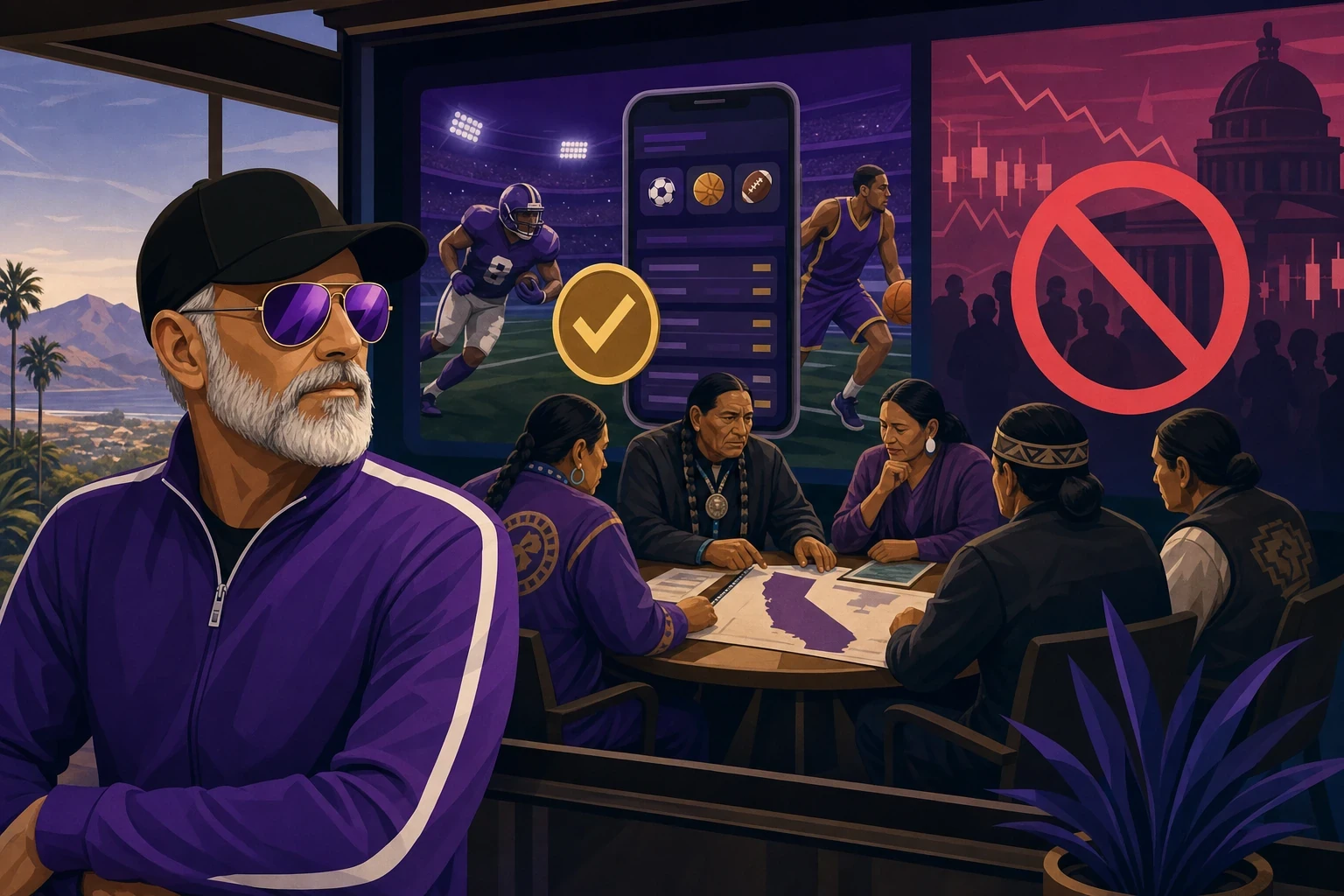
California tribes will launch a 2028 ballot initiative for online sports betting that includes a total ban on prediction markets, which they call the biggest threat to sovereignty. The move builds on 2022’s defeat of a commercial measure and decades of successful voter initiatives. Past court losses on cardroom enforcement show legal risks remain.
SCCG Take — Tribes hold the advantage with voters and can write tight language to close loopholes. Operators must decide whether to align early or risk exclusion from the largest U.S. market.
California tribes will pursue a ballot initiative in late 2027 or early 2028 to legalize online sports betting, with the explicit goal of imposing a complete prohibition on prediction markets. James Siva, chair of the California Nations Indian Gaming Association, has described the needed measure as a “kill shot” – a no-loophole ban that leaves no credibility for such platforms. The effort follows the tribes’ successful 2022 campaign that defeated a commercial online sports betting proposal.
Six years ago tribes circulated a retail sports betting measure that failed at the ballot box after they withdrew support to ensure defeat of a competing commercial initiative. That effort cost tribes about a quarter of a billion dollars. Prediction markets are now viewed as the biggest existential threat to tribal exclusivity, siphoning revenue from brick-and-mortar operations even though traditional online sports betting remains illegal in the state.
History of Voter Support and Strategic Sacrifice
Tribes have succeeded at the California ballot box before. In 1998 Proposition 5 passed 62%-37% to allow gaming compacts, though it was later struck down in court. Tribes returned with Proposition 1A in 2000, which amended the state constitution to permit Las Vegas-style gambling on reservations and passed with 64% of the vote. In 2022 the tribes detailed an in-person sports betting proposal but chose to kill it to defeat the commercial measure, which lost by 83%.
“Prop 27 had 83% no,” Siva said during a New Normal webinar July 29. “But in a lot of ways tribes take pride in that number. We’re the ones who opposed that corporate bill. We had to sacrifice our tribal bill to make sure the corporate bill went down. While people say we have a big hurdle to overcome, we actually put that number together. If tribes reach out to Californians and say we don’t believe in this, they believe us.” The analysis from InGame concludes that when tribes ask voters to trust them, Californians do.
Legal Setbacks Reveal Enforcement Risks
Recent efforts to protect tribal exclusivity have produced mixed results. The state legislature allowed tribes to sue cardrooms over house-banked games, but Sacramento Superior Court Judge Lauri A. Damrell dismissed the suit, ruling that federal law likely preempts state law. Tribes are appealing. Separately, revised regulations from Attorney General Rob Bonta aimed at curbing cardroom offerings were struck down by a San Francisco Superior Court judge. In contrast, a comprehensive prohibition on sweepstakes operators took effect January 1 after lawmakers passed the ban late last year.
These outcomes illustrate the risk that even explicit measures can face court challenges and regulatory ambiguity. Three tribes have sued Kalshi to block prediction markets on their lands, yet platforms including those from DraftKings, FanDuel, and Fanatics Betting & Gaming remain available. As @VictorRocha1 posted on X, “Repeat after me, Kalshi is a sports betting operator.”
The Path to 2028
Tribal leaders are negotiating for unity across gaming and non-gaming tribes, promising equitable access to revenues. The initiative is expected to include the prediction market ban directly rather than rely on the legislature. If tribes maintain cohesion and frame the measure around trust and sovereignty, the 2028 effort carries a strong likelihood of voter approval based on prior results. Operators and investors should track the precise language on exclusivity, as it will shape the competitive landscape that emerges.
Reporting: InGame
Generated by SCCG’s automated editorial system from published source reporting. SCCG Management holds editorial responsibility.
Tribes control California's gaming narrative at the ballot box — operators who ignore this reality risk permanent exclusion.
We've helped clients navigate tribal partnerships across every regulated market. California is the biggest prize left, and tribes own the voter lane — 64% in 2000, 83% against commercial in 2022. Prediction markets are the new wedge issue. Operators need tribal alignment now, not after signatures are filed in 2027.
- Tribes will pursue 2028 ballot initiative for online sports betting with explicit prediction market ban
- Tribes defeated commercial online measure 83%-17% in 2022 by sacrificing their own retail proposal
- Tribal gaming measures have passed California ballot box with 62%-64% support historically
SCCG angle: SCCG maintains direct relationships with tribal gaming leaders and commercial operators across 30+ U.S. jurisdictions. We broker the early conversations that determine who gets a seat when California finally opens — partnership terms, revenue models, compliance architecture. Waiting until 2027 means you're negotiating from the outside.
Gaming, betting and prediction markets — the desk’s read, every weekday.
Subscribe →