Michigan Judge Orders Kalshi Shutdown in CFTC-State Prediction Market Clash

A Michigan judge ordered Kalshi to shut down operations, citing conflicts with state gambling laws over CFTC-regulated event contracts. The ruling highlights persistent jurisdictional tensions and tests platforms’ ability to achieve consistent nationwide access. Prediction market operators must refine compliance strategies amid ongoing federal-state friction.
SCCG Take — This decision reinforces the need for precise federal guidance that respects state authority while enabling scalable innovation. Platforms should treat jurisdictional mapping as core strategy to secure sustainable growth across markets.
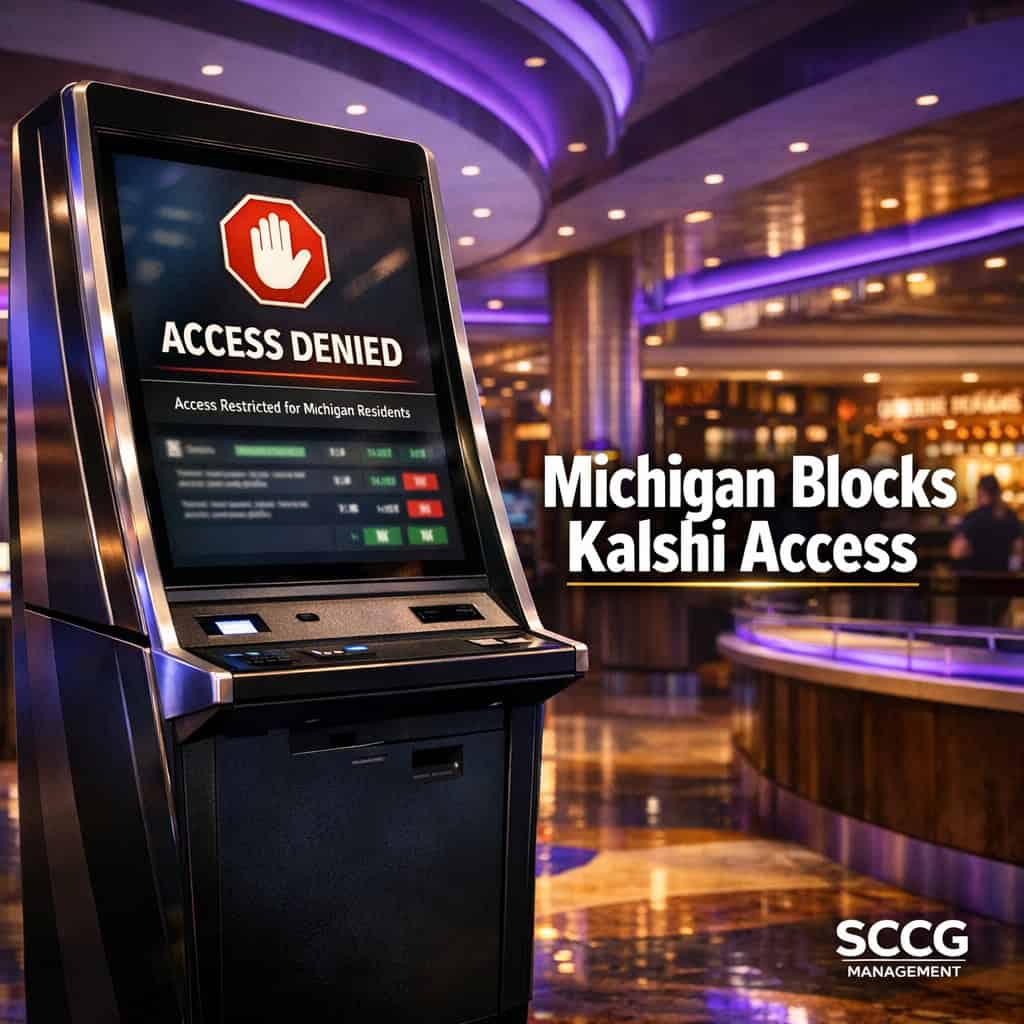
Michigan Judge Orders Kalshi Shutdown in Latest CFTC-State Prediction Market Clash
The Michigan judge put it directly: Kalshi must cease all operations in the state.
This order, according to reporting by TheLines.com, adds fresh friction to the regulatory contest between the CFTC and individual states over event contracts. The decision arrives as prediction markets seek scalable compliance models that satisfy both federal oversight and state gambling statutes, marking another test of whether nationwide access can coexist with localized authority.
The Michigan Order in Context
The court directive requires Kalshi to immediately stop offering its prediction market products to Michigan residents. At its core the ruling treats the platform’s event contracts as falling under state gambling prohibitions rather than qualifying for CFTC-sanctioned commodity status. Such classifications have become the central battleground as more states scrutinize whether these instruments constitute betting or something closer to regulated derivatives.
Operators and investors have watched similar disputes play out in other jurisdictions. The Michigan outcome reinforces a pattern where state attorneys general assert primary authority when local statutes classify prediction activity as wagering. This creates a patchwork that prediction market platforms must navigate one market at a time.
CFTC Authority Meets State Gambling Enforcement
The CFTC maintains that many event contracts qualify as commodities under its purview, especially those tied to measurable outcomes outside traditional sports betting definitions. States counter that their gaming laws reserve the right to restrict or prohibit such activity when it resembles sports wagering or lottery-style products. The Michigan ruling tilts toward the state position and illustrates the enforcement gap that persists until clearer federal boundaries are drawn.
This tension is not abstract. Platforms face the practical reality of licensing, geofencing, and user verification that can satisfy one regulator while triggering violations under another. The structural shift underway pits innovation speed against the deliberate pace of regulatory harmonization.
Kalshi’s Nationwide Compliance Challenge
For Kalshi the Michigan shutdown represents more than a single-state setback. It tests the company’s chosen federal-first strategy and its ability to secure consistent access across diverse regulatory environments. Achieving nationwide compliance will likely require tailored approaches that address state-specific concerns while preserving the core mechanics that distinguish prediction markets from conventional sportsbooks.
Client-partners in this space have voiced parallel concerns. Some seek hybrid models that incorporate state licensing where available while relying on CFTC registration for broader product offerings. Others anticipate that sustained legal pressure could force product redesigns or geographic restrictions that limit scale. Kalshi’s response, whether through appeals or adjusted market entry tactics, will signal how pure-play prediction platforms intend to resolve these conflicts.
Where the Risk Lies
Every regulatory ruling of this type carries secondary risks that extend beyond the immediate jurisdiction. A state-level enforcement win can embolden neighboring regulators and invite copycat actions, slowing industry momentum at a moment when prediction markets are demonstrating genuine liquidity and price-discovery value. There is also litigation risk: prolonged court battles consume capital that could otherwise fund product development or market expansion.
Counterarguments exist. Proponents of stronger state oversight contend that localized control protects consumers and prevents regulatory arbitrage. They note that federal preemption without clear guardrails could undermine long-standing gaming frameworks. Yet these positions must be weighed against the reality that fragmented enforcement creates uncertainty that ultimately raises compliance costs for all participants and delays the convergence of media, data, and event-driven markets.
The Path to Predictable Access
The Michigan order should prompt accelerated dialogue between the CFTC, state regulators, and industry participants. Clearer definitions around swap agreements, event contracts, and the boundaries of gaming law would reduce the litigation volume and give operators a measurable compliance roadmap. Until that clarity arrives, platforms will continue balancing aggressive federal positioning with prudent state-level risk management.
This episode underscores an inflection point. Prediction markets have moved from experimental fringe to viable vertical, yet their regulatory architecture remains a work in progress. The firms that treat these jurisdictional conflicts as inputs for disciplined structuring, rather than obstacles to be wished away, will be best positioned as the framework matures. SCCG continues to advise client-partners on precisely these strategic intersections of regulation, operations, and market entry.
Reporting: Judge Orders Kalshi Shut Down in Michigan – TheLines.com (news.google.com)
Kalshi's Michigan shutdown proves prediction markets can't outrun state gambling law without federal clarity.
We've watched this jurisdictional friction for 30 years across 150+ partners in every regulated market. Michigan's ruling signals states won't cede ground on event contracts just because CFTC says they're commodities. This isn't abstract—it's a blueprint for how other states will regulate, and operators need maps, not assumptions.
- Michigan court rejected CFTC authority over state gambling law, ordering Kalshi offline
- Federal-state clash over prediction markets mirrors decade-old sports betting legal tensions
- Platforms must map jurisdictional risk before scaling nationally, not after
SCCG angle: This is exactly why we built our partner network and regulatory playbooks across every regulated market. We can help you map which states are Kalshi-friendly versus hostile, connect you with counsel who've won these fights before, and stress-test your compliance strategy before a judge orders you offline.
Gaming, betting and prediction markets — the desk’s read, every weekday.
Subscribe →