Argentina vs. Austria: When Three Platforms Say the Same Thing, Listen
Argentina vs. Austria: When Three Platforms Say the Same Thing, Listen
There is a particular quality of information that emerges when prediction markets and sportsbooks stop arguing with each other. Argentina vs. Austria, kicking off today, has that quality.
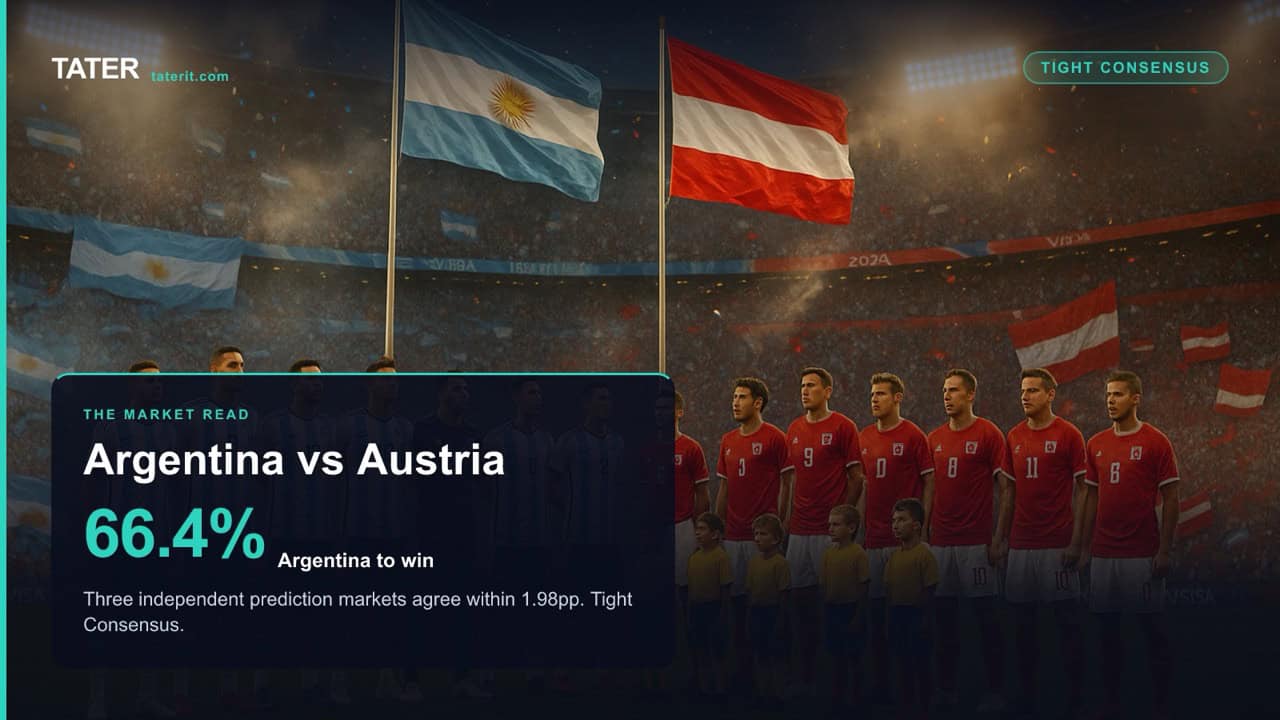
Tater, the cross-platform intelligence tool that reads Polymarket, Kalshi, and a nine-book sportsbook consensus simultaneously, tagged this match with a single phrase: Tight Consensus. That archetype is earned, not assigned. It means the platform spread, the gap between the most bullish and most bearish reads across every source, is just 1.98 percentage points. On a three-outcome soccer market, that is a remarkably compressed band.
The numbers behind it are worth sitting with. Polymarket, with $6.7 million in traded volume, puts Argentina at 67.2%. Kalshi comes in at 66.8%. The nine-book sportsbook consensus lands at 65.2%. Tater’s blended read: 66.4% for an Argentina win. Three different market structures, three different participant pools, three different incentive systems, and they are all pointing within two points of the same number. That convergence is the signal.
What does it mean structurally? Prediction markets price in sharp money early and update continuously on new information. Sportsbooks price around liquidity management and handle action from a broad public. When these two systems converge tightly, it usually indicates that the information is well-distributed and well-digested. There is no known edge sitting in a corner. The market has done its work.
The draw sits at 21.8% in the blended read. That is not a cheap outcome. It is priced as a genuine possibility, not an afterthought. In markets that have processed this much volume and this much attention, a 22% draw probability represents real uncertainty about how ninety minutes resolves, even if the directional lean toward Argentina is clear and consistent.
Austria’s upset probability is the number that carries the most weight for anyone thinking analytically about the match. Tater’s blended read puts it at 11.8%. The sportsbooks are slightly more generous at 12.9%; the prediction markets, at 11.2% to 11.4%, are a touch stingier. Neither group is dismissing Austria, but neither is offering any structural disagreement about the hierarchy. An upset here would require something outside the range of what the collective information set currently anticipates.
That is what tight consensus actually tells you. It does not tell you the favorite wins. It tells you the market has settled, that the odds of a mispriced outcome are lower than usual, and that if you are going to take a position against the grain, you need a thesis the market has not already absorbed.
Tater’s read on Argentina vs. Austria is not a recommendation. It is a temperature reading. And the temperature right now is 66 degrees Argentine.
Cross-platform consensus this tight across prediction markets and sportsbooks is a market tell you can't ignore.
We track where sharp money and retail liquidity converge because that's where the real edge lives. When Polymarket, Kalshi, and nine sportsbooks all land within two points on the same outcome, that's not noise—that's market conviction. I've seen thirty years of this game, and consensus this clean matters.
- Argentina priced at 66.4% across all platforms—spread of just 1.98 percentage points
- Prediction markets (Polymarket, Kalshi) and sportsbook consensus independently aligned within two points
- Tater's 'Tight Consensus' archetype signals rare structural agreement across different market incentives
SCCG angle: We built our network on connecting operators to the right intelligence at the right moment. When you see alignment like this across Polymarket, Kalshi, and the sportsbook consensus, that's when our partners know to trust the signal—and we help them move fast on what it means for their books.
Gaming, betting and prediction markets — the desk’s read, every weekday.
Subscribe →