Mexico iGaming Market Decline 2026: A Turning Point After Years of Strong Expansion
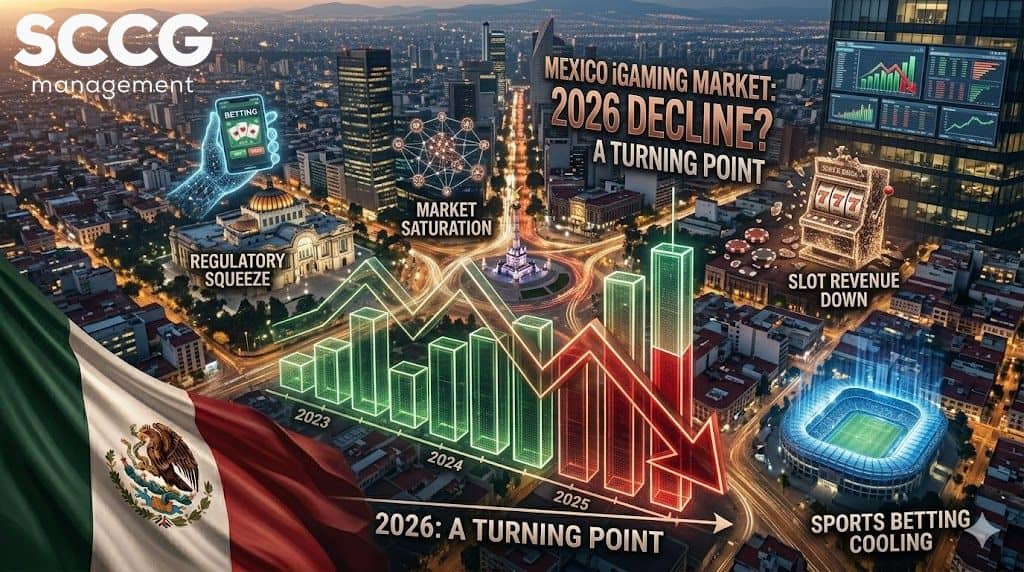
Mexico iGaming Market Decline 2026 is beginning to define a clear shift in the country’s online gambling landscape, as the Mexico iGaming Market Decline 2026 reflects the first sustained slowdown after several years of steady growth across digital betting and gaming platforms.
Mexico iGaming Market Decline 2026 marks the end of an accelerated growth phase
The Mexico iGaming Market Decline 2026 comes after a period in which the sector experienced rapid expansion driven by mobile adoption, improved digital payment access, and increasing user participation in online betting platforms. That growth phase created strong momentum for operators, many of whom scaled aggressively in anticipation of continued upward trends.
In 2026, however, that momentum has weakened. Market performance is no longer reflecting the same pace of user acquisition or engagement seen in previous years. Instead, the Mexico iGaming Market Decline 2026 shows a transition toward slower, more stable activity, suggesting that the early rapid-growth cycle may be giving way to maturity.
Regulatory adjustments are shaping the Mexico iGaming Market Decline 2026
A major influence behind the Mexico iGaming Market Decline 2026 is the evolving regulatory and fiscal environment. As government oversight becomes more structured and taxation frameworks tighten, operators are experiencing increased operational pressure. These changes have a direct impact on promotional strategies, particularly those relying on high incentives and aggressive marketing campaigns.
As costs rise and compliance requirements expand, many operators are adjusting their approach, focusing less on expansion and more on maintaining sustainable operations. This shift is contributing to the overall cooling observed in the Mexico iGaming Market Decline 2026, as growth strategies become more conservative across the board.
Market saturation is becoming more visible in the Mexico iGaming Market Decline 2026
The Mexico iGaming Market Decline 2026 is also being influenced by early signs of saturation in more developed digital regions. After years of strong onboarding, particularly in urban markets, the pool of new users is not expanding at the same pace as before.
This has created a more competitive environment where operators are increasingly focused on retaining existing users rather than acquiring large volumes of new ones. The result is a slower growth profile, even though overall participation in online gaming remains significant.
Economic pressure and industry repositioning in the Mexico iGaming Market Decline 2026
Broader economic conditions are contributing to the Mexico iGaming Market Decline 2026, as operators respond to rising costs and shifting consumer behavior. Instead of prioritizing rapid expansion, many companies are now refining their business models to focus on efficiency, retention, and regulatory alignment.
This change in strategy is consistent with patterns seen in other maturing digital entertainment markets, where initial high-growth phases naturally transition into more measured development cycles. In this context, the Mexico iGaming Market Decline 2026 reflects not only external pressure but also internal recalibration within the industry.
Outlook for the Mexico iGaming Market Decline 2026
Despite the current slowdown highlighted by the Mexico iGaming Market Decline 2026, the long-term outlook for the sector remains structurally positive. Demand for online gaming and digital betting services in Mexico continues to exist, supported by strong mobile penetration and sustained user interest in regulated entertainment platforms.
What is changing is the nature of growth itself. The market appears to be moving away from rapid expansion and toward a more mature phase where stability, compliance, and operational efficiency take precedence. The Mexico iGaming Market Decline 2026 may therefore be better understood as a normalization period rather than a structural downturn, marking a transition into a more balanced stage of development for the industry.
Mexico's rapid iGaming growth phase is over; operators now face regulatory pressure and market saturation reality.
We've watched Mexico evolve from frontier market to regulated space. This slowdown isn't failure—it's maturation. Operators who scaled on hype now compete on fundamentals. That's where our network and market intelligence separate winners from casualties.
- Regulatory tightening and higher tax compliance are directly constraining operator margins and marketing spend
- Market saturation signals the end of easy user acquisition; growth now requires operational discipline
- Operators shifting from aggressive expansion to sustainable, compliance-first strategies
SCCG angle: We've got 30 years and 150+ partners across regulated markets. We can connect you with operators already navigating Mexico's shift, show you who's thriving on discipline instead of hype, and help you benchmark your Mexico play against real performance data from the ground.
Gaming, betting and prediction markets — the desk’s read, every weekday.
Subscribe →