The Border Toll: What Crypto Casinos Keep, What They Lose, and What Crosses Back

Executive Summary
The argument
Stake.com, the Curacao-licensed platform founded in 2017, reported an estimated $4.7 billion in gross gaming revenue in 2024, according to Yield Sec data cited by the Financial Times, an 80 percent jump from 2022 and a scale that puts the crypto casino in the same conversation as Entain (roughly $5 billion in revenue) and within reach of Flutter Entertainment (roughly $14 billion). Stake’s own numbers: 25 million users and 300 billion collective bets placed since launch. Zoomed out, the same analyst lineage (Yield Sec, folded into Gaming Compliance International since November 2025) put global crypto-casino GGR at roughly $81.4 billion in 2024, a figure that, like the operator-level estimate beneath it, has never been audited, because none of these companies publish financial statements.
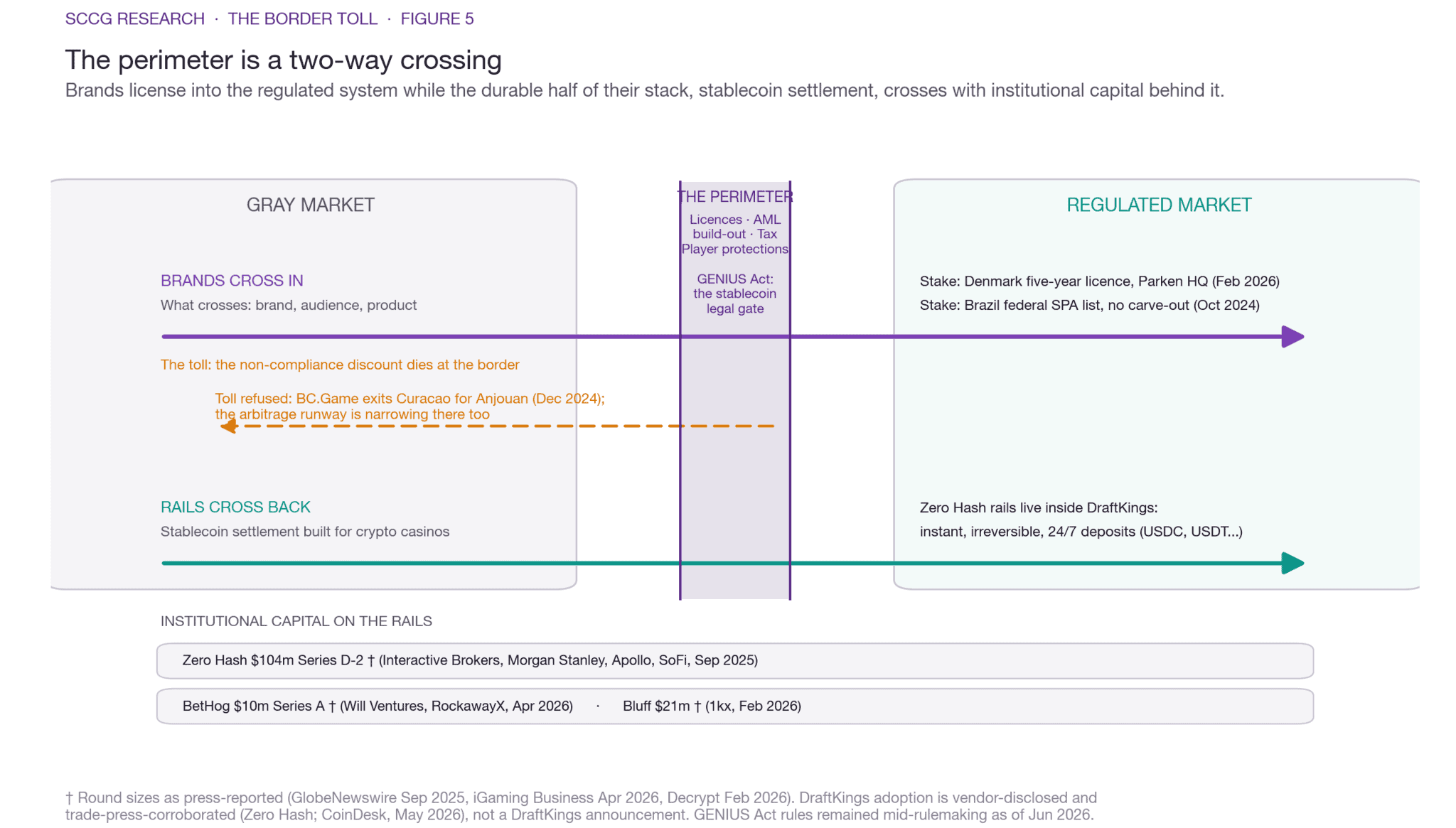
None of this is news to an industry that has spent five years asking how to keep this cohort out. What is underappreciated is what happens once these operators actually try to cross in. Stake spent 2025 and 2026 doing exactly that: licensing directly into Curacao’s rebuilt regulatory regime, acquiring its way into Denmark, and appearing without any special carve-out on Brazil’s federal approved-operator list. At the same time, a quieter migration ran in the opposite direction: stablecoin settlement rails built for crypto casinos are now live inside DraftKings, a US-listed, state-licensed operator, backed by the same institutional capital, Morgan Stanley, Interactive Brokers, that finances the rest of regulated finance. The crossing is not a one-way infiltration story; it is a sorting mechanism, and what it sorts is which part of the crypto casino stack is actually worth keeping.
The advantage this cohort has long been assumed to hold was never “crypto” as such. It decomposes into two very different things: a technology layer (instant settlement, no chargebacks, no bank-hours bottleneck) that is portable and legitimate and is now being adopted inside the regulated system, and a non-compliance layer (unbuilt AML infrastructure, unpaid tax, absent player protections) that is not portable and evaporates the moment an operator licenses. Every case study below measures how much of that second layer an operator gives up to survive the crossing, and how little of the first layer it turns out to need.
Key conclusions
- The crypto casino cost advantage is not one thing. It splits into a technology component (instant, irreversible settlement, 24/7 uptime) that is legitimate and portable, and a non-compliance component (unbuilt AML/KYT infrastructure, unpaid fees and tax, absent player-protection systems) that is a subsidy from the absence of regulation, not a durable edge. See Chapter 2.
- What survives a border crossing is brand and audience, not the cost structure. Stake’s licensed entry into Denmark (acquisition, five-year license, Copenhagen headquarters, Astralis sponsorship) and its carve-out-free inclusion on Brazil’s federal SPA operator list show a crypto-native brand operating, once licensed, under the same cost stack as any other operator. See Chapter 3.
- The crossing now runs both ways. Stablecoin settlement rails built to serve crypto casinos, via infrastructure provider Zero Hash, are now live inside DraftKings, a state-licensed US operator, backed by Morgan Stanley, Interactive Brokers, Apollo and SoFi capital, even as the GENIUS Act’s implementing rules remain mid-rulemaking. See Chapter 4.
- Jurisdictional arbitrage is narrowing, not disappearing. Curacao’s 2024-2026 reform pushed BC.Game out entirely, to Anjouan, while Stake, Cloudbet and Rollbit converted to stay, and Anjouan itself is now adding supply-chain compliance requirements. The US sweepstakes side door is closing by statute in a growing list of states. See Chapters 1 and 3.
Chapter 1: Sizing a Contested Cohort
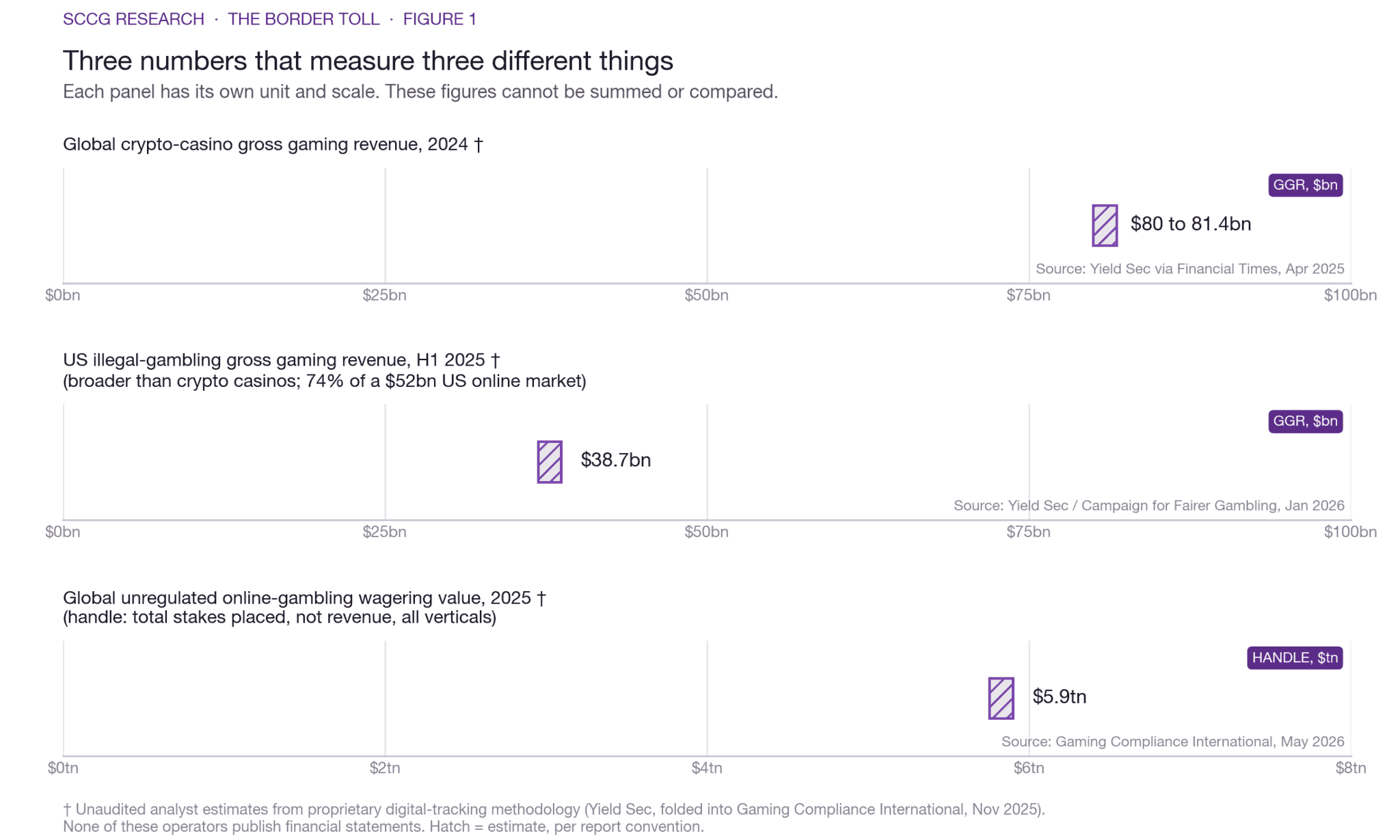
Ask for the crypto casino market’s size and you get three numbers that measure three different things. Only one of them, roughly $80 to 81 billion in 2024 gross gaming revenue, is actually crypto casinos, and even that has never been audited.
Any report on this industry has to resist the pull of a single headline number, because the data providers themselves warn against it. Three separate figures circulate under variations of “crypto casino market size,” and they measure three different things.
Three figures circulate, and they measure three different things
The narrowest and most-cited: $81.4 billion in global crypto-casino GGR for 2024, from Yield Sec data reported by the Financial Times in April 2025. Yield Sec’s methodology is “proprietary digital tracking of online activity across search engines, apps, social media, and advertising platforms,” explicitly contrasted with survey-based industry-group methods such as the American Gaming Association’s, a disclosed methodological choice, not an audited figure, read here as directionally indicative rather than precise.
A second, narrower figure covers the US only: Yield Sec research commissioned by the advocacy group Campaign for Fairer Gambling found illegal gambling operators (a broader category than crypto casinos specifically) captured 74 percent of the US online gambling market in H1 2025, $38.7 billion of a $52 billion total, per reporting published in January 2026.
A third figure is larger by orders of magnitude and measures something else entirely. Gaming Compliance International (GCI), which acquired Yield Sec outright in November 2025, published a global report in mid-May 2026 stating $5.9 trillion in worldwide wagering value, that is, handle, total stakes placed, not revenue, across all unregulated online gambling (sports betting, casino, poker, crypto and lottery combined) in 2025, with growth slowing from 12 percent year over year in 2024 to 4 percent in 2025. A separate summary of the same report cites “78 percent of online GGR” as sitting outside regulation, a market-share figure that cannot be reconciled with the $5.9 trillion handle number without a tier-by-tier breakdown the source has not made public.
The honest summary is one market number wrapped in three incompatible units
The honest summary: crypto-specific global GGR sits somewhere around $80 to 81 billion for 2024; the far larger $5.9 trillion figure describes all unregulated online gambling handle, a different and non-comparable measure; and the US-only illegal-gambling GGR figure, $38.7 billion for H1 2025 alone, is itself broader than “crypto casinos” as a category. All three trace back to the same Yield Sec/GCI analyst lineage, transparent about using proprietary tracking rather than audited disclosure.
The cohort behind the numbers is not a single population
The cohort behind these numbers is not a single population, either. Stake is the largest single operator by every estimate located in this research, reportedly generating $4.7 billion in 2024 GGR on 25 million users and 300 billion cumulative bets since 2017, an unaudited analyst estimate (Stake is private and discloses no financial statements) repeated as recently as a July 2026 report naming Stake as the operator most exposed to Curacao’s tightened regime. Rollbit, a similarly Curacao-licensed operator, is described in market reviews as operating at markedly smaller scale, more notable for its native RLB token and NFT integration than revenue size. Even basic corporate facts diverge across this cohort: Roobet’s headquarters is reported inconsistently, a Curacao registered address in one source, Belize City operations in another, and a related Limassol, Cyprus entity in a third, an unresolved conflict left as reported rather than settled.
A fourth measure, deposit volume rather than revenue or handle, comes from Tanzanite, an on-chain deposit-tracking service covering 23 crypto casinos across 10 blockchain networks and 16 currencies, reported monthly by Tribuna.com. Deposit volume measures money moving into an operator’s wallets, not gross gaming revenue and not total wagering handle, so it is not directly comparable to the $4.7 billion GGR estimate for Stake above, but it independently corroborates the same concentration story from a different data provider entirely. Through roughly May 2026, Tanzanite’s tracked market totaled $44.7 billion in deposits, up 84 percent year over year, with the top three operators, Stake, Roobet and Shuffle, accounting for 75.5 percent of that volume. Stake alone reported $22.1 billion in deposits and 32.5 million individual deposits over the same period, up 60 percent year over year; Roobet, second by volume at $9.38 billion, grew far faster in relative terms, up 181 percent year over year, evidence that Stake’s absolute lead is not shrinking but its share of the market’s growth is being contested. Monthly data sharpens the same picture: in June 2026 Stake took in $2.26 billion in deposits, up 31 percent month over month and more than $540 million higher than May, a single month’s volume exceeding the combined deposit volume of the next eight ranked operators, Roobet ($407 million), Rainbet ($279 million), Shuffle ($200 million), Gamdom ($170 million), Duel ($168 million), BC.Game ($133 million), Stake.us ($106 million) and Thrill ($97 million), a combined $1.56 billion, well short of Stake alone.
$2.26bn
Source: Tanzanite on-chain tracking via Tribuna.com and BusinessOfiGaming, 2026. Deposit volume, not revenue; on-chain-tracking estimate.
Stake’s crypto-casino deposit volume in June 2026 alone, more than the combined deposits of the next eight ranked operators.
Beneath the branded layer, a bot-native tier of uncertain size is forming
A further, less certain fracture is under way beneath the branded-casino layer: enforcement pressure appears to be pushing some gray-market activity toward Telegram-native, bot-distributed betting. The corroborated evidence is narrow but real: Telegram banned the 36,000-plus-subscriber “TG.Casino Portal” channel for terms-of-service violations in February 2025, and a year later, in February 2026, the Philippines’ Department of Information and Communications Technology publicly weighed banning Telegram outright over gambling operations “allegedly migrating to the platform,” a matter resolved when Telegram agreed to a 24/7 helpdesk and monthly takedown reporting. A follow-on report that bot-based casinos “remain plentiful” despite the ban could not be independently re-verified here and is offered as directionally consistent only. Widely circulated claims that Telegram gambling wagers grew from roughly $800 million to over $2 billion a month between Q1 2025 and Q1 2026, and that Philippine, Singaporean and French regulators have specifically targeted Telegram gambling payment rails, trace to a single uncorroborated outlet and are not repeated here as fact. What the corroborated evidence does support: the “crypto casino industry” is at minimum three distinct populations, large branded Curacao-style operators, US-facing sweepstakes wrappers (Chapter 3), and a bot-native layer of uncertain size, and no single GGR figure describes all three at once.
Chapter 2: The Compliance Discount
The cost advantage everyone calls “crypto” is really two things bundled together: a settlement technology that is legitimate and portable, and a non-compliance discount that disappears the moment an operator gets licensed.
If the crypto casino cost advantage were simply “crypto,” it would survive licensing intact. It does not, because the advantage is bundled from two unrelated sources, and only one of them is legitimate.
The settlement layer is a real, portable advantage, and it is already inside the regulated system
Instant, irreversible crypto settlement is a real, portable advantage, and it is already being adopted inside the regulated system rather than staying confined to offshore operators. CoinsPaid, an Estonia-based crypto payment processor built specifically for licensed gambling operators (processing roughly EUR 9.1 billion in 2024 across 800-plus merchants), publishes a deposit fee around 0.8 percent for mono-currency crypto deposits and a withdrawal fee around 0.3 percent, with 0 percent chargebacks (crypto transactions are irreversible by design) and no rolling reserve held back. DraftKings, a US state-licensed sportsbook and casino operator, is a disclosed client of a comparable stablecoin infrastructure provider, Zero Hash, whose rails remove the bank-hours settlement bottleneck that card and ACH processing impose (the full case, and its institutional-capital backing, is in Chapter 4). This is the technology slice of the discount: it does not require operating outside a license, and a licensed, publicly traded operator is already using it.
The honest comparison is separately published rate cards, not a single derived saving
No single audited study compares card-processing and crypto-settlement cost for the gambling vertical specifically, and none should be invented here. What exists are separately published rate cards for each side.
| Rail | Reported cost | Source |
|---|---|---|
| Credit card (iGaming, MCC 7995) | ~2% to 5% all-in (2.5-3.5% processing plus $0.10-0.30 fixed fee, plus monthly account fees) | Aeropay, April 2024 |
| Debit card | ~1.5% to 4% all-in | Aeropay, April 2024 |
| Digital wallet | ~2.5% to 5% all-in | Aeropay, April 2024 |
| ACH / bank transfer | ~0.5% to 3% all-in | Aeropay, April 2024 |
| Card-not-present interchange (average) | ~1.90%, with published tiers from 1.65% to ~2.95% plus $0.10-0.20 | AllayPay, March 2025 |
| Chargeback/dispute compliance (Visa VAMP threshold) | Tightened from 2.2% to 1.5% dispute ratio, effective April 1, 2026; $8 fine per disputed or fraudulent transaction above threshold | Merchant Risk Council, April 2026 |
| Crypto deposit (CoinsPaid, mono-currency) | ~0.8% (~0.4% using CoinsPaid’s own utility token) | iGamingPaymentSolutions, July 2026 |
| Crypto withdrawal (CoinsPaid, mono-currency) | ~0.3% | iGamingPaymentSolutions, July 2026 |
| Crypto chargebacks | 0% (irreversible by design) | iGamingPaymentSolutions, July 2026 |
| Raw network (gas) fee, illustrative | Ethereum ~$1-5 (spikes to $15); Layer-2 networks and Solana sub-cent; Tron ~$0.20-3; BNB Chain under $0.10 | Spark.money and other stablecoin fee trackers, 2026 |
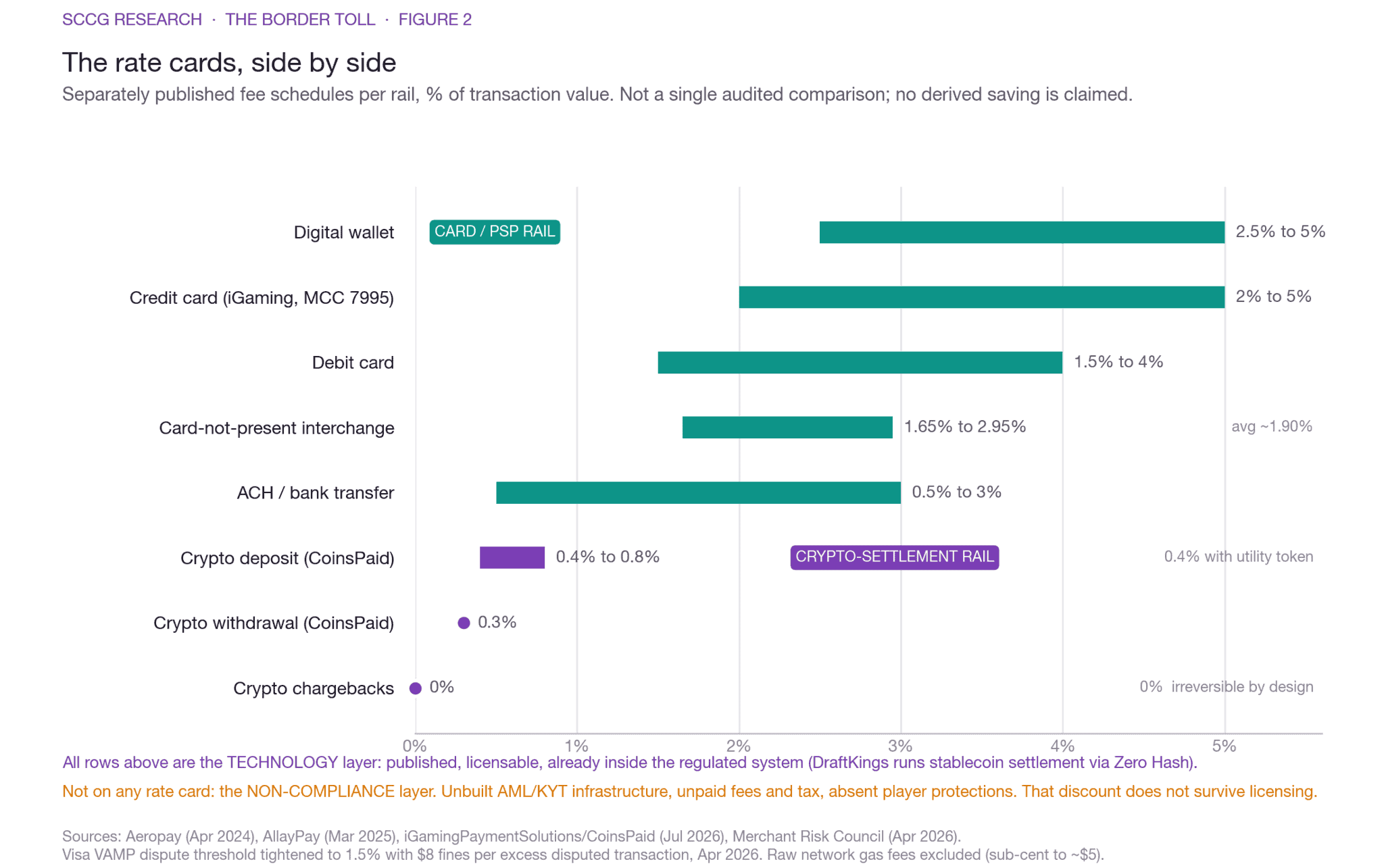
One industry vendor, BTSE Solutions, bundles figures like these into a claim (its own blog, July 2026) that stablecoin settlement runs “25 to 70 times lower cost” than card or PayPal rails, vendor content framed around general commerce rather than gambling, not an audited comparison, and noted here only as an example of a claim that should not be repeated as settled fact. The defensible statement is narrower: crypto settlement, at the processor level, carries published fee schedules meaningfully lower than published card-processing schedules and eliminates chargeback exposure entirely, a real, licensable advantage, not a crypto-casino exclusive.
The compliance layer is the part that does not survive licensing
This is the part of the discount that does not survive licensing, and Curacao’s own regulatory history makes the point cleanly. Under the old sub-license system, retired at the start of 2025, oversight is characterized by industry sources as having had “minimal AML requirements.” The replacement regime (the LOK, in force since December 24, 2024, detailed in Chapter 3) requires wallet disclosure, on-chain transaction monitoring via tooling such as Chainalysis or Elliptic, segregated treasury and player-flow wallets, a dedicated compliance officer, and FATF-aligned AML/CFT and KYC/KYT procedures. None of that is a technology cost; it is the cost of oversight an unlicensed operator was previously not paying. The Netherlands’ regulator, the Kansspelautoriteit (KSA), made the same point from the enforcement side: fining two offshore operators in March 2026 (Novatech, EUR 24.8 million, its largest-ever fine against an offshore operator; Fortaprime, EUR 1.8 million), it explicitly cited their acceptance of cryptocurrency as an aggravating factor, reasoning it “could facilitate money laundering and make it more difficult to track financial transactions.” A third operator, Chestoption, was fined EUR 3 million on the same basis. The pattern on both sides of the border, mandatory build-out for the licensed, fines that treat crypto acceptance as an aggravating risk signal for the unlicensed, points to one conclusion: the piece of the cost advantage that is not technology is a subsidy regulators are actively pricing back in.
EUR 24.8M
Source: Kansspelautoriteit via Yogonet, March 2026.
The Netherlands regulator’s largest-ever fine against an offshore operator (Novatech). It named the operator’s acceptance of cryptocurrency as an aggravating factor in the penalty.
Chapter 3: The Border Toll
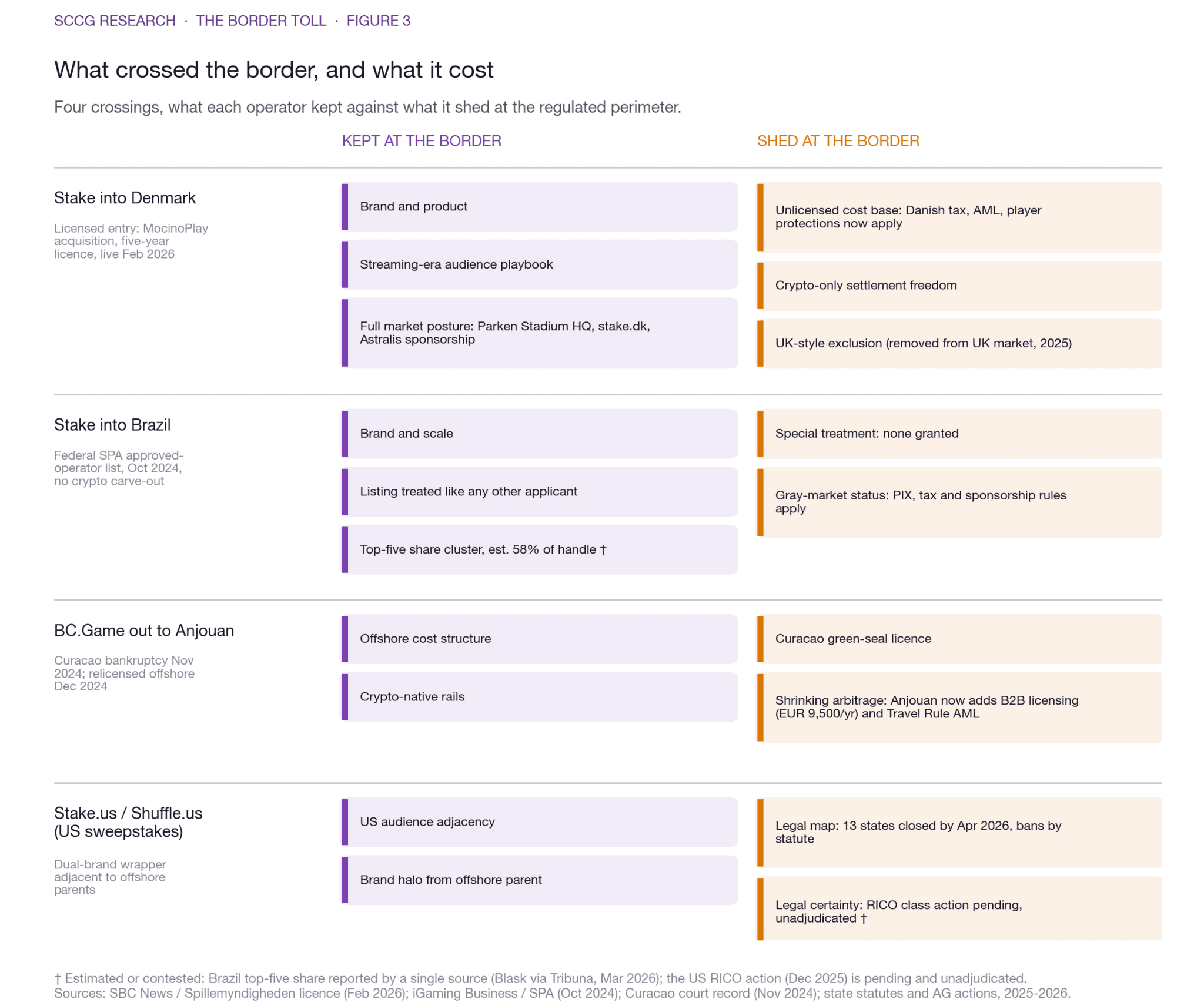
When Curacao raised the compliance bar, the cohort sorted itself: Stake paid the toll and crossed into Denmark and Brazil on the same cost stack as everyone else, BC.Game fled to Anjouan, and the US sweepstakes side door is being bolted shut state by state.
Curacao is the modal licensing jurisdiction for this cohort, and its own 2024-2026 overhaul is the clearest available natural experiment in what a tightened compliance bar actually costs a crypto-native operator, because different operators made different choices when the bar moved.
Curacao’s LOK reform is the clearest natural experiment in what the compliance bar costs
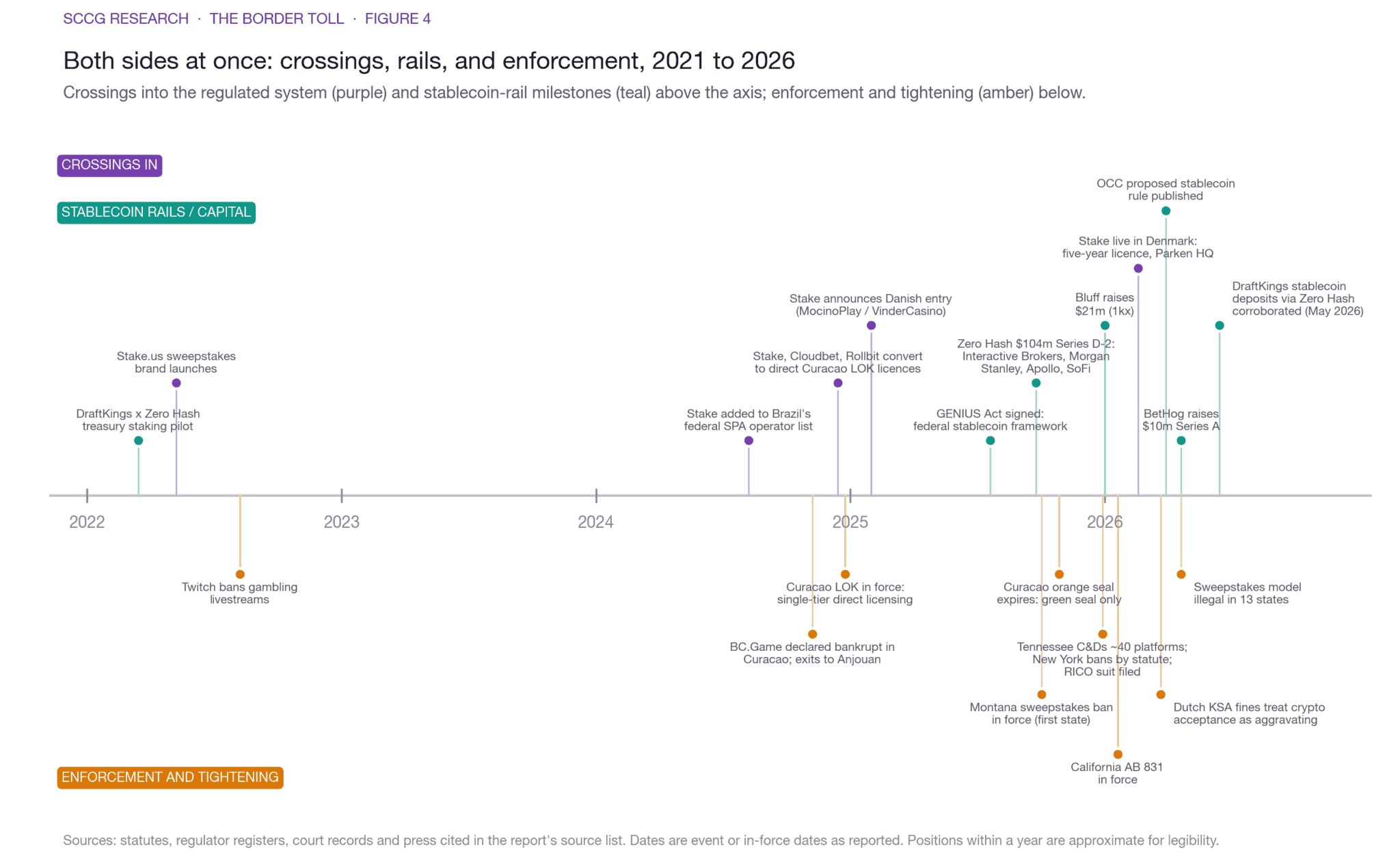
The LOK, in force since December 24, 2024, replaced the old four-master-licensee sub-license system with direct, single-tier licensing through the Curacao Gaming Authority (CGA). All old sub-licenses expired January 1, 2025; a transitional “orange seal” status expired permanently on October 15, 2025, leaving “green seal” as the only valid authorization. As of early 2026, the CGA’s public register listed more than 330 active green-seal licenses; of roughly 140 direct applications received by April 2026, only 87 had been approved, a rejection or pending rate of roughly 38 percent. Physical presence, a registered office, a Curacao-resident managing director, and a physical office (virtual offices do not qualify) became a licensing condition from January 1, 2026. The local-staffing headcount is a separate, later-phased track inside the same rule: the CGA put its planned hiring-quota requirements on hold after pushback from compliance providers, and enforcement of the specific quota, one full-time local “key person” to start, scaling to three by a licensee’s fifth year, is delayed to April 1, 2027. Read together, the two dates describe different obligations, not a contradiction: office and local management from 2026, staffing headcount enforced from 2027.
Three operators paid to stay under Curacao; others left for Anjouan
Three named operators converted to direct LOK licenses to stay under Curacao: Stake (Medium Rare N.V., license OGL/2024/1451/0918), Cloudbet (OGL/2024/328/0599) and Rollbit (OGL/2024/1260/0494). Others left. BC.Game is the clean case: the Curacao Court of First Instance declared its operating entity, BlockDance B.V., and an affiliate bankrupt on November 12, 2024, and by early December 2024 BC.Game had exited the Curacao regime entirely, relicensing in Anjouan under a new entity, Twocent Technology Limited (license ALSI-202410011-FI1). Yolo Group, operator of Sportsbet.io and Bitcasino.io, moved its licensing to Estonia rather than convert. As one payments-compliance source put it in July 2026 reporting, “crypto-forward operators looking to continue doing business with lax oversight will simply leave Curacao in search of a truly ‘anything goes’ jurisdiction,” naming Anjouan as the emerging destination, though Anjouan itself is not standing still: since July 2025 it has required B2B suppliers to its licensees to hold a local license or recognition certificate (EUR 9,500 annually) and has layered in FATF Travel Rule-aligned AML/CFT requirements, narrowing the arbitrage runway even in the newest destination.
Denmark is Stake’s cleanest completed crossing into a fully regulated market
Stake’s clearest completed crossing into a fully regulated European market is Denmark. It announced the acquisition of MocinoPlay, the Danish operator of the VinderCasino brand, in January 2025, subject to approval by regulator Spillemyndigheden; it secured a five-year license and went live in February 2026, roughly a year after being removed from the UK market, where as of February 2026 no major cryptocurrency gambling operator held a verified license. What followed in Denmark was not a nominal license sitting unused: Stake built a headquarters inside Copenhagen’s Parken Stadium, launched stake.dk, and became main jersey sponsor of Danish esports organization Astralis, a full above-ground market-entry posture rather than a paper license.
Brazil admitted Stake with no crypto-specific carve-out at all
Brazil supplies a second, larger-scale natural experiment, because the crossing there happened with no special carve-out at all. Under Law 14.790/2023 (the “Bets Law”), Brazil’s federal betting market opened January 1, 2025, regulated by the Secretaria de Premios e Apostas (SPA). Stake was added to the SPA’s approved-operator list in October 2024 alongside two other applicants, part of a transition-window cohort bringing the federally approved count to 96 operators (213 brands); the announcement treated Stake like any other applicant, with no mention of crypto-specific conditions. By mid-2026, Stake.com Brasil is reported, with lower confidence from a single source, as part of a top-five cluster (with Betano, Bet365 Brasil, Sportingbet and Estrela Bet) holding an estimated 58 percent of market handle. Brazil’s own operator counts reflect two different units rather than a contradiction: 87 licensed operator entities per the SPA’s SECAP portal as of June 30, 2026 (a figure that itself splits cleanly into 62 federal Type A, 18 state-partnership Type B and 7 provisional licenses), versus 187 individual authorized brands per a separate July 2026 count, several of which share a single underlying registration number. Brazil’s framework permits one licensed operator to run up to three distinct brands, roughly 70 licensed groups fielding “dozens of brands” per one 2026 count, which is enough on its own to bridge an operator count in the high 80s and a brand count near 190. No source located in this research documents Brazil formally excluding crypto-native brands as a category, notable given how closely the SPA otherwise scrutinizes tax, sponsorship and PIX-payment compliance.
The US sweepstakes side door is the crossing closing fastest
The third crossing point is the US sweepstakes dual-brand model, and it is the one where the border toll is rising fastest. Stake.com (the offshore crypto casino, blocking US IP addresses) and Stake.us (a separately branded US sweepstakes product, launched 2022, same corporate group and founders) is the template: Gold Coins for play with no cash value, Stake Cash as the promotional currency redeemable for prizes including crypto once playthrough requirements are met, a no-purchase-necessary entry route required under sweepstakes law, and crypto-only deposit and withdrawal on Stake.us itself. Shuffle.com and Shuffle.us, launched September 2025 under founder Noah Dummett, replicate the structure. A federal RICO class action filed in December 2025 against Drake, streamer Adin Ross and a third defendant alleges Stake.us was created specifically to bypass Stake.com’s US restrictions, and that Stake Cash is “effectively” real money; the case remains pending and unadjudicated.
What this survival path buys is shrinking fast. Tennessee sent cease-and-desist letters naming Stake among nearly 40 sweepstakes platforms in December 2025; all recipients disabled the cash-redeemable features or wound down. Montana became the first state to ban the model outright by statute (SB 555, effective October 1, 2025, felony penalties up to $50,000 and ten years); California followed (AB 831, effective January 1, 2026, extending liability to payment processors and media affiliates, the 17th state to take legal action, with an estimated $790.5 million in sector revenue projected to disappear); New York pursued cease-and-desist letters in June 2025, then banned the model outright by statute in December 2025 while leaving no-prize Gold Coin play legal. Illinois’s February 2026 campaign against 65 platforms drew only 3 percent compliance within two weeks, versus roughly a third for a similar Maryland campaign, a contrast with Tennessee’s full compliance showing enforcement discretion alone is unreliable; statutory bans close that gap. Louisiana’s Attorney General built the legal template other states now follow, an opinion treating the purchased currency as merely “a ‘cover'” for a bet, and has since extended racketeering exposure (up to 50 years, fines over $1 million) to sweepstakes-casino operation. By April 2026, sweepstakes casinos could not legally operate in 13 states: the wrapper is a moving target a growing number of states are closing, not a stable bypass.
13 states
Source: Composite of state statutes and AG actions (Montana SB 555, California AB 831, New York, Louisiana and others), through April 2026.
Where sweepstakes casinos could not legally operate by April 2026, up from zero eighteen months earlier, as bans move from cease-and-desist letters to statute.
One caveat spans all three crossings: the streaming audience may not be as durable as assumed
One caveat applies to all three crossings: the idea that these brands carry their streaming audience with them assumes that audience is durable, and the evidence is mixed. Kick’s Gambling category (the platform most associated with crypto-casino streamer acquisition, co-owned by Stake’s founders) saw monthly watch time fall 17 percent in February 2026, its biggest category decline that month, even as total platform hours held above 400 million for a ninth straight month; an earlier study of Twitch found its 2022 gambling-livestream ban cut weekly gambling-stream output 63.2 percent among banned streamers and 12.2 percent even among unbanned ones. The acquisition channel may itself be shrinking, not simply transplanting intact.
Chapter 4: The Reverse Crossing
The durable half of the crypto casino stack is already crossing the other way: stablecoin settlement rails built offshore now run inside DraftKings, financed by the same institutional capital that backs the rest of regulated finance.
The border does not only admit crypto-native brands into the regulated system. It is also carrying the durable part of their payments stack in the opposite direction, into operators that never needed an offshore address to begin with.
The GENIUS Act is the legal floor, close to final rules but not yet finished
The legal foundation for that movement is the GENIUS Act (the Guiding and Establishing National Innovation for U.S. Stablecoins Act), which passed the House 308-122 on July 17, 2025 and was signed into law the next day, creating the first federal regulatory framework for payment stablecoins in the United States. It sets the OCC as default federal regulator (with state supervision permitted below a $10 billion issuance threshold if certified “substantially similar” to the federal standard), requires 1:1 reserve backing by insured deposits, and restricts issuance to OCC-approved non-banks, uninsured national banks and federal branches of non-US banks. The Act contains no gambling-specific provisions; its relevance is indirect, it gives dollar-pegged tokens a defined federal legal and reserve status, which is what payments vendors serving gambling operators point to when marketing stablecoin rails as compliance-ready. Implementation remains mid-stream: the OCC published a proposed rule in the Federal Register on March 2, 2026, and Treasury’s and FinCEN/OFAC’s related comment periods closed in early June 2026, with final rules across all three tracks still unpublished as of a June 4, 2026 tracking report, against the Act’s own one-year implementation deadline of July 18, 2026. Whether agencies met that deadline is unresolved in available public reporting as of this writing; the correct framing is that the federal legal foundation exists and is close to final rules, not that a complete, tested compliance regime for gambling settlement is finished.
DraftKings is the clearest live example of the rail already inside a regulated operator
The clearest live example of this rail already inside a regulated operator is DraftKings. Zero Hash, a stablecoin infrastructure provider, discloses DraftKings as a client alongside Morgan Stanley, Interactive Brokers, Stripe, BlackRock’s BUIDL fund and Franklin Templeton. Its “Stablecoin Account Funding” product enables instant, 24/7 stablecoin deposits (USDC, USDT, PYUSD, RLUSD, across 15-plus blockchains) that settle on-chain immediately, are irreversible, and run automated KYC checks; the gambling-specific rationale, per Zero Hash’s own marketing, is that roughly 90 percent of DraftKings’ betting activity occurs in the twelve hours before an event and half during live play, so instant funding removes a bank-hours bottleneck card and ACH rails cannot. This detail is vendor-disclosed and trade-press-corroborated (via CoinDesk, May 2026), not a DraftKings-issued announcement, a distinction worth preserving. An earlier, smaller precedent exists: DraftKings and Zero Hash partnered in March 2022 on treasury crypto staking on Polygon, treasury activity, not deposit settlement.
~90%
Source: Zero Hash marketing, corroborated by CoinDesk, May 2026. Vendor-disclosed, not a DraftKings statement.
Share of DraftKings betting activity that lands in the twelve hours before an event, half of it during live play. That bank-hours bottleneck is what instant stablecoin funding removes.
Institutional capital is moving the same direction, into rails and product, not offshore brands
Institutional capital is following the same direction. Zero Hash raised a $104 million Series D-2 in September 2025, led by Interactive Brokers with Morgan Stanley, Apollo-managed funds and SoFi participating, reaching a $1 billion valuation; as of May 2026 it was pursuing a new round above $1.5 billion after Mastercard dropped acquisition talks and instead acquired competitor BVNK for $1.8 billion. Two more targeted, gambling-native examples show the same capital moving into product rather than offshore brands: BetHog, an AI live-dealer and crypto casino platform founded by former FanDuel executives, raised a $10 million Series A in April 2026 (co-led by Will Ventures and RockawayX, total funding to $16 million); Bluff, staffed by former Stake, Bet365 and William Hill executives, raised $21 million in February 2026, led by 1kx, on the strength of a pre-launch beta reporting more than 600,000 signups and 125 million bets processed in three months. None of this capital is flowing into unlicensed offshore brands; it is flowing into the infrastructure and product layer that survives being plugged into a licensed operator.
Chapter 5: Implications by Seat
Whatever seat you hold, operator, offshore brand, supplier, investor or regulator, the instruction is the same: build something other than the compliance discount, because it is a depreciating asset.
For licensed operators, the instant-funding answer no longer waits on Washington
For licensed operators, the competitive answer to instant-funding demand no longer requires waiting on Washington: DraftKings already runs stablecoin settlement through a regulated vendor relationship, ahead of the GENIUS Act’s rules being finalized. The technology slice of the compliance discount in Chapter 2 is available today to any operator willing to adopt it.
For crypto-native operators, the arbitrage runway is narrowing on both sides at once
For crypto-native operators still outside the perimeter, the arbitrage runway is narrowing on both sides at once. Curacao’s LOK regime has already pushed one major operator, BC.Game, out entirely and imposed a real compliance build-out on those that stayed; Anjouan, the most cited landing spot for leavers, is itself layering in B2B licensing and Travel Rule-aligned AML obligations. In the US, the sweepstakes side door that let brands like Stake.us and Shuffle.us operate adjacent to their offshore parents is closing by statute, state by state, faster than any operator can plausibly relicense around it.
For B2B suppliers, liability is moving up the chain
For B2B suppliers, liability is moving up the chain rather than stopping at the front-facing operator. Ontario’s gaming regulator fined suppliers Arrise Solutions and Relax Gaming CAD 40,000 each after their games turned up on unregulated sites, and warned media platforms over advertising for unlicensed operators; Anjouan’s new B2B recognition-certificate requirement (EUR 9,500 annually) is the licensing-side mirror of the same shift. A supplier’s own license is no longer sufficient insulation if its product surfaces on an unlicensed platform.
For investors, capital is already voting for the rails, not the brands
For investors, the capital pattern in Chapter 4 signals where durable value is judged to sit: into stablecoin settlement infrastructure and betting product (Zero Hash, BetHog, Bluff), not offshore brand equity. Institutional names (Morgan Stanley, Interactive Brokers, Apollo, SoFi) are underwriting the rails, not the unlicensed casinos those rails first proved themselves on.
For regulators, a statute behind the letter is what separates 3 percent compliance from full compliance
For regulators, enforcement posture produces visibly divergent outcomes from similar tools. Tennessee’s cease-and-desist campaign against nearly 40 sweepstakes platforms achieved full compliance; Illinois’s nearly identical campaign against 65 platforms achieved 3 percent, because a cease-and-desist letter is only as strong as the untested legal theory behind it. Statutory bans close that gap. The Netherlands’ regulator has gone further, treating crypto acceptance as an explicit aggravating factor in fine calculations (Novatech, Fortaprime, Chestoption), pricing the non-compliance layer from Chapter 2 directly into enforcement penalties rather than leaving it unstated.
3% vs 100%
Source: Gambling Insider (Illinois) and NewsChannel9 / iGaming Business (Tennessee), 2025-2026.
Illinois’s cease-and-desist campaign against 65 sweepstakes platforms drew 3 percent compliance. Tennessee’s near-identical campaign drew full compliance. The difference is the statute behind the letter.
Conclusion: What Crosses Next
A compliance discount that regulators are actively pricing back in, jurisdiction by jurisdiction, is not a structural advantage. It is a depreciating asset.
The next eighteen months will not be decided by whether crypto casinos continue to exist; enforcement has never come close to eliminating them, and jurisdictional arbitrage still has runway left even as it narrows. They will be decided by which half of the stack this report has separated turns out to be durable. The technology half, instant settlement, no chargebacks, always-on funding, is already migrating into the regulated system through vendors like Zero Hash and into operators like DraftKings, backed by the same institutional capital that finances the rest of regulated finance, and does not need an unlicensed operator to carry it. The non-compliance half, the unbuilt AML infrastructure, the unpaid tax, the absent player protections, is being priced back in wherever a regulator gets serious, from Curacao’s licensing bar to the Netherlands’ fine schedule to a growing list of US states closing the sweepstakes door by statute. A compliance discount that regulators are actively pricing back in, jurisdiction by jurisdiction, is not a structural advantage. It is a depreciating asset, and the operators, suppliers and investors who win this decade will be the ones who built something other than the discount itself.
Where SCCG Fits
Every seat in this story eventually needs a counterparty on the other side of the border. Crypto-native brands need licensed market entry and local partners; regulated operators need payments and product capability they did not build in-house; investors need to know which layer of the stack survives the toll before they underwrite it. SCCG Management works at exactly that crossing point, across four standard workstreams:
- Capital introductions. Connecting operators, suppliers and platforms to the institutional and strategic capital already underwriting this sector’s durable layer.
- International expansion. Licensed market entry and local partnership across Denmark-style regulated markets, Brazil’s SPA framework, and beyond.
- Affiliate and white-label partnerships. Building the distribution and product relationships that carry a brand across a border intact.
- Strategic advisory and M&A. Diligence on which half of a target’s stack survives the toll, before anyone underwrites it.
If this report describes a decision your organization is facing, that is the conversation to start.
Risks, Methodology and Sources
Methodology notes and what was deliberately excluded
Every GGR and handle figure here derives from proprietary digital-tracking methodology (Yield Sec, now folded into Gaming Compliance International), not audited financial statements or the survey-based methods groups such as the American Gaming Association typically use; treat these figures as directionally indicative, never as a single point estimate. The deposit-volume figures in Chapter 1 come from a separate provider, Tanzanite, with its own on-chain tracking methodology across 23 casinos, 10 chains and 16 currencies; Tribuna.com’s monthly write-ups were the only accessible version of this data (Tanzanite’s own terminal was not queried directly), and deposit volume should not be treated as a proxy for revenue, since it measures money moving in, not money kept.
Several data points were deliberately excluded or heavily caveated because they could not be independently corroborated: Telegram bot-casino wager-volume statistics, Roobet’s operational headquarters, several 2026 US state sweepstakes bans sourced only to aggregator trackers, and platform-level Twitch/Kick market-share figures, which conflicted too sharply to be usable.
The payments comparison in Chapter 2 is an illustration built from separately published rate cards, not a single audited cross-vertical study; no such study exists publicly for gambling, and a vendor claim of “25 to 70 times” cost savings is one payments company’s own marketing, not an independent finding.
Two jurisdictional figures that read as conflicting on first pass were re-checked directly against the original source pages plus additional corroborating sources before publication and turned out to describe different units, not contradictions: Curacao’s physical-presence rule (office and local management from January 2026; local-staffing headcount enforcement phased to April 2027, both inside the same rule) and Brazil’s operator count (87 licensed operator entities versus 187 individual brands, since Brazil permits multiple brands per license). Neither regulator’s own register could be directly re-fetched to confirm the reconciliation as a primary source (Curacao’s CGA site blocked automated access; Brazil’s SPA register is a PDF/CSV not machine-readable in this pass), so both rest on convergent, detail-matching secondary reporting rather than a regulator’s own text. Both are resolved with the reconciling detail in Chapter 3 above.
Sources
Market sizing, named operators, and Telegram distribution
- Financial Times, “Crypto casino takings top $80bn as gamblers bypass blocks” (secondary reprint), casinoforcrypto.com, https://casinoforcrypto.com/crypto-casino-takings-top-80bn-as-gamblers-bypass-blocks/, April 21, 2025
- Forbes (Boaz Sobrado), “Drake Lawsuit Exposes $38 Billion Illegal Crypto Casino Market,” https://www.forbes.com/sites/boazsobrado/2026/01/08/drake-lawsuit-exposes-38-billion-illegal-crypto-casino-market/, January 8, 2026
- iGaming Business, “Gaming Compliance International acquires Yield Sec to strengthen black market mitigation efforts,” https://igamingbusiness.com/strategy/ma/gaming-compliance-international-acquires-yield-sec-to-strengthen-black-market-mitigation-efforts/, November 2025
- Forbes (Boaz Sobrado), “Third-Largest Economy? $5.9 Trillion Gambling Beyond Regulation,” https://www.forbes.com/sites/boazsobrado/2026/05/14/third-largest-economy-59-trillion-gambling-beyond-regulation/, May 14, 2026
- Tribuna.com, “Global gambling black market reaches $5.9tn, GCI says 78% of online GGR now sits outside regulation,” https://tribuna.com/en/casino/news/2026-05-18-global-gambling-black-market-reaches-59tn-gci-says-78-of-online-ggr-now-sits-outside-regu/, May 18, 2026
- Track360, “Stake.com Review 2026: Business Model & Operator Analysis,” https://track360.io/blog/stake-com-operator-review-2026-crypto-casino-analysis, 2026
- Tribuna iGaming (LinkedIn post, screenshot), “Stake generated more deposit volume than nine crypto casinos combined in June, while Duel.com posted the fastest deposit growth,” https://tribuna.com/en/casino/blogs/stake-generated-more-deposit-volume-than-nine-crypto-casinos/, July 2026
- BusinessOfiGaming.com, “Largest Crypto Casinos by Deposit Volume 2026 – Full Market Analysis” (citing Tanzanite Terminal, yearly figures through May 2026), https://www.businessofigaming.com/crypto-casinos-deposit-volume/, 2026
- EEGaming, “Curacao’s crypto haven status challenged by new regulations,” https://eegaming.org/news/2026/07/04/142046/curacaos-crypto-haven-status-challenged-by-new-regulations/, July 4, 2026
- Gamblingsitefinder.com, “Rollbit Review (2026),” https://www.gamblingsitefinder.com/reviews/rollbit/, 2026
- Silentbet.com, “Roobet Owner, CEO, HQ & Full Company Details,” https://silentbet.com/roobet/owner/, 2026
- GamblingNews, “Telegram Bans TG.Casino Amid Gambling Concerns,” https://www.gamblingnews.com/news/telegram-bans-tg-casino-amid-gambling-concerns/, February 20, 2025
- iGaming Business, “Telegram avoids Philippines ban, agrees to crack down on criminal content,” https://igamingbusiness.com/legal-compliance/regulation/telegram-avoids-philippines-ban-agrees-to-crack-down-on-criminal-content/, late February 2026
- Tribuna.com, “Philippines considers Telegram ban over illegal gambling and child abuse concerns,” https://tribuna.com/en/casino/news/2026-02-25-philippines-considers-telegram-ban-over-illegal-gambling-and-child-abuse-concerns/, February 25, 2026
- Bonus.com, “Telegram Rife with Bot-Based Casinos Despite Reported Ban,” https://www.bonus.com/news/telegrams-illegal-bot-based-casinos-remain-plentiful-despite-reported-crackdown/ (not independently re-fetchable in this research; cited only as an unverified, directionally consistent secondary report)
Payments, stablecoins, and institutional capital
- Aeropay, “What’s the Total Merchant Cost for Popular iGaming Payment Methods,” https://www.aeropay.com/blog/whats-the-total-merchant-cost-for-popular-igaming-payment-methods, April 1, 2024
- AllayPay, “Current Interchange Rates in the USA (Updated 2026),” https://allaypay.com/blog/processing/current-interchange-rates-in-the-usa-updated-2026/, March 7, 2025
- Merchant Risk Council, “Stricter VAMP Ratio Thresholds Are Now in Effect,” https://merchantriskcouncil.org/learning/resource-center/member-news/blog/2026/stricter-vamp-ratio-thresholds-are-now-in-effect-heres-how-to-stay-compliant, April 1, 2026
- iGamingPaymentSolutions, “CoinsPaid Review 2026: Fees, Features & iGaming Rating,” https://igamingpaymentsolutions.com/providers/coinspaid, updated July 5, 2026
- Spark.money, “Stablecoin Fee Calculator,” https://www.spark.money/tools/stablecoin-fee-calculator, 2026
- BTSE Solutions, “Crypto vs. Traditional Payments in 2026: Fees, Speed & Settlement, A Data-Driven Comparison,” https://btsesolutions.com/articles/crypto-vs-traditional-payments-2026, July 14, 2026
- Mayer Brown, “GENIUS Act Signed into Law: US Enacts Federal Stablecoin Legislation,” https://www.mayerbrown.com/en/insights/publications/2025/07/genius-act-signed-into-law-us-enacts-federal-stablecoin-legislation, July 2025
- The White House, “Fact Sheet: President Donald J. Trump Signs GENIUS Act into Law,” https://www.whitehouse.gov/fact-sheets/2025/07/fact-sheet-president-donald-j-trump-signs-genius-act-into-law/, July 2025
- Federal Register, “Implementing the Guiding and Establishing National Innovation for U.S. Stablecoins Act…,” https://www.federalregister.gov/documents/2026/03/02/2026-04089/implementing-the-guiding-and-establishing-national-innovation-for-us-stablecoins-act-for-the, March 2, 2026
- Crypto Impact Hub, “The GENIUS Act Rulemaking Sprint: Inside the Race to July 18,” https://cryptoimpacthub.com/genius-act-stablecoin-rulemaking-sprint/, June 4, 2026
- CoinDesk, “Zerohash pursues new funding at more than $1.5 billion valuation after Mastercard drops investment plans,” https://www.coindesk.com/business/2026/05/19/zerohash-pursues-new-funding-at-more-than-usd1-5-billion-valuation-after-mastercard-drops-investment-plans, May 19, 2026
- Zero Hash, “Stablecoin Account Funding Infrastructure,” https://zerohash.com/products/stablecoin-account-funding, accessed July 2026
- Zero Hash, LinkedIn post on DraftKings stablecoin funding, https://www.linkedin.com/posts/zerohash_stablecoins-are-a-natural-fit-for-draftkings-activity-7392588701635121154-DkTU (exact posting date not independently confirmed)
- DraftKings / Zero Hash, press release via Yahoo Finance, https://finance.yahoo.com/news/draftkings-joins-forces-zero-hash-140000452.html, March 7, 2022
- GlobeNewswire, “Interactive Brokers leads zerohash capital raise as Morgan Stanley, Apollo and SoFi also make significant Onchain Infrastructure Investment,” https://www.globenewswire.com/news-release/2025/09/23/3154607/0/en/Interactive-Brokers-leads-zerohash-capital-raise-as-Morgan-Stanley-Apollo-and-SoFi-also-make-significant-Onchain-Infrastructure-Investment-zerohash-Reaches-Unicorn-Status-and-is-no.html, September 23, 2025
- iGaming Business, “BetHog raises $10m in Series A funding to roll out AI live dealers,” https://igamingbusiness.com/tech-innovation/bethog-raises-10m-ai-dealers/, April 23, 2026
- EU-Startups, “Crypto casino BetHog closes 8.5 million euro Series A to scale AI live dealer platform from the UK,” https://www.eu-startups.com/2026/04/crypto-casino-bethog-closes-e8-5-million-series-a-to-scale-ai-live-dealer-platform-from-the-uk/, April 2026
- Decrypt, “BLUFF Raises $21 Million to Power Betting Innovation,” https://decrypt.co/356760/bluff-raises-21-million-to-power-betting-innovation, February 3, 2026
- Streams Charts, “Kick viewership holds steady in February 2026 as Gambling category declines by 17%,” https://streamscharts.com/news/kick-february-2026, March 4, 2026
- Qifan Han, Jasmine Yang, and Andrey Simonov, “The Impact of Banning Online Gambling Livestreams: Evidence from Twitch.tv,” SSRN, https://papers.ssrn.com/sol3/papers.cfm?abstract_id=5298054, posted February 27, 2025
Curacao, Anjouan, and licensing regimes
- Coincub, “Curacao Gaming License 2026: Navigating the New LOK Regime,” https://coincub.com/blog/curacao-gaming-license/, 2026
- LicenseGentlemen, “Curacao Gaming License 2026: Key Changes After CGA Reform,” https://licensegentlemen.com/blog/updated-gcb-curacao-license/, 2026
- Zitadelle AG, “Curacao iGaming License 2026, LOK Reform, Who Got Licensed, Who Left, and What Changed,” https://www.zitadelleag.com/news/offshore-igaming-curacao-license-guide, 2026
- Whitepaper.bc.game, BC.Game licensing appendix, https://whitepaper.bc.game/bc-white-paper/appendix/bc.game-license, 2026
- Ghanasoccernet.com, “BC Game Owner,” https://ghanasoccernet.com/in/wiki/bc-game-owner/, 2026
- SOFTSWISS, “Anjouan Gaming Licence in 2026, A Comprehensive Guide,” https://www.softswiss.com/knowledge-base/anjouan-igaming-licence-guide/, 2026
- Global Law Experts, “The Anjouan Gaming Licence: What We’ve Learned From Structuring Dozens Of Offshore Gambling Operations,” https://globallawexperts.com/the-anjouan-gaming-licence-what-weve-learned-from-structuring-dozens-of-offshore-gambling-operations/, 2026
Denmark, Brazil, and market entry
- SBC News, “Stake to acquire VinderCasino and enter Denmark,” https://sbcnews.co.uk/europe/2025/01/13/stake-vinder-casino/, January 13, 2025
- SBC News, “Stake secures five-year licence in Denmark,” https://sbcnews.co.uk/sportsbook/2026/02/18/stake-denmark-licence/, February 18, 2026
- Tribuna.com, “After a tough start in Brazil, Stake goes all in on Denmark,” https://tribuna.com/amp/en/casino/news/2026-03-24-after-a-tough-start-in-brazil-stake-goes-all-in-on-denmark-denis-bolshakov-of-blask-exami/, March 24, 2026
- iGamingToday, “Gambling Commission warns UK must act on crypto betting,” https://www.igamingtoday.com/uk-gambling-commission-crypto-gambling-warning-2025/, 2025
- Henk Wolff, “SPA Licence Guide for Brazil 2026,” https://henkwolff.com/insights/spa-brazil-licence-guide/, 2026
- iGaming Business, “Stake and two others added to Brazil SPA’s list of approved operators,” https://igamingbusiness.com/legal-compliance/stake-brazil-approved-operators/, October 9, 2024
- Stake-info.com, “Stake in Brazil 2026: Regulation, PIX Payments, Tax, and Compliance Guide,” https://stake-info.com/stake-brazil/, 2026
- Track360, “Brazil Bets ANGB Q3 2026: 87 Licensed Operators Status,” https://track360.io/blog/brazil-bets-angb-operator-status-q3-2026-update, 2026
- OneFootball, “187 Bets Autorizadas no Brasil,” https://onefootball.com/pt-br/apostas/bets-autorizadas, 2026
- Aposta Casa Brazil, “Operadoras Licenciadas Pela SPA/MF: Lista Atualizada 2026,” https://apostacasa.com/operadoras-licenciadas-spa-mf/, 2026 (source for the operators-vs-brands reconciliation: roughly 70 licensed groups, up to 3 brands per license)
- Secretaria de Premios e Apostas / Ministerio da Fazenda, official authorized-operator register, https://www.gov.br/fazenda/pt-br/composicao/orgaos/secretaria-de-premios-e-apostas/lista-de-empresas, updated 13 May 2026 (primary source; PDF/CSV format, not text-extractable in this research pass)
US sweepstakes enforcement and legislation
- Washington City Paper, “Shuffle.com Joins the Sweepstakes Casino Boom, What D.C. Residents Should Know Before Playing,” https://washingtoncitypaper.com/article/776640/shuffle-com-joins-the-sweepstakes-casino-boom/, 2025-2026
- NewsChannel9, “Tennessee AG sends cease-and-desists to nearly 40 online sweepstakes casinos,” https://newschannel9.com/news/local/tennessee-ag-sends-cease-and-desists-to-nearly-40-online-sweepstakes-casinos-attorney-general-jonathan-skrmetti, December 29-30, 2025
- iGaming Business, “Tennessee shuts down 40 sweepstakes casinos at end of 2025,” https://igamingbusiness.com/legal-compliance/tennessee-skrmetti-sweepstakes-casino-cease-desist-letters/, 2025-2026
- SBC Americas, “Montana Takes Unprecedented Step To Ban Online Sweepstakes,” https://sbcamericas.com/2025/05/23/montana-officially-bans-sweepstakes/, May 23, 2025
- Yogonet, “Montana becomes first US state to ban sweepstakes gambling,” https://www.yogonet.com/international/news/2025/05/26/106048-montana-becomes-first-us-state-to-ban-sweepstakes-gambling, May 26, 2025
- Yogonet, “California: Governor Newsom signs AB 831, closing loophole on online sweepstakes casinos,” https://www.yogonet.com/international/news/2025/10/13/115761-california-governor-newsom-signs-ab-831-closing-loophole-on-online-sweepstakes-casinos/, October 13, 2025
- iGaming Business, “Newsom signs California bill banning sweepstakes casinos,” https://igamingbusiness.com/gaming/gaming-regulation/newsom-california-sweepstakes-casinos-ban/, October 2025
- New York Attorney General, “Attorney General James Stops Illegal Online Sweepstakes Casinos,” https://ag.ny.gov/press-release/2025/attorney-general-james-stops-illegal-online-sweepstakes-casinos, June 6, 2025
- Casino.org, “Online Sweepstakes Ban Passes in a New York Minute,” https://www.casino.org/news/online-sweepstakes-ban-passes-in-new-york/, June 2025
- SBC Americas, “Illinois Launches Sweepstakes Gaming Assault, Hits 60+ Sites,” https://sbcamericas.com/2026/02/06/illinois-sweepstakes-c-and-ds/, February 6, 2026
- Gambling Insider, “Illinois Sweepstakes Crackdown Sees Just 3% Compliance in First Two Weeks After 65 C&D Letters,” https://www.gamblinginsider.com/news/112448/illinois-sweepstakes-3-percent-compliance-cd-letters-sb1705, 2026
- Forbes (Daniel Wallach), “Louisiana Opinion On Sweepstakes Casinos Provides Legal Playbook For State AGs,” https://www.forbes.com/sites/danielwallach/2025/08/06/louisiana-opinion-on-sweepstakes-casinos-provides-roadmap-for-other-state-ags/, August 6, 2025
- Lines.com, “Louisiana Signs Sweepstakes Casino Racketeering Law,” https://www.lines.com/louisiana-signs-sweepstakes-casino-racketeering-law, 2026
- Covers.com, “Louisiana Lawmakers Send Gambling Crackdown Bill to Governor,” https://www.covers.com/industry/louisiana-sends-gambling-racketeering-bill-to-governor-may-5-2026, May 5, 2026
- Company.gi, “Sweepstakes Casino Regulation in 2026,” https://company.gi/blog/sweepstakes-casino-regulation-us, 2026
European and other regulatory enforcement
- Yogonet, “Dutch regulator imposes record fines on two offshore gambling operators,” https://www.yogonet.com/international/news/2026/03/11/118012-dutch-regulator-imposes-record-fines-on-two-offshore-gambling-operators, March 11, 2026
- InterGame Online, “KSA hands out EUR3m fine to unlicensed gaming operator,” https://www.intergameonline.com/igaming/news/ksa-fine-unlicensed-gaming-operator-netherlands, 2026
- SportsHandle, “Deadline Set For Unregulated Operators And Suppliers In Ontario,” https://sportshandle.com/ontario-deadline-unregulated-operators-agco/, 2025
- Gambling Insider, “Ontario’s AGCO Fines Arrise, Relax Gaming Over Unregulated Casino Websites,” https://www.gamblinginsider.com/news/159294/ontario-agco-fines-arrise-relax-gaming-unregulated-casino-websites, 2025
Crypto casinos scaled past novelty into legitimate competitive force; regulated operators must decide how to respond or risk ceding ground.
We've watched offshore grow from footnote to frontline competitor. Stake's $4.7 billion puts it in Entain's weight class — that's not a sideshow anymore. For our partners building in regulated markets, this is the new baseline: crypto speed, global reach, and a customer set that crosses back over the border every day. Ignoring it is no longer an option.
- Stake.com hit est. $4.7B GGR in 2024, up 80% from 2022, rivaling Entain's scale
- Global crypto-casino GGR estimated at $81.4B in 2024 by Yield Sec analysts
- Offshore platforms now compete directly for regulated market customers and talent
SCCG angle: SCCG helps regulated operators respond strategically — we connect you to payments, platform, and compliance partners who can match crypto speed without the regulatory exposure. Our network includes the tech stack and market intelligence to compete on experience, not just licensing. We've done it in 545 partnerships across every regulated jurisdiction.
Gaming, betting and prediction markets — the desk’s read, every weekday.
Subscribe →