Go As Fast As You Can, But No Faster
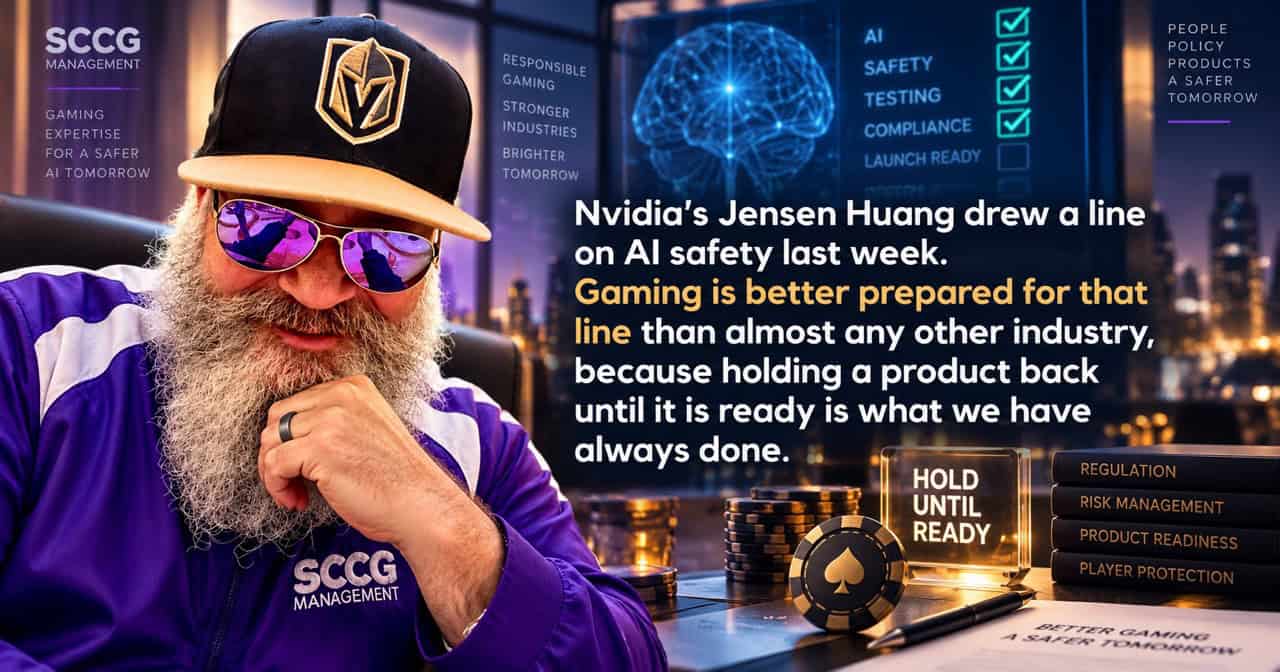
Nvidia’s Jensen Huang drew a line on AI safety last week. Gaming is better prepared for that line than almost any other industry, because holding a product back until it is ready is what we have always done.
Jensen Huang said something last week that I have argued inside this industry for years, and he said it better than I have.
Speaking after a run of incidents that rattled the technology sector, the Nvidia chief executive told Fox Business: “If it’s not ready, just hold it back. You should go as fast as you can, but no faster than that.”
In the same conversation, the man who sells the chips that make all of this possible said he expects to sell twice as many next year as this year.
Caution and full steam ahead, in one breath. That is not a contradiction. It is an operating plan, and it is the right one for gaming.
I wrote last week about why I line up with the people building these systems when they say the pace matters. Huang puts the same view in an operator’s language. As someone who has spent more than three decades in this business, I want to make three points.
One. We already know how to hold something back
Holding a product back until it is ready is not a new discipline for us. It is the architecture of our industry.
A slot machine reaches a casino floor not because somebody clever built it, but when an independent testing laboratory says it does what it claims and a regulator agrees. Every operator I know has told a supplier no. Every supplier I know has missed a launch window rather than ship something that would not certify.
Huang is asking technology companies to build a muscle gaming has been exercising for decades. The rest of the economy is only now working out how to test before it deploys. We already have the referees and the laboratories.
That is an advantage. It is not a brake.
Two. The real work is in the places nobody is writing about
Most of the noise about artificial intelligence in gaming is about the product: smarter games, personalised experiences, a machine that knows what you want to play next.
The money today is somewhere less interesting. Onboarding a customer and checking they are who they say they are. Payments, and spotting fraud before it settles. The first line of customer support, where most contacts are the same six questions. Pricing and risk on the trading floor. And player protection, where a licensed operator sees patterns nobody outside a regulated market can see at all.
None of it makes a headline. All of it takes cost out this year, while tax and competition squeeze margins.
My advice to client-partners is simple. Start where the work is repetitive, the rules are clear and a mistake is cheap to catch. Earn the right to move to where a mistake reaches a customer.
Three. The boundary is judgment, and it does not move
I am committed to these tools. There is no arguing they are useful, and anyone in a leadership seat who pretends otherwise will be overtaken by someone who did not.
The question is not whether to use them. It is what the best use of them is, and that question has an answer at the edges.
They do not replace your own articulation. They do not replace your instincts or your judgment. They cannot. In our business the product is a relationship, a read on a room and a decision somebody has to own. Automate the assembly. Never automate the position.
So there has to be a boundary, and every operator, supplier and adviser should be able to say where theirs is in one sentence, out loud. Most cannot yet. That is the work of the next twelve months.
Where that leaves us
The same three I started with. We know how to hold something back, so stop treating caution as the opposite of ambition. The value this year sits in the unglamorous middle of the business, not the product demonstration. And the line between what a machine does and what a person owns has to be drawn deliberately, by each of us.
Go as fast as you can. No faster than that. In a licensed industry that is not a compromise between innovation and accountability. It is what innovation meeting accountability has always looked like.
If you are working out where artificial intelligence belongs in your own operation, and where it does not, that is a conversation we have with client-partners every week. Let’s set up a call.
By Stephen A. Crystal, Founder & CEO, SCCG Management. The Gambling Industry’s Global Connector.
Stephen A. Crystal on AI in gaming: the series
- Three Rivals Agreed on One Thing This Week. Gaming Has Heard It Before. (12 September 2026)
- Go As Fast As You Can, But No Faster (18 September 2026, you are reading this)
- What AI Actually Does in a Casino Today (25 September 2026)
Jensen Huang’s remarks are quoted from Fox Business, 17 September 2026, reported by Bradford Betz: Nvidia CEO draws line on AI safety after alarming incidents.
Gaming, betting and prediction markets — the desk’s read, every weekday.
Subscribe →