The Lottery Went Digital and the Shops Got Busier

The oldest mass-market gambling product in the world is quietly becoming one of the most modern. The surprise is what happened to the corner shop.
Somewhere this morning, someone put a few coins on a shop counter and bought a scratchcard. Cash. Paper. Thirty seconds. That transaction is the oldest mass-market gambling product in the world, and it looks almost exactly as it did fifty years ago.
Everything around it has changed completely.
As someone who has spent more than three decades in this industry, I have heard the same prediction about lottery for most of them. Digital would arrive, players would move online, and the shop would empty out.
It did not happen. What happened instead is more interesting.
Both channels grew, in the same year
European Lotteries publishes an annual report covering 67 lotteries across 37 countries.
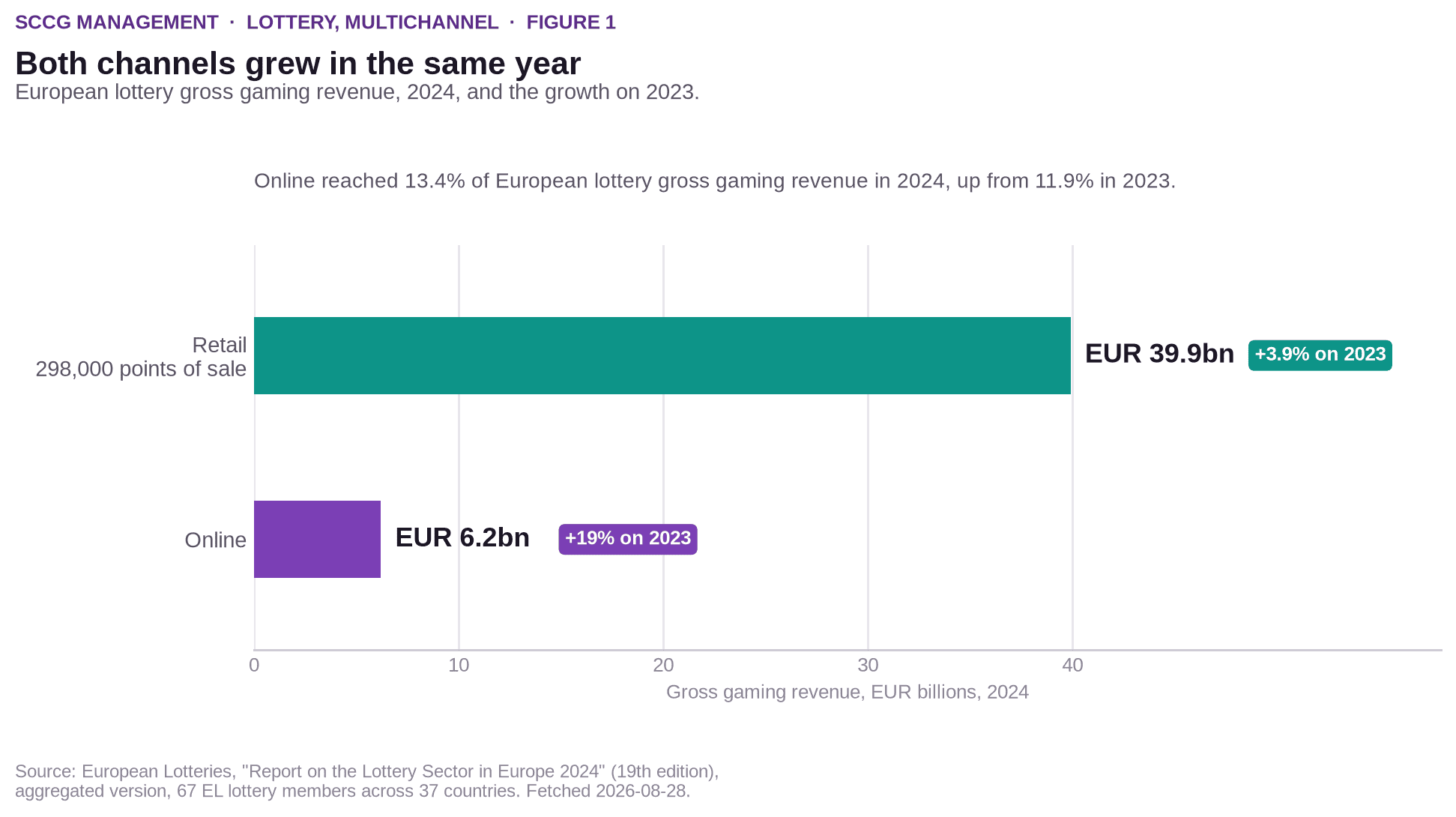
In 2024, online gross gaming revenue for those lotteries rose 19 percent, to 6.2 billion euros. Online is now 13.4 percent of the sector’s gross gaming revenue, up from 11.9 percent a year earlier.
In the same year, retail gross gaming revenue rose 3.9 percent, to 39.9 billion euros, across 298,000 points of sale.
Both went up. Digital grew far faster, and the shops still had a better year than the one before.
The United Kingdom shows it at closer range. In Allwyn’s 2025 annual report for the National Lottery, digital sales reached a record 4.1 billion pounds, up 9.8 percent, and passed half of total sales for the first time. In that same year, 43,500 retail partners earned a record 225 million pounds in commission, and instant games, largely a shop product, hit a record 1.2 billion pounds. Total sales were 8.1 billion pounds, up 3.5 percent.
Digital crossed the halfway line, and the retailers had their best year on record.
The content is what fills the channel
Most writing about lottery talks about channels. The channel is the easy part. What actually changed is the content.
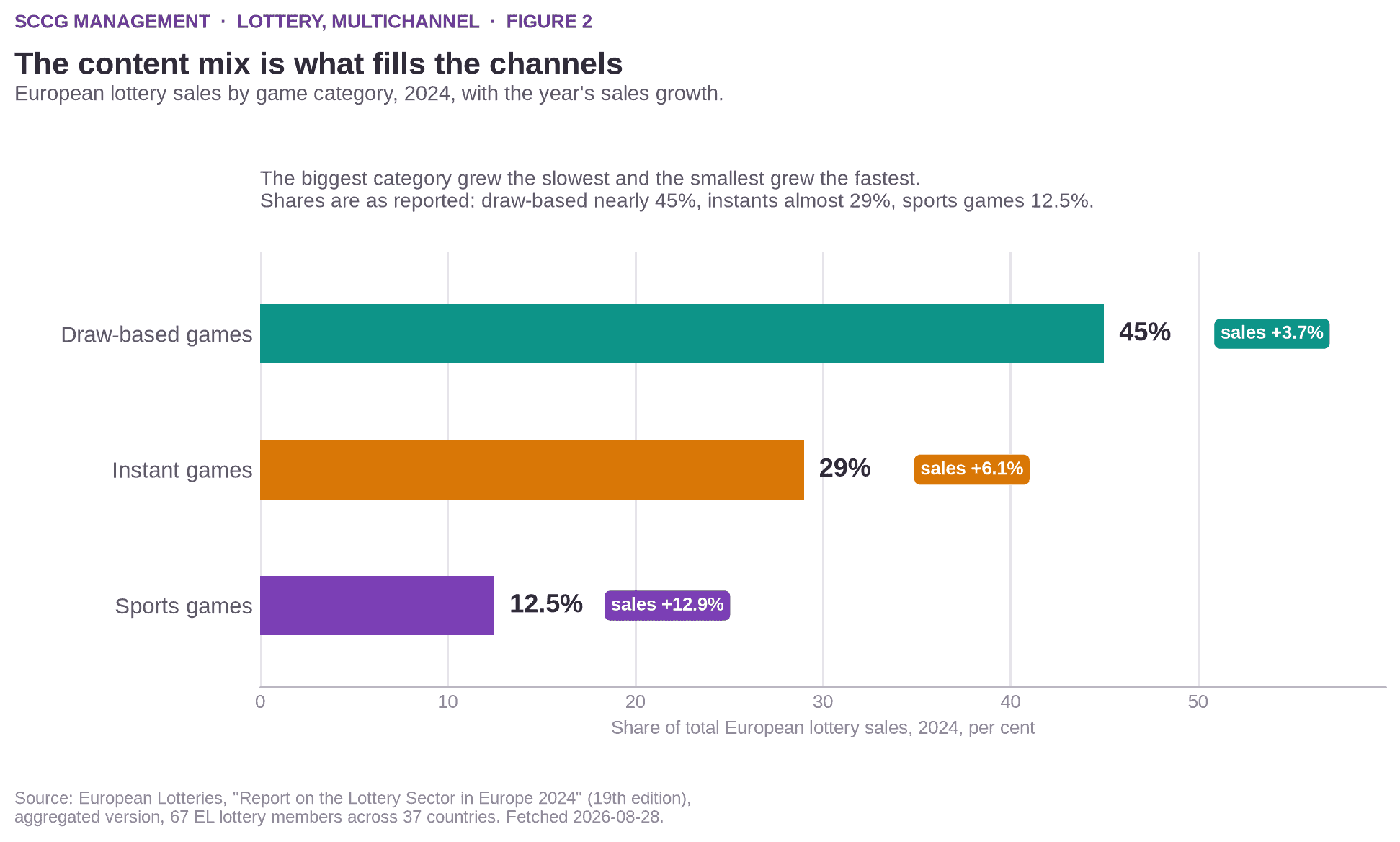
European Lotteries breaks it out. Draw games, the Saturday night ritual, remain the biggest category at nearly 45 percent of sales, and grew 3.7 percent in 2024. Instant games are almost 29 percent of sales and grew 6.1 percent. Sports games are 12.5 percent of sales and grew 12.9 percent, the fastest of the three.
Add fast-play games, digital instants, second-chance draws and subscription. Someone who once bought a single ticket on a Saturday now has something to do on a Tuesday.
The digital channel filled up because there was finally something to put in it.
Kentucky shows the balance. In fiscal 2025 it reported sales above 2.1 billion dollars, its fourteenth consecutive record year. Digital was more than 828 million dollars of that, 38 percent. Retail was still 62 percent.
Who builds it, and who runs it
Brightstar Lottery is the scale player. It says on its own site that it serves around 90 lottery customers and is the primary technology provider to 26 of the 46 United States lottery jurisdictions. It reported second-quarter 2026 revenue of 584 million dollars, global same-store sales up 1.5 percent, and iLottery wagers growing, in its own words, at a double-digit pace. Its flagship platform runs retail and digital as one system, which tells you where the value now sits.
Scientific Games is the instant-ticket and systems specialist: printed games, retail terminals, self-service kiosks and iLottery, in more than 50 countries. Intralot, now trading as Bally’s Intralot and listed in Athens, has turned acquisitive, announcing a firm offer for evoke plc in June 2026. Jumbo Interactive in Australia has taken total transaction value from 660 million Australian dollars in 2022 to 1.13 billion in 2026. Aristocrat now lists iLottery in its interactive division. Light & Wonder went the other way and completed its exit from lottery in April 2022.
Allwyn runs the UK National Lottery alongside businesses in Austria, Greece, Cyprus, the Czech Republic and North America, and reported 4.1 billion euros of net gaming revenue for 2025. In North America the operators are mostly states and provinces.
The technology work has been unglamorous and enormous. Allwyn reports investing over 450 million pounds modernising the National Lottery, installing 39,000 new retail terminals and migrating three billion historical transactions and 18 million player records onto new platforms. That is plumbing, and in this industry the plumbing is the product.
The problems, said plainly
Volume is not profit. Jumbo’s transaction value is up 70.6 percent over five years while its net profit after tax has fallen since 2024. Brightstar’s second-quarter revenue was down 7 percent on the year. A digital channel costs money well before it makes money.
Retailer economics are the loudest fear, and the evidence is reassuring. Kentucky paid more than 82 million dollars in retailer commissions and incentives in fiscal 2025. Colorado, reporting a record year of its own, added 130 retail locations. Nobody is giving up the counter.
Fragmentation is real and not going away. Forty-six lottery jurisdictions in the United States, 67 lotteries across 37 countries in Europe. No single door.
Player protection outranks all of it, and it is now measured rather than asserted. Allwyn reported that 93.5 percent of UK retailers correctly asked for identification on first mystery-shopping visits in 2025, its highest rate recorded. That number is published. It can be checked next year.
What lottery has that nobody else has
Every commercial operator competes on price, product and marketing. Lotteries do all three and carry something else: an obligation to hand most of the money to somebody else.
In 2024 the European sector returned 29.4 billion euros to society, more than 62 percent of gross gaming revenue, roughly 47 euros for every person. The World Lottery Association says its members, across 90 countries, contributed 96 billion dollars to good causes in its 2025 financial year. Georgia’s lottery has sent 31.3 billion dollars to education since 1992. Allwyn has set out to double the UK’s weekly contribution from 30 million pounds to 60 million by 2034.
That obligation is usually written up as a burden. It is the opposite. It is why this product kept its licence, its shelf space and its permission to modernise while the rest of gambling was still arguing for itself.
The oldest game in the business did not need reinventing. It needed rebuilding underneath, and that work is well under way.
If you are looking at lottery as an operator, a supplier or an investor, we should talk. Schedule a meeting.
By Stephen A. Crystal, Founder & CEO, SCCG Management. The Gambling Industry’s Global Connector.
Sources
Every figure in this article was taken from the document or page listed below and read on 28 August 2026. Nothing is estimated, modelled or carried from memory.
- European Lotteries, “Report on the Lottery Sector in Europe 2024” (19th edition), aggregated version. European lottery sales EUR 109.9bn and GGR EUR 46.1bn (2024); EUR 29.4bn returned to society, more than 62% of GGR, about EUR 47 per capita; retail GGR EUR 39.9bn, up 3.9%, across 298,000 points of sale; online GGR EUR 6.2bn, up 19%, now 13.4% of GGR against 11.9% in 2023; draw games nearly 45% of sales and up 3.7%, instants almost 29% and up 6.1%, sports games 12.5% and up 12.9%; 67 EL lottery members across 37 countries. https://www.european-lotteries.org/sites/default/files/2026-03/EL%20Report%202024%20-%20Aggregated%20version_Final.pdf
- Allwyn Entertainment Ltd, Annual Report and Accounts 2025. UK National Lottery total sales GBP 8.1bn, up 3.5%; Good Causes GBP 1.7bn, up 4%; digital sales record GBP 4.1bn, up 9.8%, over half of total sales for the first time; 43,500 retail partners earned record GBP 225m in commission; instant games record GBP 1.2bn; over GBP 450m invested in modernisation, 39,000 new retail terminals, over 3 billion historical transactions and 18 million player records migrated; 93.5% of retailers correctly asked for ID on first mystery-shopping visits; ambition to double weekly Good Causes from GBP 30m to GBP 60m by 2034. https://cdn.prod.website-files.com/686b4b6563b5a93062da3264/6a41a207f90b0844dd9e0009_Allwyn%20UK_AR2025_Final.pdf
- Allwyn corporate website, FY2025 summary. Allwyn group FY2025 net gaming revenue EUR 4.1bn and EUR 4.9bn returned to good causes and gaming taxes; operations in Austria, Greece, Cyprus, the United Kingdom, the Czech Republic and North America. https://www.allwyn.com/
- Kentucky Lottery, annual report summary. Kentucky Lottery FY2025 total sales above USD 2.1bn, 14th consecutive record year; iLottery sales above USD 828m, 38% of total, retail 62%; over USD 384m transferred for scholarships and grants; over USD 82m paid in retailer commissions and incentives. https://www.kylottery.com/apps/about_us/annual_report_home.html
- Brightstar Lottery plc, second quarter 2026 results, 4 August 2026. Brightstar Lottery Q2 2026 revenue USD 584m; global same-store sales up 1.5% at constant currency; iLottery wagers continuing to grow at a double-digit pace. https://www.brightstarlottery.com/news-and-insights/news-releases/2026/brightstar-lottery-plc-reports-second-quarter-2026-results
- Brightstar Lottery corporate website. Brightstar Lottery serves around 90 lottery customers and is the primary technology provider to 26 of the 46 United States lottery jurisdictions; its OMNIA platform is marketed as uniting retail and digital lottery channels. Self-reported, undated company claim. https://www.brightstarlottery.com/
- Scientific Games corporate website. Scientific Games offers instant games, draw games, WAVE retail terminals, PlayCentral self-service kiosks and iLottery, operating in over 50 countries across six continents. https://www.scientificgames.com/
- Bally’s Intralot investor relations announcements. Intralot trades as Bally’s Intralot, is listed on Euronext Athens, and announced a firm offer for all shares of evoke plc dated 05/06/2026. https://www.intralot.com/investor-relations/announcements
- Jumbo Interactive, Five-Year Performance Summary. Jumbo Interactive total transaction value from continuing operations AUD 659,924k in FY22 to AUD 1,125,782k in FY26, a 70.6% cumulative rise; net profit after tax from continuing operations AUD 43,349k in FY24 to AUD 34,574k in FY26. https://www.jumbointeractive.com/investors/five-year-performance-summary/
- Aristocrat corporate website. Aristocrat Interactive is one of Aristocrat’s three reporting segments and its stated offering includes iLottery. https://www.aristocrat.com/
- Light & Wonder newsroom. Light & Wonder press release “Completion of Lottery Business Divestiture”, dated 4 April 2022. https://explore.lnw.com/newsroom/
- NASPL Insights (trade press reporting Colorado Lottery figures). Colorado Lottery FY2025-26 record total revenue USD 887.9m, over USD 181m to beneficiaries, over USD 64m in retailer commissions, and 130 additional retail locations. https://www.nasplinsights.com/post/colorado-lottery-reports-record-fy26-scratch-sales-nearly-888-million-in-total-revenue-more-than
- Georgia Lottery Corporation, About Us. Georgia Lottery has transferred more than USD 31.3bn to the State Treasury’s Lottery for Education Account since its 1992 inception. https://www.galottery.com/en-us/about-us.html
- World Lottery Association website. World Lottery Association: 166 members operating across 90 countries; members contributed USD 96bn to good causes in FY2025 and an estimated USD 2 trillion cumulatively since 1999. https://www.world-lotteries.org/
The oldest product in gambling just proved omnichannel works: digital accelerates the category, retail captures the expanded audience.
We have been told for decades that digital cannibalizes retail in lottery. The 2024 European data proves the opposite. Digital grew 19 percent, retail grew 4 percent, and 298,000 points of sale earned more commission than the year before. This is not substitution — it is expansion, and it changes how lotteries should allocate capital and partnership strategy.
- European lottery online GGR rose 19% to €6.2B; retail rose 3.9% to €39.9B in same year
- Digital now 13.4% of sector revenue, up from 11.9% prior year
- UK National Lottery digital passed 50% of sales; 43,500 retail partners earned record commission
SCCG angle: SCCG has direct relationships with lottery operators, digital platform providers, and retail technology companies across regulated markets. When a lottery needs to scale both channels without cannibalizing either, we connect them to the vendors and strategists who have actually done it — not theoretically, but in live markets with real revenue data.
Gaming, betting and prediction markets — the desk’s read, every weekday.
Subscribe →