After the World Cup, Retention Becomes a Production Problem
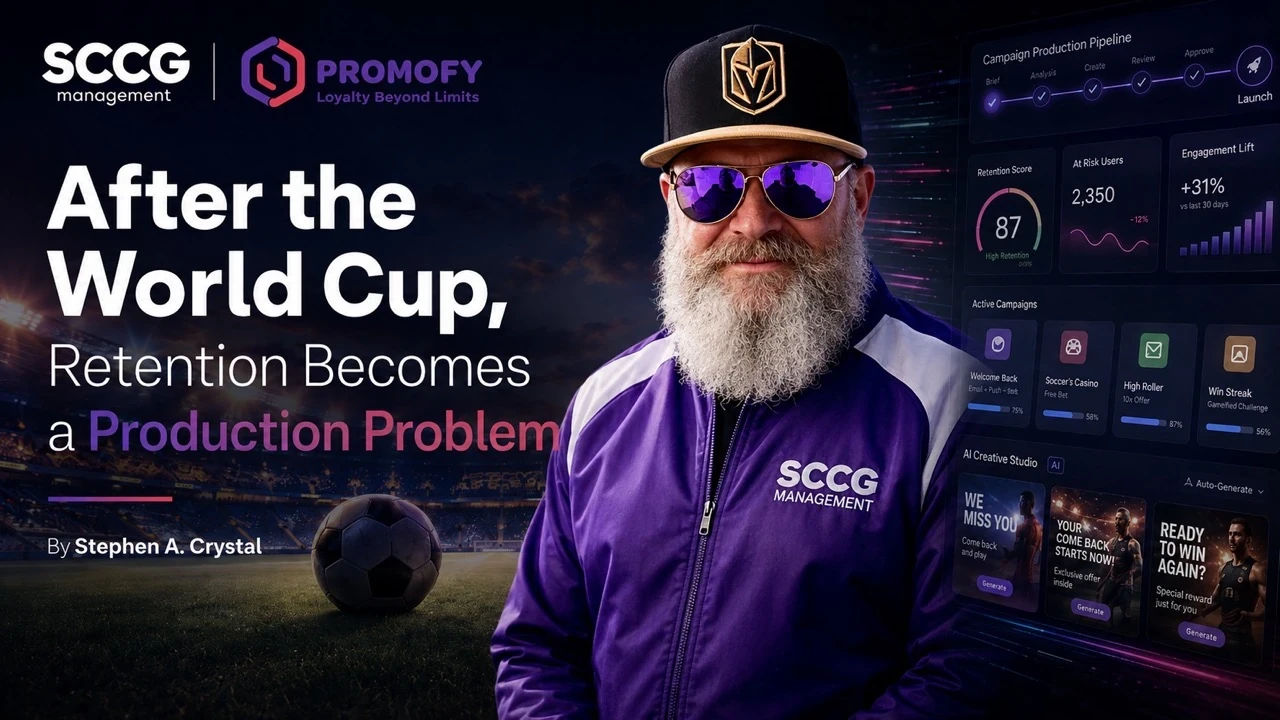
The World Cup is over and the post-tournament reports are being written across the industry. In more than three decades in gaming I have watched this cycle repeat after every event that pulls a general audience into a betting or casino product: a month of extraordinary traffic, a record acquisition quarter, and then an autumn in which the numbers quietly settle back to roughly where they sat in the spring. The tournament was never the hard part. The eight weeks after it are.
Key Takeaways
- A major tournament does not produce loyal players. It produces a large cohort that arrived on the same day for the same reason, which means it can leave on the same day too.
- Post-event value leaks in three places: the registration door during the spike, the empty calendar after it, and the operator’s own production queue.
- The third leak is the one almost nobody names. Most operators do not have a retention strategy problem. They have a throughput problem.
- A campaign that has to queue behind a design backlog and a localisation pass arrives after the cohort it was written for has already gone.
- The operators still monetising this summer’s cohort at Christmas will be the ones who can put a campaign live the same afternoon they think of it.
A tournament does not create loyal players. It creates a cohort with a shared expiry date
This is the distinction that gets lost in the post-event review. A tournament delivers attention, and attention is not the same thing as an audience. Everybody in the market received the same surge, on the same days, driven by the same fixtures, and everybody’s version of that cohort has the same natural end date. When the final whistle goes, the reason those players registered stops existing simultaneously for all of them.
That is a structural fact about event-driven acquisition, not a criticism of it. Events are the cheapest audience an operator will ever be handed. But an operator who books that surge as a win, rather than as a loan that has to be converted into something durable, is measuring the wrong half of the trade. The number that matters is not how many players the tournament brought. It is how many are still playing in week six.
The first leak is the door, and it opens widest exactly when nobody is watching it
During a spike, an operator’s site takes the highest-intent traffic it will see all year, and it takes that traffic from people with the least patience. They came for one thing, they are three taps from a competitor, and a registration flow calibrated for an ordinary Tuesday treats them exactly as it treats an ordinary Tuesday.
Most operators respond to a spike on the acquisition side of the door, with more spend and more affiliate activity, and leave the door itself untouched. That is an odd allocation. The cheapest incremental player in any event window is the one already standing on the site who leaves without registering. Doing something at that moment, giving a visitor a reason to complete rather than browse, is the least glamorous conversion work in the business and the highest-yield.
The second leak is the calendar, and it belongs to somebody else
Once the tournament ends, the operator discovers whose calendar its engagement programme was actually running on. If the reason to return each week was the fixture list, the reason stops when the fixture list stops. Between tournaments there is a stretch of weeks with no external event supplying urgency, and a generic daily bonus does not supply it either, because every competitor is offering the same one to the same players.
What fills that gap is a mechanic the operator owns and the player can see moving. A prize pool that grows in real time is the clearest example, because it manufactures anticipation on a schedule the operator sets rather than one FIFA sets. Progress the player can watch is a reason to come back that does not require anyone else’s tournament to be happening.
The third leak is the one that never makes the board deck
Here is where I would push back on most post-event reviews I read. The first two leaks are well understood. Every retention deck in this industry already contains a version of them. Very few operators actually close them, and the reason is not that they do not know what to build.
It is that they cannot ship fast enough. The idea arrives in a Monday meeting, the creative goes into a design queue behind three other requests, the localisation pass adds another wait for each market, compliance reviews the copy, and the campaign goes live long after the cohort it was written for has drifted. Multiply that by every market an operator runs in and the practical output is a handful of campaigns a month, most of them scheduled far enough in advance that they cannot respond to anything.
So the binding constraint on retention in 2026 is production capacity, not strategy. Two operators with identical retention plans will get very different results if one can run four campaigns a month and the other can run twenty five. That is not a marketing insight. It is an operations one, and it is why the tooling question has stopped being a procurement detail and become a structural question about how fast a company can act on what it already knows.
This is why the engagement layer stopped being a feature and became infrastructure
The platforms built for this exist precisely because acquisition, engagement and loyalty stopped being three separate departments with three separate tools. Promofy, one of our client-partners at SCCG, is a clear worked example of the shape the category is taking, and its product news this month maps almost exactly onto the three leaks above.
For the door, Promofy’s Spark places site-side experiences such as a spin wheel, a scratch card or a mystery box in front of a visitor at the point of intent, which the company says can be added to an existing site without rebuilding the platform. For the calendar, Promofy Jackpot runs progressive campaigns of up to four levels, with prize progression visible in real time and new cycles starting automatically once one completes; Promofy announced this month that the product has completed its GLI-19 evaluation, the interactive gaming systems standard operators expect before anything prize-bearing goes near a live floor or site. And for the queue, its AI suite pulls campaign creation, targeting, localisation, creative generation and reporting into one workflow, with a generative tool the company calls Canvas AI producing on-brand campaign visuals from a written description rather than a design ticket.
Take the vendor name off that list and the argument still stands. Whatever an operator uses, the same three jobs have to be done by something, and the third one, the throughput job, is the one most in-house stacks quietly fail. If you want to see what a purpose-built engagement layer looks like up close, our partner Promofy is here: promofy.ai.
The Bottom Line
Every operator in this market just received a large, motivated, externally funded cohort of players, and most will have handed the majority of them back by the autumn. That will be recorded as normal seasonal decay. It is not. It is three specific leaks, in the door, in the calendar and in the production queue, and the third one is where the difference between operators is actually being made.
Acquisition remains the scoreboard everybody watches. The advantage has moved somewhere quieter. It sits with the operators who can convert attention into an audience faster than the attention fades, and speed there is a function of what your team can put live this week, not what is written in your annual plan.
I will be at G2E in Las Vegas at the end of September, and this is exactly the conversation I want to have with operators there: what your post-tournament cohort actually did, and what it would take to hold the next one. If that is a useful half hour, book it directly: Schedule a meeting with Stephen Crystal.
By Stephen A. Crystal, Founder & CEO, SCCG Management. The Gambling Industry’s Global Connector.
Post-event retention isn't a strategy problem — it's a production throughput problem, and most operators can't ship fast enough.
We've tracked this cycle for thirty years: every World Cup, every March Madness, the same surge and the same slow leak. The operators who win aren't the ones with the best retention roadmap — they're the ones who can execute that roadmap in forty-eight hours, not six weeks. Speed is the new moat.
- Major events create cohorts with shared expiry dates, not loyal players
- Value leaks through registration friction, empty post-event calendars, and slow production queues
- Operators who monetize tournament cohorts at Christmas can launch campaigns same-day, not next quarter
SCCG angle: SCCG connects operators to the modular tech stack and agile content partners that collapse production cycles — CRM platforms, creative studios, localization shops that turn strategy into live campaigns in days. We've built the network that removes the queue.
Gaming, betting and prediction markets — the desk’s read, every weekday.
Subscribe →