Prediction Market Routing: How Order Flow Reaches a DCM
A regulated US prediction market has three roles: an FCM that holds customer funds, a DCM that matches trades, and a DCO that clears them. Fanatics has climbed all three rungs in two years. Owning an exchange does not remove the need for competitive routing – it raises the standard that routing must meet.
SCCG Take — The commercial question for operators is not whether prediction markets are threat or opportunity, but which link in the three-part chain they intend to own and what it costs to rent the others.
Ask most people in this industry how a prediction market works and you will get
a description of the front end. Someone opens an app, picks a market, taps buy.
It looks like a sportsbook with different vocabulary.
The front end is the least interesting part. What decides who makes money in
this sector over the next two years is the plumbing behind that tap — and it is
plumbing borrowed wholesale from futures markets, not from gaming. In 30+ years
as a securities and gaming attorney I have watched a good many operators discover
a market structure late. This is one worth understanding early, because the
structure is being rebuilt right now, in public.
Three roles, and only three
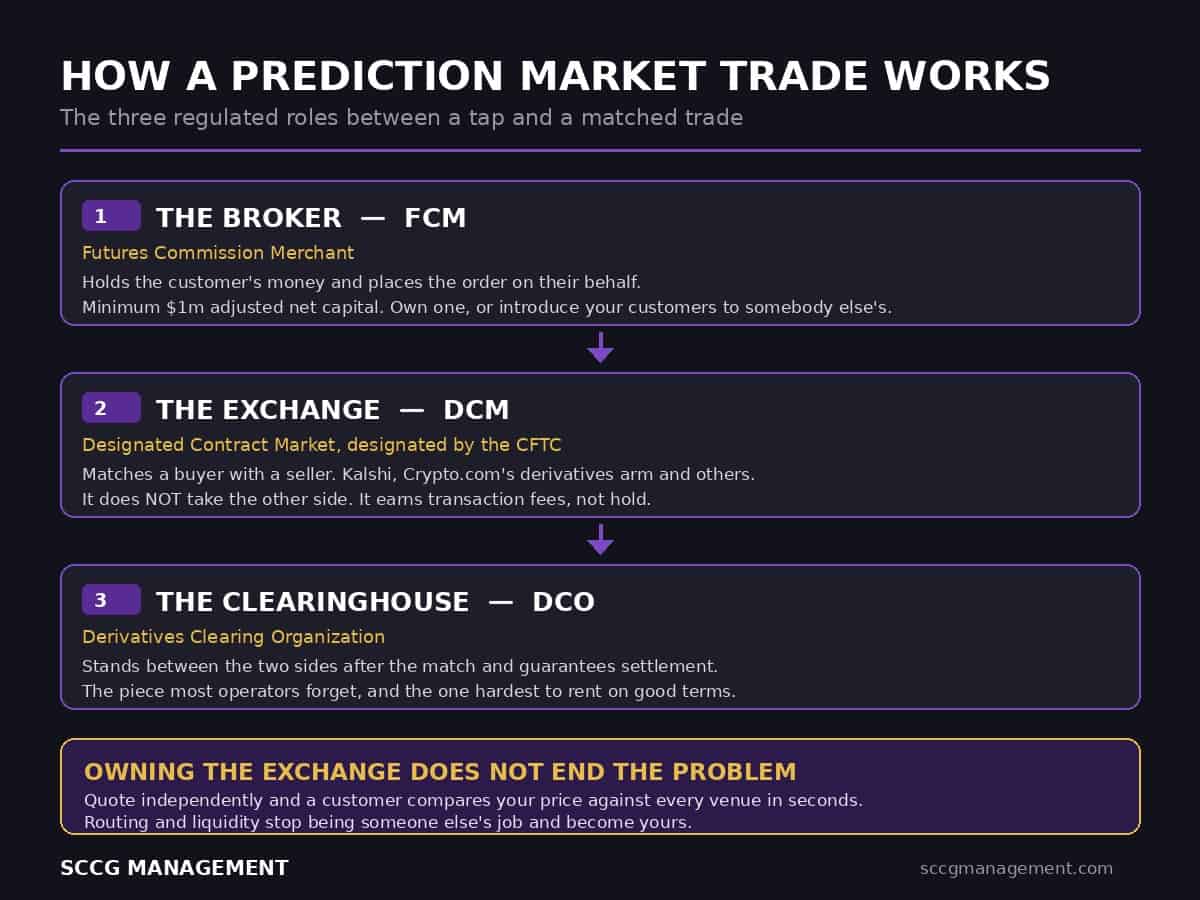
Strip away the branding and a regulated US prediction market has three jobs in
it.
The exchange. In this world it is a Designated Contract Market, a DCM,
designated by the Commodity Futures Trading Commission. Kalshi is one.
Crypto.com’s derivatives arm is one. This is the venue where a buyer and a
seller are matched.
The broker. A Futures Commission Merchant, an FCM, is the registered
firm that can accept and hold a customer’s money and place orders on their
behalf. It requires at minimum $1m of adjusted net capital, and considerably
more once risk margin scales.
The clearinghouse. A Derivatives Clearing Organization, a DCO, stands
between the two sides after the match and guarantees settlement.
Here is the first thing that trips up people from our side of the industry: the
DCM does not take the other side of the trade. It is not the house. It earns
transaction fees, not hold. Every instinct a casino operator has about
theoretical hold, liability management and limiting winning customers maps badly
onto a venue that is indifferent to who wins.
The flow itself
A customer taps buy in an app. What happens next is:
- The app’s FCM — the entity that holds the customer’s funds — accepts the
order. If the brand has no FCM of its own, it is introducing that customer to
somebody else’s. - The order is routed to a DCM, the exchange, which matches it against
a counterparty. - The DCO clears the matched trade and guarantees settlement.
That is the whole chain. The commercial question is who owns which link.
Two ways to reach a DCM, and one of them is losing favour
Until recently most order flow reached an exchange one of two ways. Either the
platform ran its own market, or it routed in through somebody else’s as an FCM.
The second model is under pressure, and the reason is obvious once stated: if
you route into a rival’s exchange, your economics, your product roadmap and your
market access are all rented. Nobody wants to be permanently dependent on a
venue that also competes with them.
Fanatics is the clearest illustration, because it climbed every rung in
public and did it in two years:
| July 2025 | Acquires Paragon Global Markets — an introducing broker |
| December 2025 | Launches Fanatics Markets, renting Crypto.com’s exchange and clearinghouse |
| March 2026 | Fanatics Markets FCM registered — now holds customer funds directly |
| 27 July 2026 | Agrees to acquire a DCM and a DCO from BGC Group |
Two details in that last line deserve attention. It is a DCM and a DCO — the
clearinghouse is arguably the more consequential half, because it removes the
last piece anyone else controls. And it is an agreement: the primary
releases describe an acquisition agreed, not completed, with terms undisclosed
and no closing date stated. Anyone telling you Fanatics owns an exchange today is
ahead of the filings.
There is a detail in that transaction that tells you how fast this is moving.
The exchange Fanatics is buying, Water Street Labs, only became a DCM on 16
July 2026. It was sold eleven days later.
The part almost everyone gets wrong
The intuition is that owning your own exchange ends your dependence on anyone
else. It does not. It changes what the remaining problem is.
The moment you are quoting prices independently, a customer can compare your
price against every other venue in seconds. In futures this happens through a
Request for Quote — an RFQ — where a participant asks for a price rather than
taking whatever sits on the order book. If your quote is not connected to and
competitive with the rest of the market, the flow goes to whoever’s is.
So owning a DCM does not remove the need for a routing and liquidity layer. It
raises the standard that layer has to meet. Specialist firms have grown up to do
exactly this — White Swan Predicts is one, connecting into RFQ venues across the
map — and the existence of that category is itself the evidence: if vertical
integration solved the problem, nobody would need them.
What I would take from this
The barbell, not the death, of routing. It is fashionable to say the
FCM-routing model is dying. It is not. Building a DCM is a multi-million-dollar,
twelve-to-twenty-four-month exercise; an introducing broker relationship costs a
fraction of that. Routing remains the only rational entry for most firms, while
the largest integrate backwards. Both ends grow; the middle thins.
Owning the wallet is the real prize. Watch when a firm registers an FCM
rather than when it announces an exchange. That is the moment it stops
introducing its customers to someone else and starts holding their money — and
the economics change there, not at the DCM.
The legal ground is not settled, whatever the headlines suggest. The most
prominent operator in this space has recent wins and recent losses in different
courts, faces a state attorney general action, and is withdrawing from at least
one state this month. Anyone building a plan on the assumption that federal
preemption is resolved is building on a contested foundation.
For operators, suppliers and tribal nations weighing whether to enter, the
question is not whether prediction markets are a threat or an opportunity. It is
which link in that three-part chain you intend to own, and what it costs you to
rent the others while you decide.
Stephen Crystal is the founder of SCCG Management.
Fanatics is building the whole stack; most operators will rent pieces and routing decides who captures margin.
We're fielding more routing and white-label questions in prediction markets than any other vertical this quarter. The operators who win here will understand they're running a futures exchange dressed as a sportsbook, and that means different economics, different partnerships, and capital calls most gaming CFOs have never modeled.
- Three roles: FCM holds funds, DCM matches trades, DCO clears — no house edge
- Fanatics built all three in two years; most operators will lease one or two tiers
- Routing determines margin capture and customer experience, not branding
SCCG angle: SCCG sits between the operators asking whether to build or rent and the FCMs, DCMs, and technology providers who can deliver each piece. We've structured partnerships in every regulated futures and derivatives market globally — we know which vendors clear fast, which routing costs scale, and where the capital requirements break model assumptions before the first contract goes live.
Gaming, betting and prediction markets — the desk’s read, every weekday.
Subscribe →