Alberta Launches Regulated iGaming and Sports Betting as 50 Operators Register

Alberta launched its regulated igaming and sports betting market on July 13 with 50 operators registered, including DraftKings, FanDuel and Tonybet. Day-one self-exclusion, RG Check accreditation and strong player trust data (74% licensing preference, 61% safety perception) define the framework. The model projects operator strategies for US state parallels and broader North American convergence.
SCCG Take — This launch creates an inflection point for client-partners to apply US state and Ontario lessons with emphasis on trust and responsible gaming, accelerating regulatory convergence while capturing share from unregulated operators.
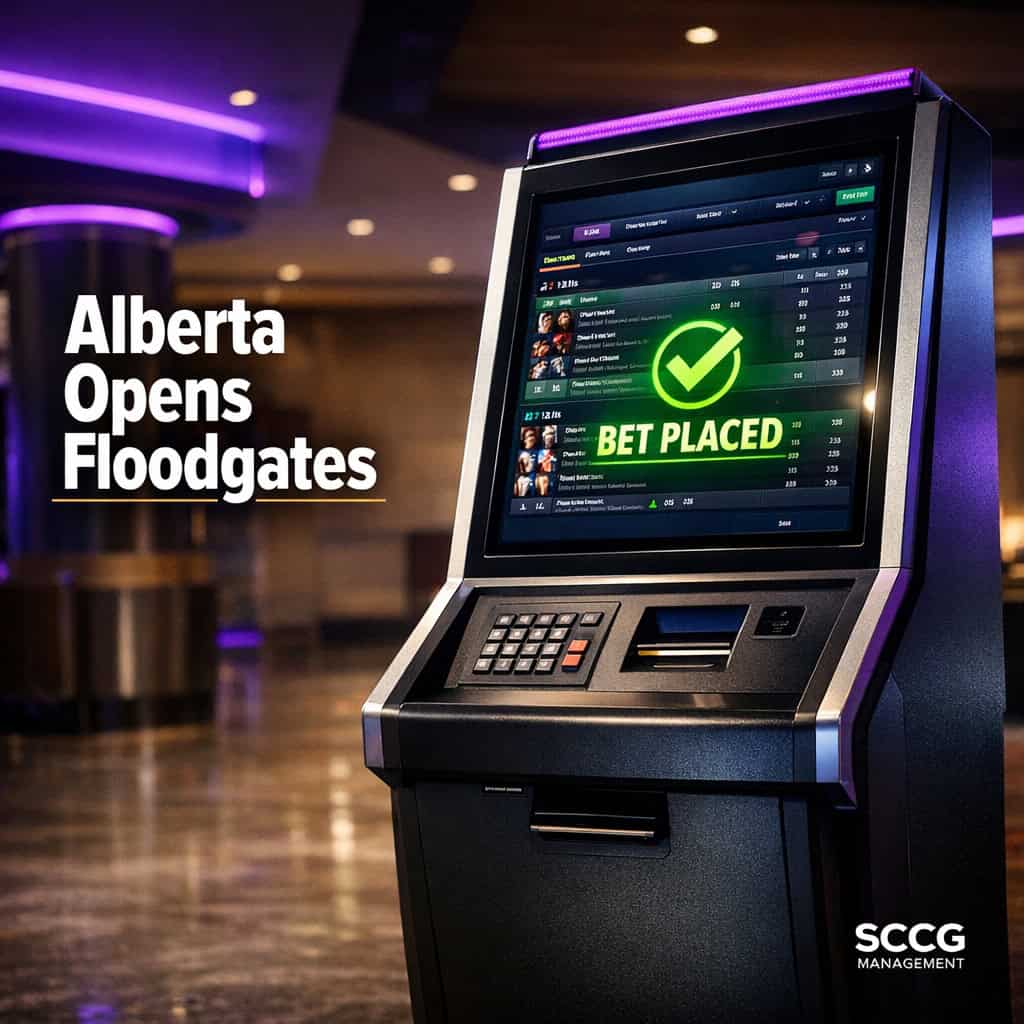
Alberta Launches Regulated iGaming and Sports Betting as 50 Operators Register: Signals for North American Convergence
Key Takeaways
- Market Launch: Alberta’s regulated igaming and sports betting market goes live July 13 with 50 operators registered with AGLC and commercial agreements required with AiGC.
- Operator Momentum: FanDuel, DraftKings, BetMGM, Caesars, bet365 and Tonybet are among those completing registration, with DraftKings entering its 34th North American jurisdiction.
- Player Trust Data: 74% of surveyed Canadians will not bet on unlicensed platforms and 61% of Albertans view online gambling as safe under the new framework.
- Responsible Gaming Focus: Self-exclusion is mandatory from day one with RG Check accreditation required, unlike Ontario’s four-year delay.
“Alberta will officially open its regulated online gambling market to private operators on Monday under the new iGaming Act,” posted @yegwave. “That means Albertans will be able to legally use private online casinos and sports betting sites, not just PlayAlberta. The province says the move will help shift users from unregulated sites and collect a 20% share of operator profits.”
This quote captures the structural shift now underway. Alberta’s launch on July 13, as detailed across reporting by InterGame Online, Casino.org and G3 Newswire, brings 50 registered operators into a provincially managed framework. AiGC will conduct and manage the market on behalf of the province. Operators must finalize commercial agreements before going live.
Fifty Operators and the Competitive Entry Wave
The rapid registration of 50 operators signals robust interest. FanDuel, DraftKings, BetMGM, Caesars, Betway, PointsBet, theScore Bet, bet365 and BetRivers have all completed registration and paid the required fees, according to the provincial regulator. Tonybet, an Estonia-based operator, now holds licenses in three Canadian jurisdictions: Ontario, Kahnawake and Alberta.
This influx mirrors the early rush seen in newly liberalized markets. Yet commercial agreements with AiGC remain a gating item. Registration alone does not equal immediate operation. The requirement creates a final compliance checkpoint that prioritizes structured market entry over speed.
Trust Metrics and the Licensing Premium
Tonybet released YouGov survey results on the eve of launch. Three-quarters of Canadians surveyed (74%) said they would never bet on a platform without a Canadian licence. The study covered igaming users in Alberta, Ontario and Quebec aged 22 to 54.
“Canadian players treat licensing as a serious indicator of operator quality, and that has shaped how we’ve approached the market from the start,” said Tonybet CEO Dmitry Arabuli. “We came into Ontario on the conviction that regulated growth is durable growth, and the past three years in Canada have borne that out. Players reward operators who take the rules seriously, and that trust compounds over time.”
Separate research commissioned by Betty Gaming Canada with the Angus Reid Forum found 61% of Albertans view online gambling as safe after learning about the regulatory framework. Safety and security rank among the top considerations when choosing a platform. These figures underscore a licensing premium that operators must convert into market share.
Responsible Gaming Built In From Day One
Alberta’s framework demands RG Check accreditation for all operators to verify standards and safeguards. Responsible gambling information must be readily available, visible and accessible. Tools such as time and deposit limits are required. Self-exclusion integrates with the AiGC system from the first day of operation.
This stands in contrast to Ontario, which introduced centralized self-exclusion four years after its market opened. Alberta’s day-one approach reduces early exposure to unregulated sites and sets a higher baseline for player protection. Operators must void or refund unsettled futures wagers if a player self-excludes before resolution.
Tonybet Head of Product Kiryl Liudvikevich highlighted the operational commitment: “We’ve invested heavily in payments because fast, reliable withdrawals are one of the clearest signals of trust. Entering a newly regulated market like Alberta is a strong step forward for operators and players alike, creating a safer environment, clearer standards, and better responsible gaming tools, including integration with the AiGC self-exclusion system. Long-term success comes from combining entertainment, reliability and player protection in one experience players can genuinely trust.”
DraftKings’ Launch Tactics and Community Signal
DraftKings is launching its sportsbook, casino and Golden Nugget Online Gaming brand in Alberta on July 13. The province becomes DraftKings’ second Canadian jurisdiction and its 34th across North America. The timing aligns with the FIFA World Cup, with DraftKings hosting a watch party at Calgary’s Wildhorse Saloon on July 11 featuring live viewing, giveaways and activations.
“We’re thrilled to launch DraftKings Sportsbook and DraftKings Casino, as well as Golden Nugget Online Gaming in Alberta and continue expanding our presence in Canada,” said Greg Karamitis, Executive Vice President and General Manager of Sports at DraftKings. “Alberta is home to a passionate sports fan base, and we’re excited to bring customers across the province our industry-leading sports betting and online casino experiences. Launching during one of the biggest moments in global sports, with the World Cup taking place across North America, makes this an especially exciting time to welcome Albertans to DraftKings.”
DraftKings employees will volunteer with Food Banks Alberta and present a $150,000 donation. The funds will purchase over 40,000 pounds of essential items including fruits, vegetables and baby formula. This community step reinforces brand trust in a market where 61% of respondents prioritize safety.
Risks in Rapid Scale and Unfinished Agreements
While 50 registrations reflect strong operator appetite, the requirement for AiGC commercial agreements introduces execution risk. Any delay in finalizing those contracts could stagger go-live dates and create uneven competitive conditions. The 20% provincial share of operator profits, as noted in public commentary, also compresses margins relative to some US state tax structures.
Coverage across the sources emphasizes registration numbers, trust metrics and responsible gaming tools. What remains underemphasized is the precise playbook operators will use to migrate users from unregulated sites at scale while maintaining uniform compliance across an expanding Canadian footprint. The competitive calculus favors those who convert licensing trust into retention faster than rivals.
The Convergence Calculus for Operators and Regulators
Alberta’s model, with its day-one self-exclusion, mandatory accreditation and clear profit share, offers a pragmatic template. It parallels the US state-by-state evolution post-PASPA where operators learned to navigate varied regulatory demands while scaling responsibly. Tribal sovereignty considerations in the United States similarly underscore the value of distinct jurisdictional frameworks that respect local control while enabling private operator participation.
This launch represents an inflection point for North American regulatory convergence. Operators and client-partners should treat Alberta as a proving ground: integrate responsible gaming tools seamlessly, leverage event-driven momentum such as the World Cup, and refine user migration strategies from gray markets. Regulators elsewhere will study whether the 20% share sustains investment and whether player trust metrics hold once the market matures. The structural shift favors disciplined execution over rapid expansion. Those who align early with Alberta’s emphasis on trust and protection will hold a lasting edge as more provinces and states converge on coherent frameworks.
Reporting: Alberta opens doors to regulated igaming, sports betting – InterGame Online (news.google.com)
Alberta's 50-operator launch proves trust and responsible gaming win share when regulation converges with real consumer expectations.
We've seen 545 partners navigate 30+ markets, and Alberta's day-one self-exclusion and RG Check accreditation mirror what worked in Ontario and winning US states. Fifty operators registered means the playbook is proven, and clients who adapt US strategies here—fast—will capture share from gray market holdouts while regulators watch closely.
- 50 operators including DraftKings, FanDuel, Tonybet registered for July 13 launch
- 74% of players prefer licensed operators; 61% cite safety as top concern
- Mandatory RG Check accreditation and day-one self-exclusion set high bar
SCCG angle: SCCG has guided operators and suppliers through Ontario, state-by-state US rollouts, and now Alberta. We connect clients to the compliance, payments, and platform partners who've already cracked responsible gaming accreditation and consumer trust positioning—so you enter fast, compliant, and credibly.
Gaming, betting and prediction markets — the desk’s read, every weekday.
Subscribe →