One Activity

A football league bought shares in a television network this year. Our August research report follows that one fact to the place it now shows up hardest, which is the price of sport.
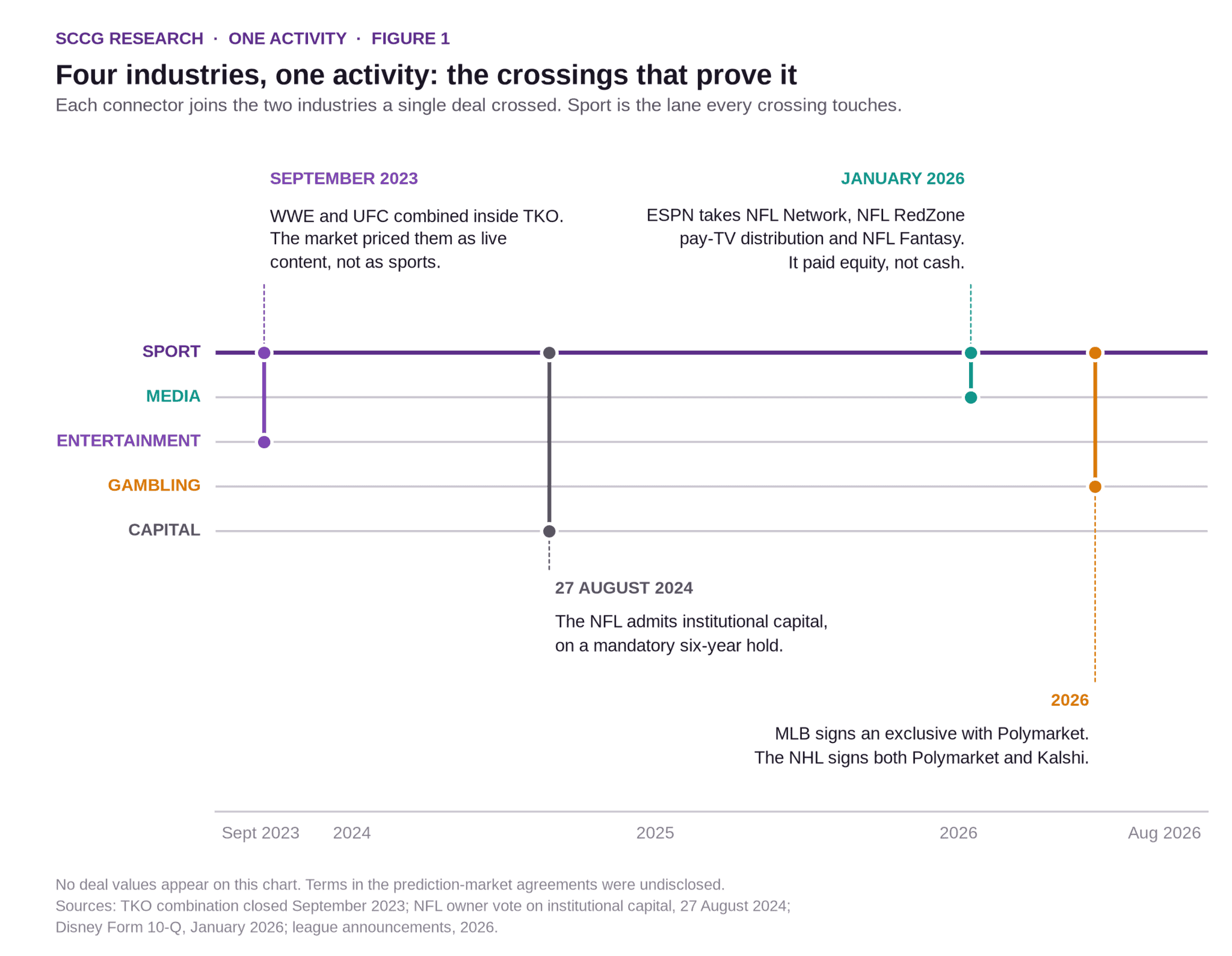
In January, ESPN bought NFL Network, the pay-television distribution of NFL RedZone, and NFL Fantasy. It did not pay cash. It paid in shares of itself.
So a football league is now a shareholder in a television network.
Ask yourself which industry that deal happened in. Sport, or media, or something else. The honest answer is that the question has stopped having an answer, and that is the whole of what I want to say this month.
Four industries, one business
Gambling, sport, media and the older entertainment businesses, the movies and the television and the music, are one activity now carrying four legacy names. I have been making that argument for five years, and every year it takes less work.
Look at what each of them has actually become. Live casino is made in a studio, with a host, a set and a format. That is game show television with a wager attached. A sports broadcast carries a betting layer that did not exist ten years ago, built into the coverage rather than sold beside it. Movies, television and music chase the same audience by the same means, in the same live moments, on the same second screen.
You can keep calling those four things four industries. They have stopped behaving like four.
Why sport ended up as the asset everybody wants
I am asked constantly why sport is the hottest asset class in the world. The answer people expect is something about franchises, or scarcity of teams, or rich men buying toys.
The money is not buying a game. It is buying the one place where live attention still gathers reliably, and it is buying it in the only form attention can be owned, which is a contract.
Passive media held that attention for thirty years. It does not hold it now. An audience that turns up at the appointed hour, in numbers, has become a scarce thing, and scarcity is what capital prices.
The clearest case is a league nobody was arguing about two years ago
The WNBA was a marginal property until 2024. Then Caitlin Clark arrived, and what followed was not really a basketball story. It was drama. Drama is what an audience pays for, and the prices moved with the drama.
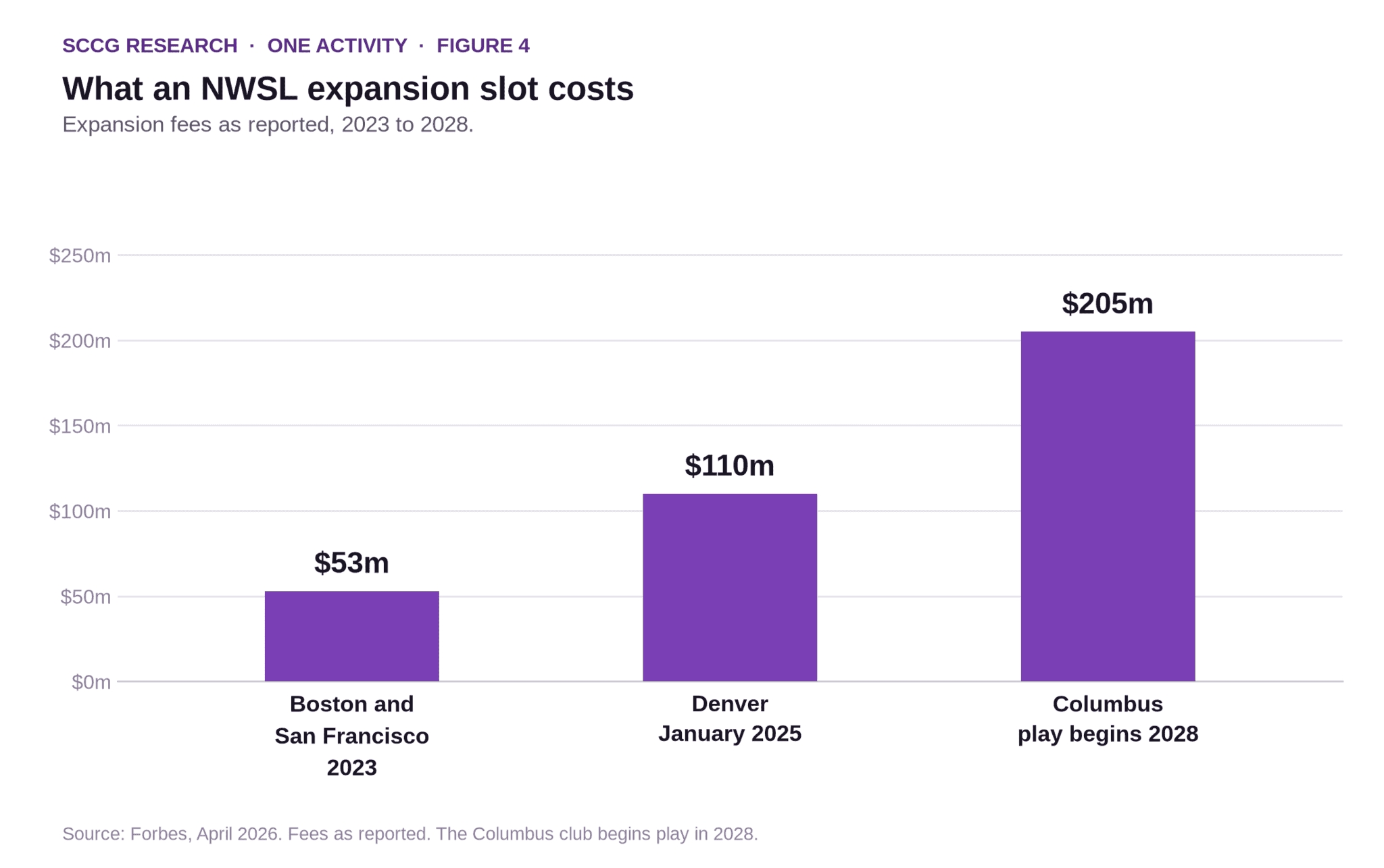
Golden State and Toronto had joined on reported expansion fees of $50 million. In 2025 Cleveland, Detroit and Philadelphia each paid a reported league record of $250 million. In May, Forbes put the average value of the thirteen existing clubs at $414 million, up 52 percent in a single year.
That is an appraisal rather than a sale. It still tells you what changed.
TKO makes the same point from the other direction. World Wrestling Entertainment and the Ultimate Fighting Championship have sat inside one company since 2023. Which of the two is more of a sport is a debate worth having, and the fact that it is debatable is the point. The market did not price them as sports. It priced them as live content with an audience, a format and rights attached. That is the test now being applied to everything.
A league used to sell one thing. It now sells six.
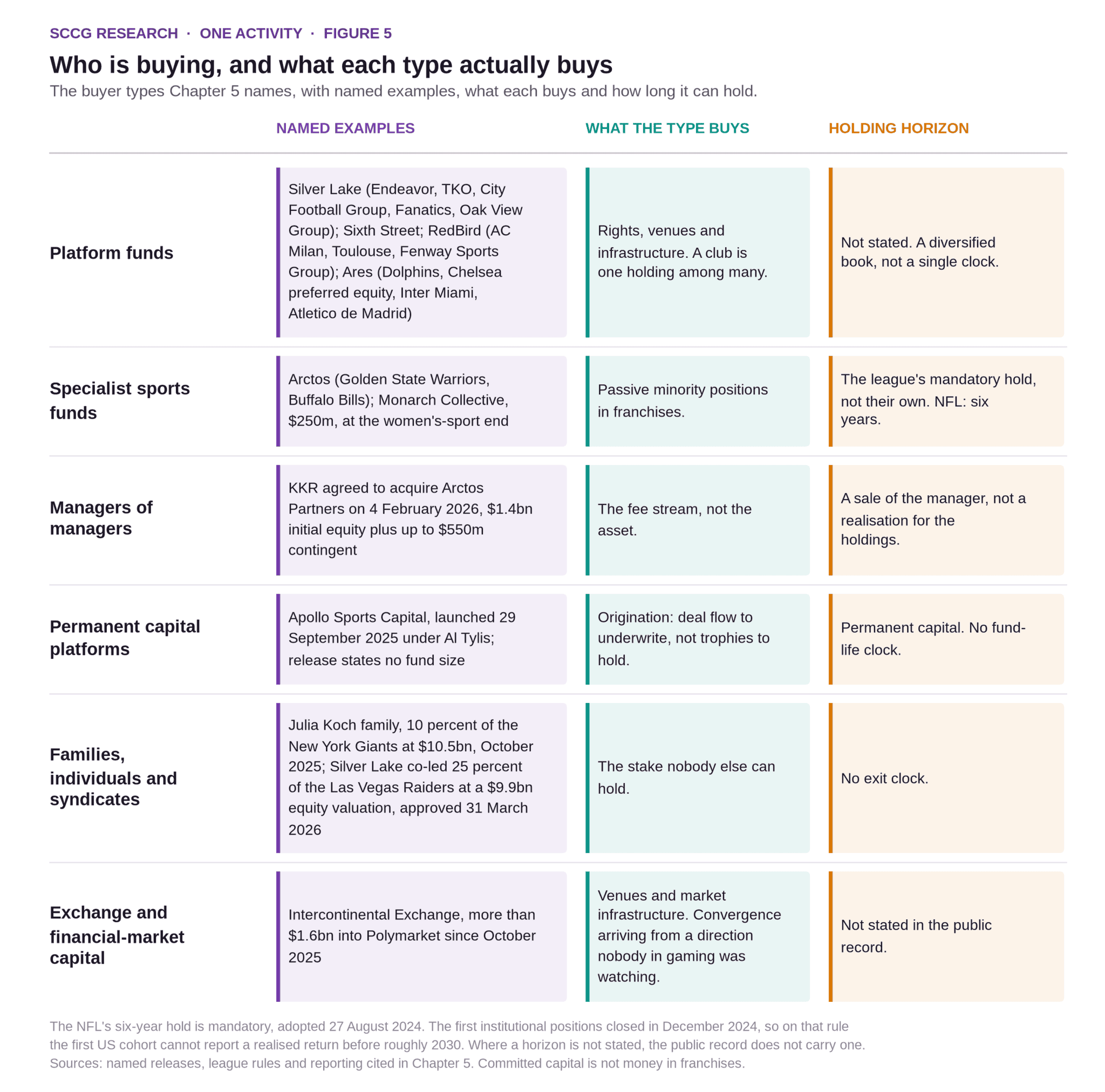
Ask what a fund is really buying when it takes a slice of a club. Not the roster, not the stadium, not the fanbase. It is buying a share of the contracts that sell that club’s live attention.
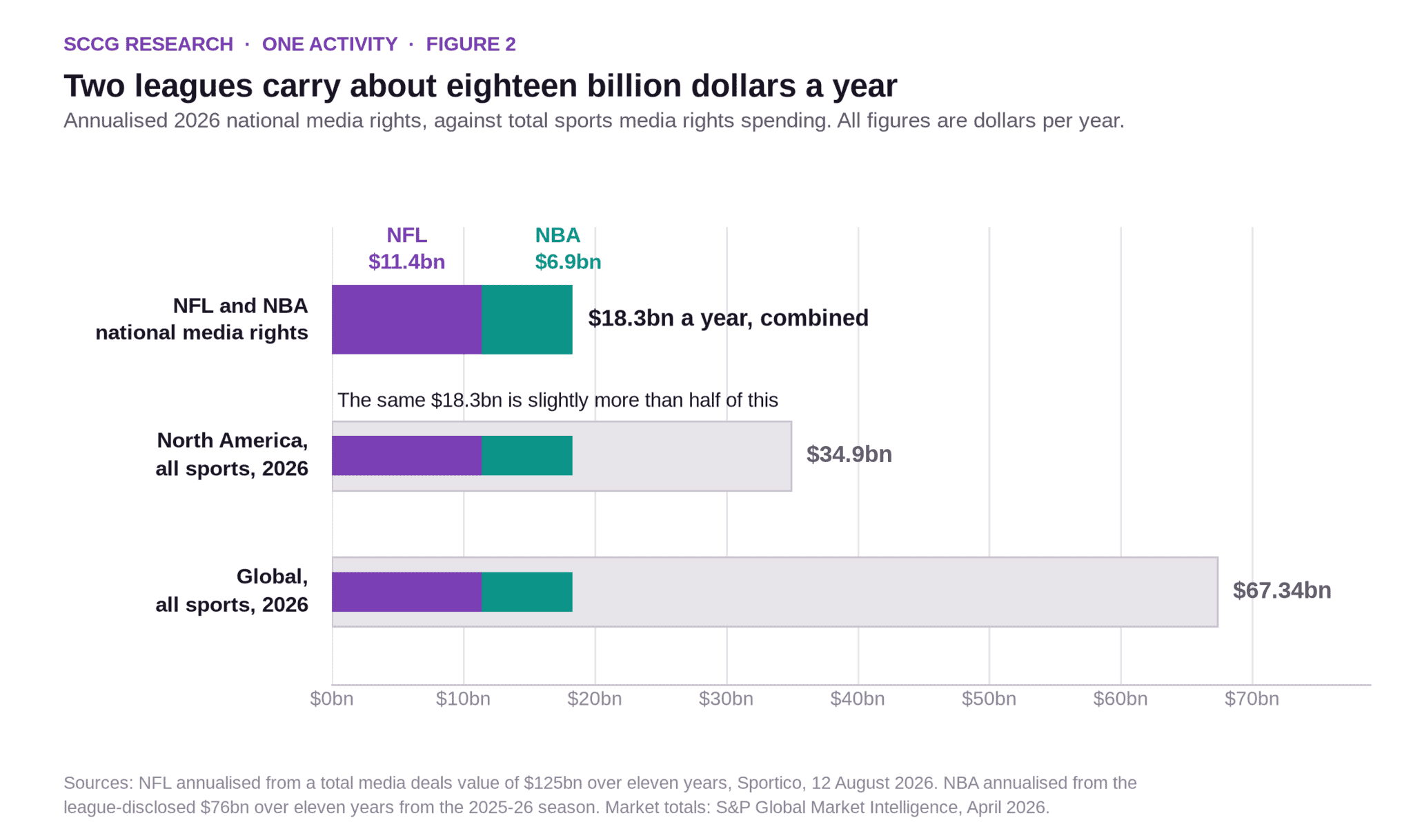
A decade ago that meant broadcast, and nothing else. Today a league sells broadcast rights, official data, the integrity feed, betting rights, the sportsbook inside the building, and, since last year, prediction market partnerships. Six lines, one counterparty, one negotiation, one renewal date.
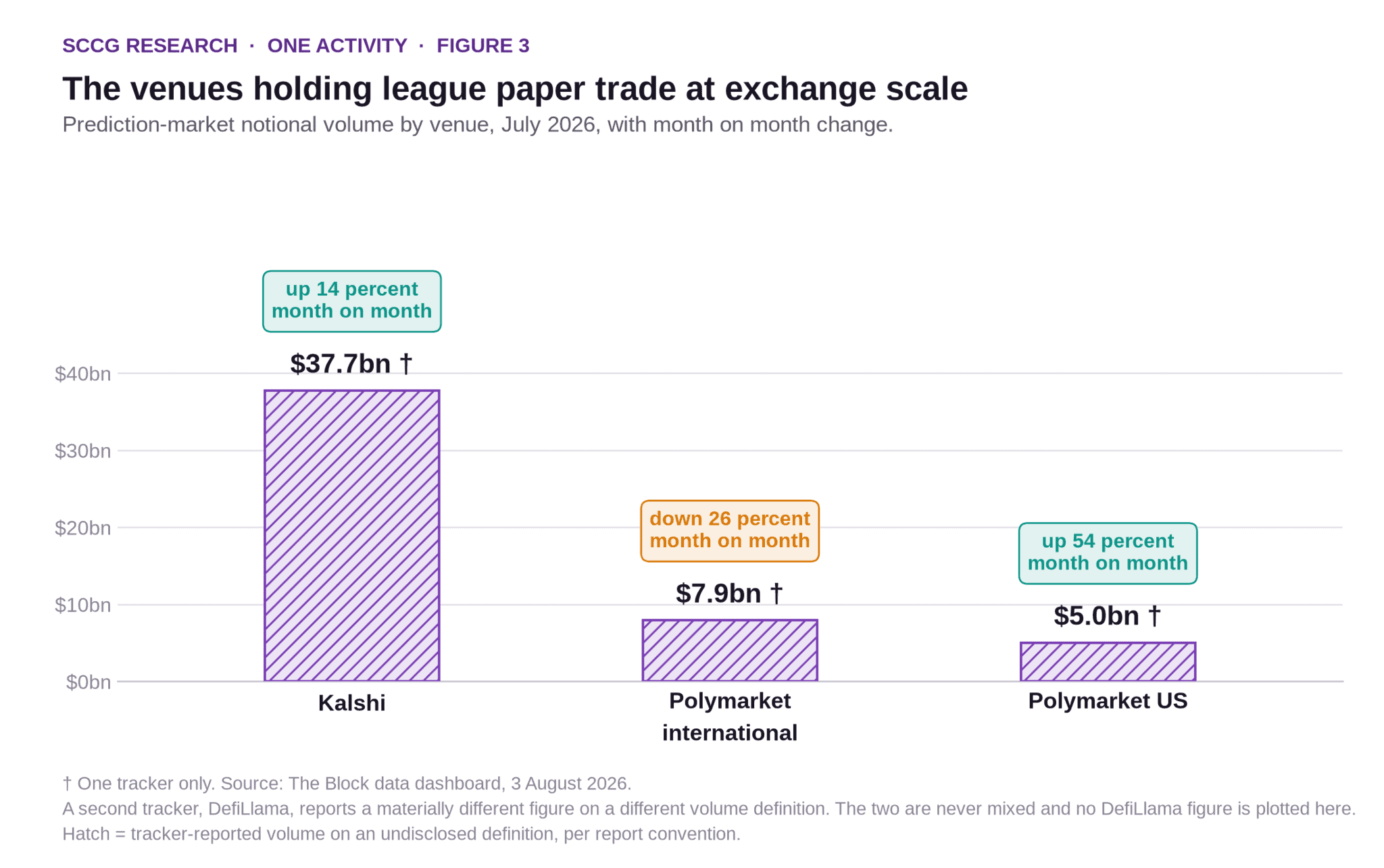
That last line is worth stopping on. In 2025 no North American league had a prediction market partner. By 2026 Major League Baseball had signed an exclusive with Polymarket, and the National Hockey League had signed with both Polymarket and Kalshi. Terms were undisclosed in every case, so I will not put a value on any of them.
The speed is the finding. A right that did not exist two years ago now sits on the same term sheet as television and sponsorship, sold by the same people, on the same clock.
Nobody has been paid yet
This is the part I would want if I were reading somebody else’s report.
On Sportico’s valuations of 12 August, the average NFL club is worth $9.34 billion, up 31 percent in a year. On the same set, those clubs’ revenue grew by under 6 percent. Almost the whole of the rise is what buyers will now pay for each dollar of revenue, rather than the dollars themselves.
Against that, our research located exactly one quantified realised return in the entire sector. Blue Owl claims 158 percent on the Phoenix Suns, with the method undisclosed. One.
There is a plain reason for it. The NFL admitted institutional money in August 2024 with a mandatory six-year hold, and the first positions closed that December. On that rule, the first American cohort cannot show anyone a realised return until roughly 2030.
An asset class can rise 31 percent in a year and still have paid no investor a cheque. Everything in that number is a mark, not a receipt. Anyone selling into this market, or taking money from it, should know the difference before the meeting rather than after it.
The boundary is already gone
I opened with a league taking shares in a television network. The reason that deal is hard to file under one heading is that it does not belong under one. It belongs to the business that four industries turned into while a good many people were still defending the walls between them.
That convergence is not a forecast. It is the thing that already happened, and the capital is simply the first party to price it honestly. Whoever sells you data, betting rights, live inventory or a seat in the building is now working inside one business, usually with a fund behind it and a clock it did not set.
Our August research report is called One Activity. It sets out what a league actually sells today, who is buying it, what each type of buyer is really after, and the three questions nobody in the market can answer yet. Where two reputable sources disagreed, we printed the disagreement instead of splitting the difference.
It is free on our site, with no paywall. Download it, and tell me which seat you are sitting in.
By Stephen A. Crystal, Founder & CEO, SCCG Management. The Gambling Industry’s Global Connector.
The NFL owning ESPN equity proves the four verticals merged; sport is now the anchor asset for an unsolved pricing puzzle.
We've watched sport become the chassis for gambling, streaming, sponsorship, and fantasy for three decades. Now the money is buying the entire stack, not just rights or distribution. Our August research maps what's actually inside the asset and who's buying it — because if you're building a position in this converged business, you need to know where the boundaries disappeared.
- ESPN paid the NFL in equity shares, not cash — a league now owns part of a network
- Gambling, sport, media, entertainment are now one business with four legacy labels
- Nobody has solved the pricing model for the converged stack yet
SCCG angle: SCCG sits in every corner of this converged stack — operators, leagues, platforms, media partners across 545 relationships. When you're evaluating a sport asset or a content play with gambling or sponsorship upside, we can connect you to the other side of the deal and help you understand what you're actually buying before the market figures out how to price it.
Gaming, betting and prediction markets — the desk’s read, every weekday.
Subscribe →