Is Online Casino Driving Casino Growth?

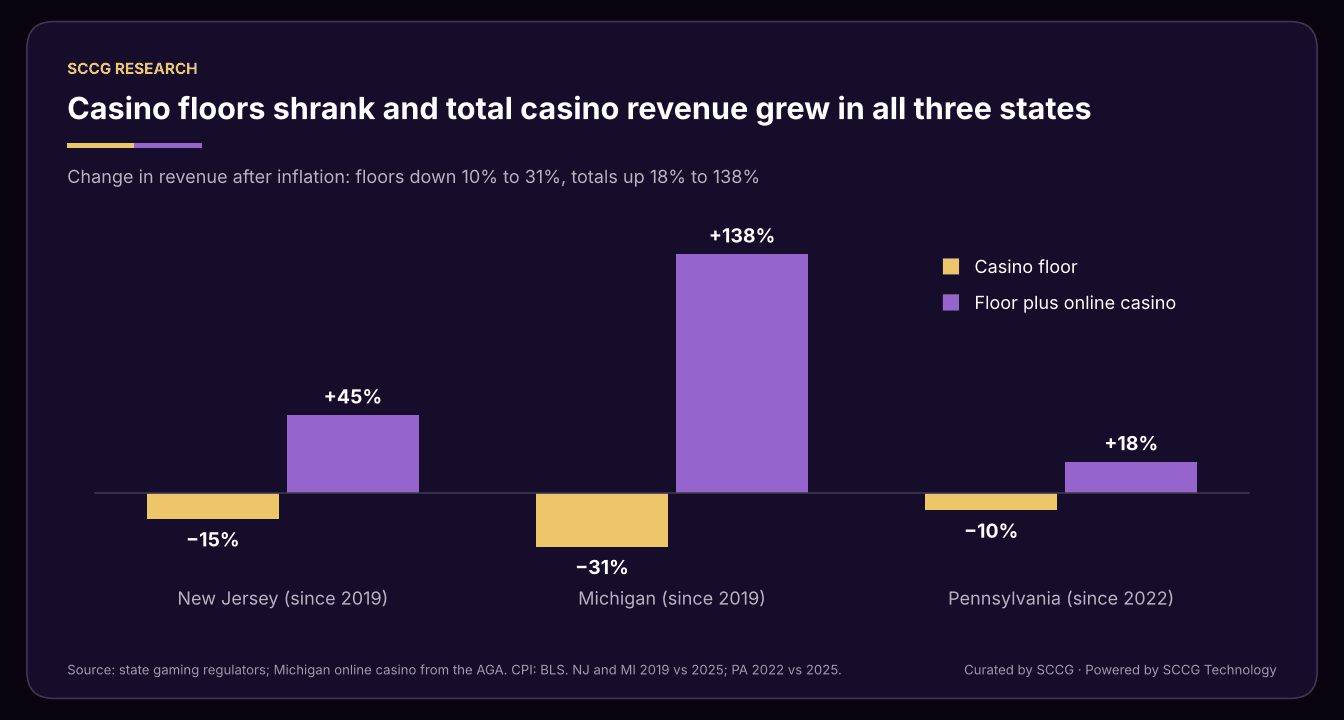
In New Jersey, Michigan and Pennsylvania, total casino revenue is up after inflation and online casino accounts for all of the growth, while in-person casino floors have not kept pace with inflation.
The crossover
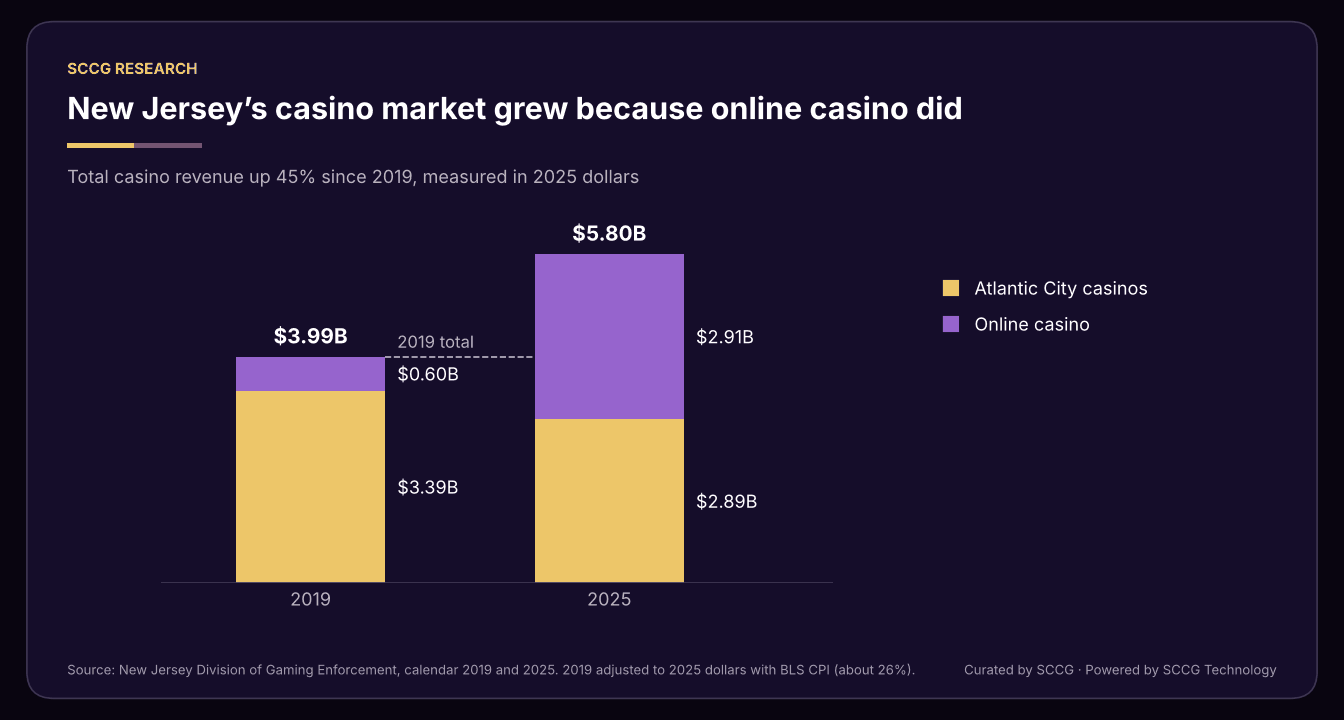
In 2025, New Jersey's online casinos won $2.91 billion, slightly more than the $2.89 billion its Atlantic City casinos won in person, according to the state's Division of Gaming Enforcement. In Michigan, online casino reached about $3.09 billion by the AGA's count, more than double the roughly $1.27 billion won by Detroit's three casinos. Pennsylvania is the exception for now: its in-person casinos took in $3.36 billion and its online casinos $2.78 billion, according to the state's Gaming Control Board. In two of the three states, online casino has now overtaken the casino floor.
Since 2019
The longer record is less comfortable for the floor. Atlantic City's in-person revenue rose from $2.69 billion in 2019 to $2.89 billion in 2025, up 7.7 percent. But consumer prices rose about 26 percent over that time, so after inflation it fell about 15 percent. Over the same years New Jersey's online casino went from $0.48 billion to $2.91 billion. Counting both, New Jersey's casino revenue grew 83 percent, about 45 percent after inflation, so the market as a whole is larger even though the floor is not. In Detroit, revenue fell from a record $1.45 billion in 2019 to about $1.27 billion in 2025, down 13 percent, or about 31 percent after inflation, a stretch that includes the January 2021 launch of Michigan's online casinos. In Pennsylvania, where a clean comparison is available only from 2022, in-person slots and tables went from $3.38 billion in 2022 to $3.36 billion in 2025, down about 10 percent after inflation, while online casino doubled from $1.36 billion to $2.78 billion. Counting both, Michigan's casino revenue rose from $1.45 billion in 2019 to about $4.36 billion in 2025, up about 140 percent after inflation, and Pennsylvania's rose from $4.74 billion in 2022 to $6.14 billion in 2025, up about 18 percent after inflation.
What this does not show
It is likely that online casino has taken share from the casino floor, though not dollar for dollar. Other forces, including tribal competition in Michigan and post-Covid habits, have muted the effect, and the data here shows a pattern, not absolute proof. New Jersey has offered online casino since 2013, so 2019 is not a pre-online baseline there. A fair test would compare these states with ones that have no online casino, and this article does not yet make that comparison. Nationally, in-person casino revenue rose 2.3 percent in 2025 to a record $51.06 billion, according to the AGA. That is slightly less than the 2.6 percent rise in consumer prices that year.
Online casino is bigger than sports betting
Sports betting gets most of the attention, but in all three states online casino brings in more. In 2025, New Jersey's online casinos won $2.91 billion against $1.18 billion for sports wagering. Pennsylvania's took in $2.78 billion against $0.60 billion, and Michigan's about $3.09 billion against $0.69 billion.
The latest months
Recent results look better for the floor in dollars. For January through September 2026, New Jersey's online casino win rose 13.2 percent to $2.40 billion, while Atlantic City's in-person win rose 1.4 percent to $2.24 billion. Detroit's slots and tables rose 2.3 percent over the same nine months. Growth that small, with prices rising, can still be a decline in real terms. In Pennsylvania's fiscal year ended June 2026, online casino grew 18 percent to $2.93 billion while the casino floor was flat at $3.35 billion, cutting the gap roughly in half.
Why it matters for casino operators
For operators with both an app and a casino floor, the question is whether the online customer is a new one or the same person playing somewhere else. Opponents of legalization argue that online play pulls customers away from properties that support hotels, restaurants and local jobs. Supporters point to the tax revenue it generates. Only seven states offer online casino games, so if more legalize, the question moves from a handful of states to many.
What to watch
Four things will say more than any one year: (1) how in-person casinos in states with no online casino have done since 2019, (2) whether the inflation-adjusted decline at Atlantic City, Detroit and Pennsylvania's casinos continues, (3) whether dollar growth in 2026 holds up and (4) whether more states legalize online casino.
The bottom line
Yes: in New Jersey, Michigan and Pennsylvania, total casino revenue is up after inflation, and online casino accounts for all of the growth. In two states online casino is now the larger business, and in a third it is close, while the floor has not kept pace with inflation. Whether online casino has also taken customers from the floor is still unproven.
Note. Figures are calendar-year revenue from each state's gaming regulator, except where a fiscal year is stated. Inflation adjustments use the Bureau of Labor Statistics' annual average consumer price index. Detroit's 2025 figure combines slots ($1.02 billion) and tables ($247.8 million) and leaves out in-person sports betting. Pennsylvania's 2019 figures were not available on a comparable basis, so I used 2022.
By Andrew Zarnett, Senior Advisor to SCCG.
Gaming, betting and prediction markets — the desk’s read, every weekday.
Subscribe →