Ninth Circuit, Senate and CFTC All Move on Prediction Markets in One Week
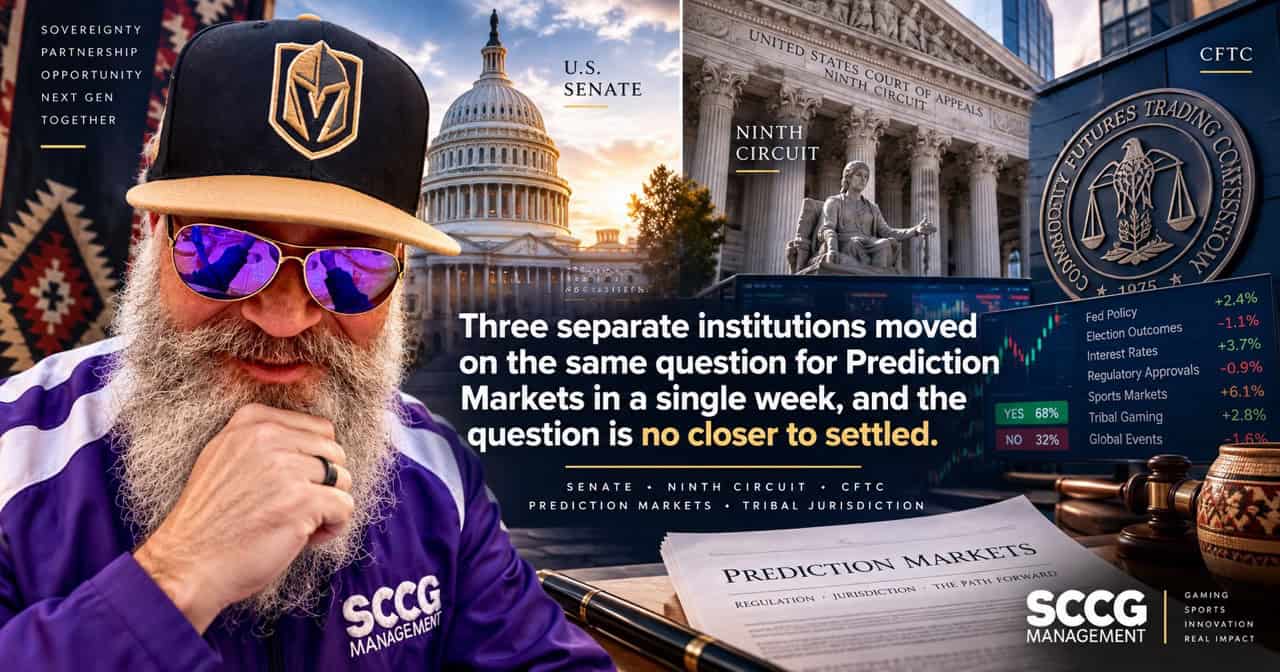
Three separate institutions moved on the same question in a single week, and the question is no closer to settled. Here is what each of them actually did.
The Senate
On Tuesday the Senate did not advance the Digital Asset Market Clarity Act. Tribal organisations had spent months seeking explicit protections in the bill for the Indian Gaming Regulatory Act, for tribal-state compacts and for tribal gaming authority, and had opposed it in the form it reached the floor.
The Ninth Circuit
On Wednesday the Ninth Circuit held that Blue Lake Rancheria and Chicken Ranch Rancheria are likely to succeed on their IGRA claim against Kalshi, reversing the district court.
The panel applied a functional test. “The analysis is functional,” it wrote. “IGRA does not ask whether the operator labels the product a bet or an event contract, or something else. It asks what the activity looks like.” On that basis it concluded that Kalshi’s sports event contracts constitute Class III gaming, and are located on Indian lands when a user enters the contract from tribal territory.
Two things about the posture matter and are easy to lose. This is a preliminary finding of likelihood of success, not a final judgment on the merits. And the case now returns to the district court, where the standard will be applied to a fuller record.
Kalshi disputes the reasoning. Company spokesperson Elisabeth Diana said: “We’re reviewing all of our options to address this decision, including appeal. This ruling is hard to square with other federal laws, which leave regulation of on-exchange derivatives trades exclusively to the CFTC.”
That is the crux of the disagreement, stated plainly by the party on the losing end of it. One reading asks what an activity resembles. The other asks which statute assigns it. Both are orthodox methods of construction, and they point in different directions here.
The CFTC
On Monday, before either of the above, at least a dozen tribal leaders met Chairman Michael Selig, currently the agency’s sole commissioner, at CFTC headquarters. Tribal representatives came away without the discussion of the proposed prediction-market rules they had sought. Jason Giles of the Indian Gaming Association described it afterwards: “All they would say was, ‘We can’t talk about the rule right now.'” Declining to discuss a rule while its proceeding is open is a common agency practice, and it is also a source of frustration for anyone in the room.
The agency’s position on the underlying question has been stated publicly. Testifying to the House Agriculture Committee in April, Selig said: “There are many risks that could be hedged through various contracts on our markets. The bottom line is that these markets need to be well-functioning and comprehensively regulated by the CFTC. Our statute mandates it, and we’ll continue to do it.” Asked specifically whether prediction markets encroach on IGRA, he said it was something that could be addressed through the rulemaking process, and noted he had met with several tribes and would continue to do so.
Reporting this week indicates the agency has since raised the possibility of tribes participating in event-contract markets themselves, as operators or exchange participants.
Tribal organisations have not received that as a resolution. California Nations Indian Gaming Association Chairman James Siva’s position, as reported, is that a sports event contract is illegal gambling regardless of who offers it, that labelling it a financial product does not exempt it from federal, state or tribal gaming law, and that the approach amounts to divide and conquer. Around seventeen tribal organisations had already written to the agency about the rulemaking. The Oklahoma Indian Gaming Association has said the meeting did not constitute government-to-government consultation.
Where the disagreement actually sits
Reduced to its parts, this is not one dispute but three, and they are being litigated in different places.
A question of characterisation. Is a sports event contract a derivative or a wager? The Ninth Circuit answered functionally. Kalshi and the CFTC answer by statute. Neither answer is unreasonable on its own terms.
A question of jurisdiction. If the Commodity Exchange Act gives the CFTC exclusive authority over on-exchange derivatives, does that displace IGRA on Indian lands? The Ninth Circuit’s preliminary answer is no. That is now on its way to being tested further.
A question of process. Whether the consultation obligation owed to tribes was met is separate from the merits and can be raised independently of them.
These can resolve in different directions. A court can hold the activity is gaming while an agency finalises a rule treating it as a derivative, and the resulting conflict is then someone else’s to resolve.
What is worth watching
Whether any tribe takes up the participation route. Tribal gaming has never been a single bloc, and interests differ by state, by compact, and by whether a nation’s revenue is exposed to this competition.
Whether the consultation objection is pressed, which would move the rulemaking timetable without reaching the substance.
What the district court does with the functional test on remand, and whether Kalshi appeals.
Whether the CFTC’s final rule addresses IGRA directly, as Selig indicated it could.
I have spent more than three decades in an industry where the identity of the regulator is contested more often than the conduct is. What I would say to operators, suppliers, regulators and tribal nations reading this is narrow: the jurisdictional question is genuinely open, the timetable is not in anyone’s control, and positions taken now are being taken under uncertainty. That is not a reason to wait. It is a reason to know which of the three questions above your own exposure actually turns on.
SCCG Management advises operators, suppliers, regulators and tribal nations across the global gaming industry. If you are working through what this means for your own position, that is a conversation we have every week.
Gaming, betting and prediction markets — the desk’s read, every weekday.
Subscribe →